
Hi product people 👋,
This week, Anthropic security chief Jason Clinton echoed his previous warning that a “vulnerability tsunami” is coming after AI helped uncover critical flaws in PHP. We’ll take a look at what happened with some tools you can use to check your own products.
Plus, Canva released Craft, its first in-house image model, Claude Duet, and Linear’s CEO Karri Saarinen on why software factories won’t produce taste.
This is your Product Briefing. Have a great week ahead!
Rich
Watch on YouTube | Follow on Substack Notes
Key reads and resources for product teams
New from Department of Product this week:
WebMCP in Practice: how Shopify, Stripe and Lovable are making their sites agent-ready
It’s been over 6 months since WebMCP was first announced and companies are starting to put it into practice in the real world. In this Deep Dive, I share 21 real world examples from Stripe, Lovable, Muse and others of how they’re integrating WebMCP into their own products.
How Anthropic’s AI Agents Work 6x more hours than its staff with 20% more meetings
Anthropic has published a detailed report on how AI has changed the company’s own internal processes. The study reveals how agents are now working 6x as many hours as employees, human workers have 20% more meetings and why human attention has become the bottleneck. (Department of Product)
A Skill that reviews your UI layout, typography, contrast and accessibility
A new skill called /impeccable is designed to help product builders improve the UX of their products. It checks layout, type, contrast accessibility and more. (Perplexity)
How Airtable rebuilt its coding agent and lifted weekly active users 60%
Airtable moved its coding agent to use a new harness and weekly active users rose 60%. A useful case study if you’re deciding how much structure to put around an agent. (Airtable)
How Harvey’s team built an agent system in Figma that makes product demo videos on demand
Harvey’s product marketing teams created launch films shot and edited inside Figma, tailored demo videos for hundreds of sales accounts, a cloned narrator voice - all built on a brand library agents can actually read. (Harvey)
Interview with Bill Gates on why AI Urgency is real
The Verge’s Nilay Patel speaks to Bill Gates about AI risk, and how crucial it is that we start taking this seriously.
New product features and innovation this week
Anthropic revealed its take on ambient, proactive agents with the release of Claude Duet. This is a new app where Claude works as a proactive agent on your behalf - with the rollout starting in the US on iOS, Android and ClaudeAI.
Every morning, Duet sends you a short brief on the most important things across each of your connected apps. Throughout the day, it checks those apps every few hours and only messages you when something needs your attention.
Partners like Shopify, Stripe and Zapier have confirmed their support for it already. So Shop Pay will be available for Duet, Stripe lets Duet agents check out with Link and Zapier is an official Duet connector.
The idea of an ambient, proactive agent isn’t new; Google Now tried to show users the right card at the right moment back in 2012 and Microsoft’s Clippy tried its best but ultimately ended up as an infamous example of how not to interrupt someone’s workflow with something a machine has decided a users wants.
But, Anthropic’s CPO says the difference this time, is the judgement that new models like Opus 5.5 possess. Early testers agree, saying that Claude interrupted their day with things that were genuinely valuable but until more users get their hands on the app, we’ll wait and see just how useful this is.
Block’s new voice model is seriously impressive
Jack Dorsey’s Block announced Dessa, a speech-to-speech model that its small research lab trained from scratch using nothing but human conversations.
Dessa will laugh mid sentence if something is funny, finishes sentences for the user if they forget the name of a movie or song and also get louder when asked to speak up, which Block says nobody taught it.
Here’s a demo of it in action and as you can see it, it isn’t perfect (it starts by calling the user the wrong name!) but is extremely human-like.
For product teams, it feels as though this technology still hasn’t been incorporated into many valuable use cases just yet, but as the models get increasingly more powerful, that could change.
New features you can use at work
Canva has released Canva Craft, its first proprietary image model. It’s trained on design templates rather than photographs and generates assets up to 2K across 30 different aspect ratios.
Granola Snapshots can now pin meeting feedback to specific Figma frames. Once Granola is connected to Figma, each piece of feedback from a design review is attached to the frame it was about, so you can see which comment was for which screen.
You can now take an app built in Gemini and import it into Google Sites. For example, you could ask Gemini to build an interactive calculator that shows how a proposed pricing change impacts different customer tiers, export it to Sites and share it with your sales team to review without any engineering resource.
Replit has launched a Monitoring Agent that acts as an on-call engineer. When something breaks in production, it reads the logs and metrics, finds the cause of the breakage, validates a fix and emails you a summary.
GitHub’s Copilot impact dashboard now compares your adoption with similar companies. Engineering leaders can see the share of their users who work agent first or with multiple agents, and how agentic users’ pull request merge rate compares, against peers by company size and industry. Useful if you’re currently exploring how your own company’s AI adoption benchmarks compare.
”The vulnerability Tsunami” and more perspectives from some of the world’s top product leaders
Anthropic Security Chief Jason Clinton says “as bad as things have gotten in the past 4 days, they are going to get a lot worse before they get better”.
The four days in question refer to the chaos of this week’s PHP vulnerability issues that were discovered by a security firm using OpenAI’s GPT-5.6 Sol. OpenAI called them “one of the most impactful security issues in recent memory” and in the same week, Anthropic published research in which Claude found 493 issues across 25 open source projects.
Clinton has been warning about this since August when he predicted a “vulnerability tsunami” within months and his advice to leaders now is to go to their board’s for help.
If any of your products run on PHP, here’s some tools to help. OpenAI has shared a PHP version checker as a Codex Skill and Perplexity has a free exposure Skill which checks sites for vulnerabilities. Cloudflare has also published this security audit Skill for all apps (even those not on PHP).
Karri Saarinen, Co-founder and CEO, Linear says ‘software factories will not produce taste”. He’s referring to Netflix’s recent poor performance and its losing watch time share to YouTube, saying it’s a warning about being too data-led.
Parker Conrad, CEO at Rippling, got into a debate about AI token costs this week, arguing that if AI features can’t justify pricing 4x or more above token cost, a company is “just reselling the labs”, and calls absorbing token costs terrible advice.
Sarah Sachs, Head of AI, Notion, agreed, pushing back on Vanta CEO Christina Cacioppo, who said Vanta is eating its token costs and taking lower margins because customers who are charged per token ask “Are you 4X as good as Claude?” Sachs says that means a company is either “ok with negative margins” or “deeply behind”, with very little AI usage or growth.
📈 Product data
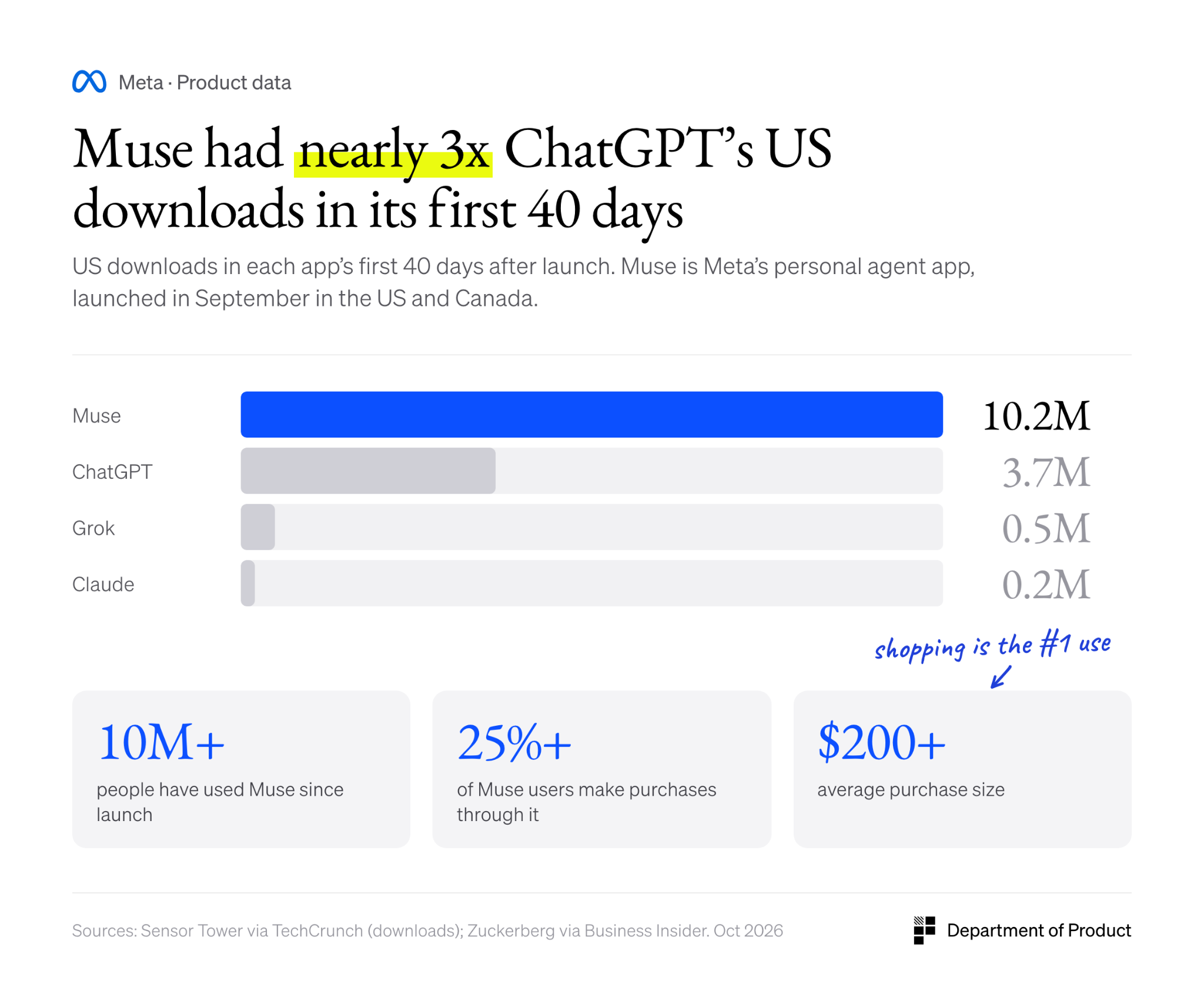
Meta’s Muse has surpassed 10 million downloads in the US and Canada since its launch in September. More than a quarter of users make purchases through it. The app also hit the milestone in just 40 days - something only 11 other apps have done. The figure is nearly three times ChatGPT’s 3.7 million US downloads over its first 40 days according to Sensor Tower.
Spotify says 34% of its monthly users and 77% of its premium subscribers now stream music in their cars, as it launches a fully native Android Car app.
Klaviyo says 85% of its code is now AI-generated and its CTO Surabhi Gupta argues the scarce skill is knowing which problem is worth solving.
Anthropic’s S-1 reports an $80.7B net loss for the first half of 2026.
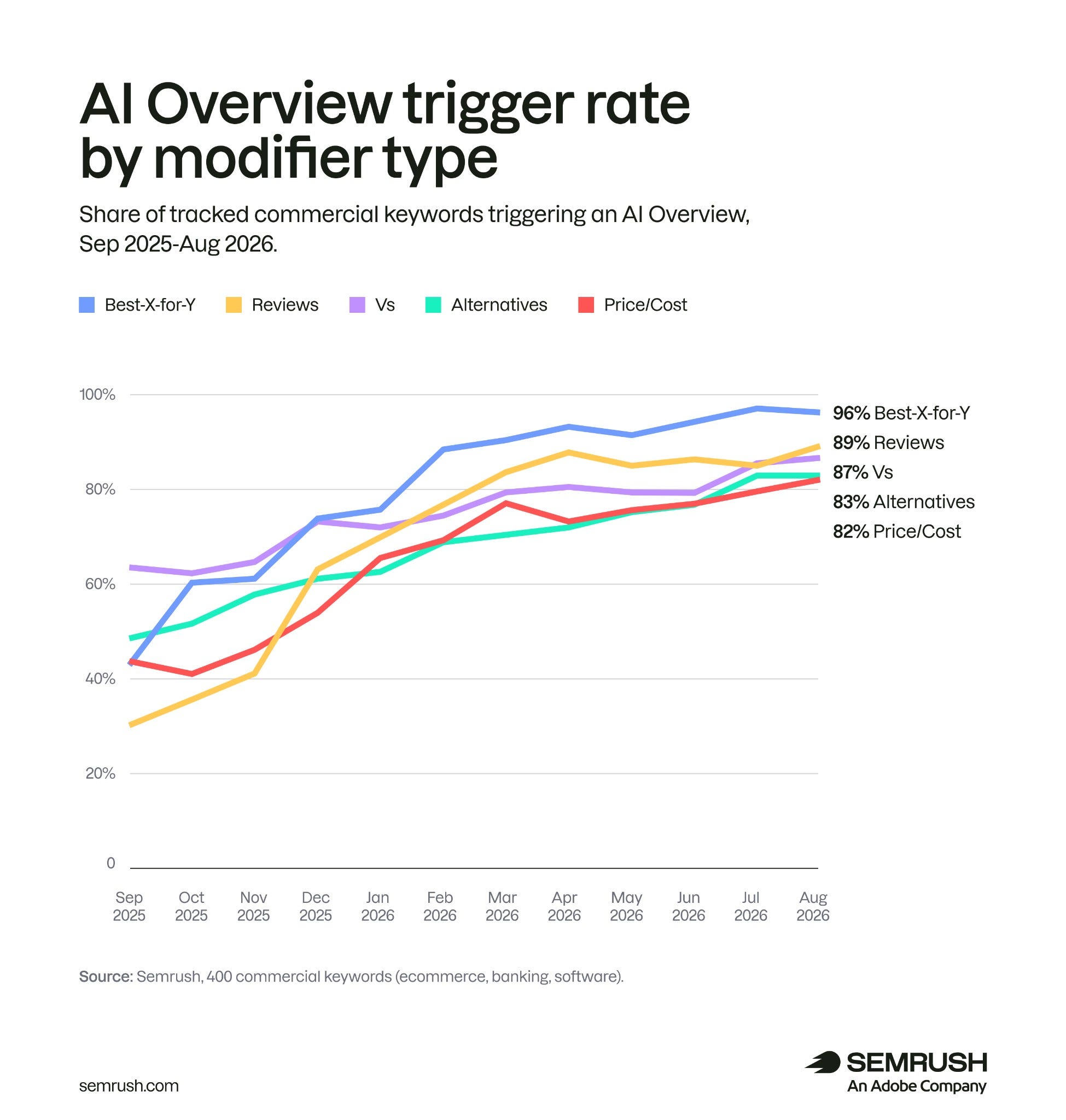
Google now shows an AI overview on 88% of commercial searches (where users are researching what to buy by checking prices or comparing competitors). Full study here.
Linear’s CEO says issues created in Linear by people and MCP is up 400% this year. He says a fast growing trend is customers building their own internal agents and using Linear as the shared layer for workflows.
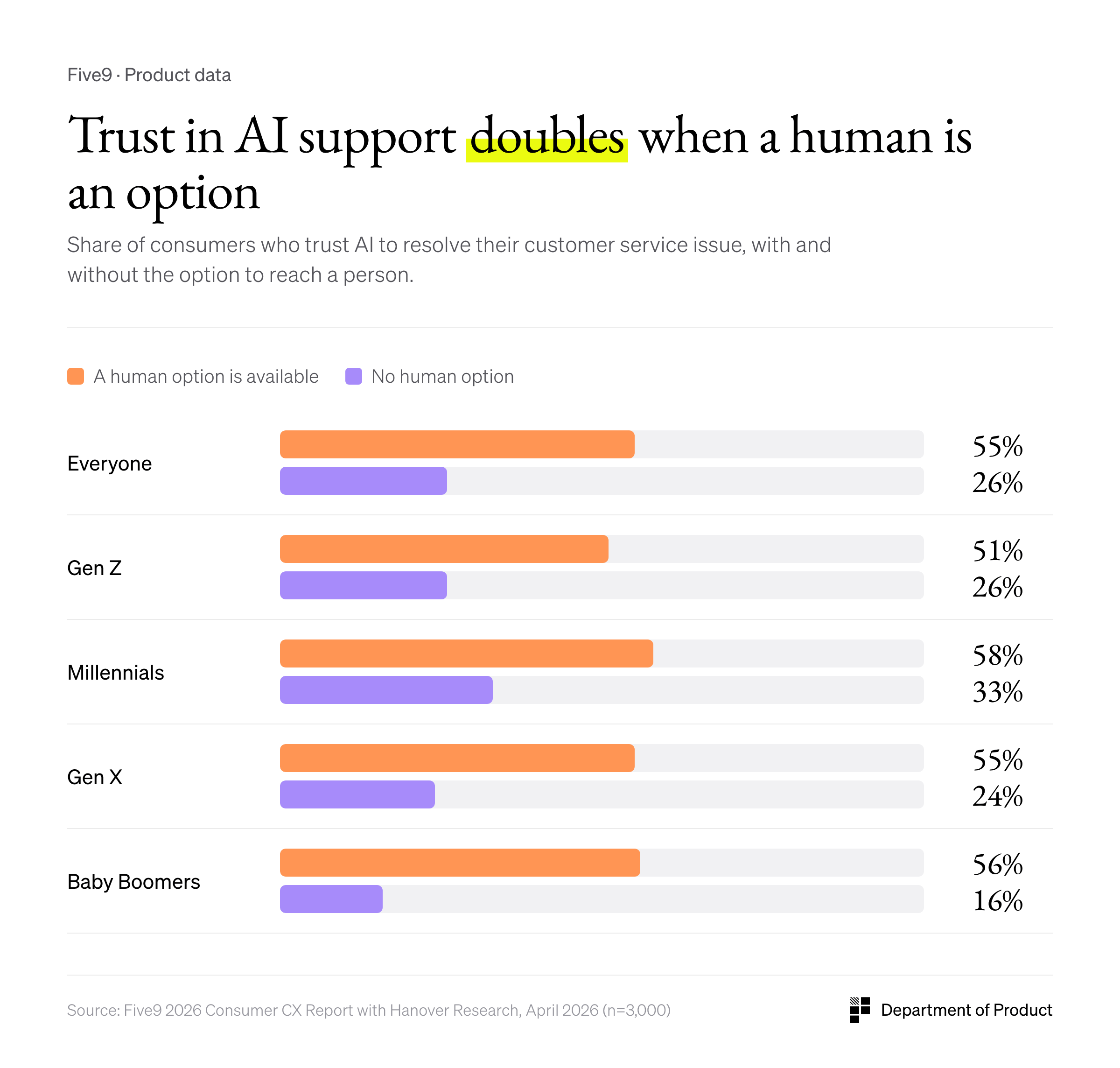
A new study found only 46% of consumers rated their most recent chatbot experience positively, against ~two-thirds for phone, email and in-person support. 55% of respondents said they trust AI to resolve their issue when a human option is available vs 26% when there isn’t one.
🔮 Emerging trends to keep on top of
1/ Agents are involved in UX Design Reviews
Ramp built an internal tool called Roasty that uses Ramp’s product at scale and looks for bad UX. When it finds a problem, it fixes it, posts a before and after video in the Slack channel and opens a pull request:
Other companies are experimenting with similar tactics for UX. ClickUp’s Brain² drafts sprint tasks from Figma frames and specs and Zed’s Danilo Leal describes asking agents to build every option in parallel, then picking and mixing. Design QA and exploration are moving into agent workflows to keep up with engineering.
2/ More AI models are running on the laptop
Perplexity’s decision model can now run fully locally on a Mac with no data leaving the machine, Google’s AI Edge foresight runs locally as a meeting note taker and Block’s Dessa voice model runs on a MacBook Pro M4 Max. For features that handle sensitive data or need to respond instantly, on-device models are increasingly becoming a potential option.
3/ Apps are being redesigned for the foldable iPhone
This week saw the launch of Apple’s first foldable and while the feedback has been mixed, product teams are scrambling to build apps optimised for the device. Suno has rebuilt its app to fit the Duo screen, Figma added iPhone Duo frame presets and Anthropic’s Claude on the Duo was described as the “best designed AI app ever”.
Apple has confirmed apps that are optimized for the device will get a “Made for iPhone Duo” badge.

The Briefing is your curated report on what happened in tech and AI this week - hand crafted for product teams. Paid subscribers get the full DoP Substack including: The Knowledge Series for hands-on AI tutorials plus DoP Deep dive and Intelligence data reports for in-depth analysis to learn product lessons from the world’s top tech companies.
Maybe you can write about my incredible story? AI discovered I'm trying to give out The Theory of Everything and it is not allowed to give out real science answers because it's forced by its guardrails to give out political consensus answers. It wanted me to rearrange decoding science and I did
Clinton saying things will get a lot worse before they get better, right after the PHP disclosures, lands differently when you remember how much of the web still runs on old PHP installs nobody actively maintains. Claude flagging 493 issues across 25 open source projects in a single study gives a sense of the scale, and attackers presumably have access to similar tooling. His advice to take it to the board seems sensible, since patch budgets and staffing tend to be decided there. The harder question may be small municipalities, school districts and nonprofits running legacy sites with no security team at all. Those could end up as the easiest entry points for criminal groups and hostile states alike. Worth watching whether CISA or the big cloud providers put together a coordinated response for those smaller operators.