
Hi product people 👋,
This week, Cursor unveiled its first major product since its acquisition by SpaceX. We’ll take a closer look at what it is and how people are using it for tasks including product-related work.
Plus, why Shopify’s CTO says the narrative around SEO is wrong, Gemini has cause for celebration and concern and a new study reveals what impact having an AI super user in a team has on product innovation.
Have a great week ahead!
-Rich
Key reads and resources
New from the Department of Product Substack:
How to manage AI agents effectively
A guide for product teams and leaders on how to manage AI agents effectively. Spend management, governance, testing and safety infrastructure tactics explored. Real world examples, tools and case studies from OpenAI, AWS, Uber, Block, Atlassian, Slack and more. (Department of Product)
How Cursor’s new icons were designed over a one year period - a case study from the designer who created them
Cursor’s new icon set looks simple, but it took a full year, 600+ hand-drawn icons, two sizes, two styles, and 156 attempts at a single hamburger icon to get there. Designer Marek Minor walks through the whole process: replacing an inherited, drifting icon library, building a system for concepts with no existing set covers, and shipping it all without breaking a single reference. (Marek Minor)
An AI governance framework
Retool’s product lead for Governance & Infrastructure published a simple runtime governance framework built around three questions: who’s acting, what can they reach, and can you stay in control. It’s grounded in Retool’s own survey of 307 CTOs, CIOs, and CISOs, where only 8% rated their internal AI governance as “strong” and just 5% felt confident they could see what’s running in production. (Retool)
The future of data analytics and why AI is rewiring the role of data analysts
Databricks’ Emma Stowell, Angus Morshead and Ogo Odili on why the analysts who thrive next will be the ones asking better questions, not writing better queries. (Databricks)
How Ramp built third party product integrations that write themselves
Ramp's Shubhayan Srivastava wanted to skip the backlog of one-off connector requests, so he built an agentic system that researches a provider's API, writes and tests the integration, and ships it in minutes instead of months. (Ramp)

New product features and innovation worth knowing about this week
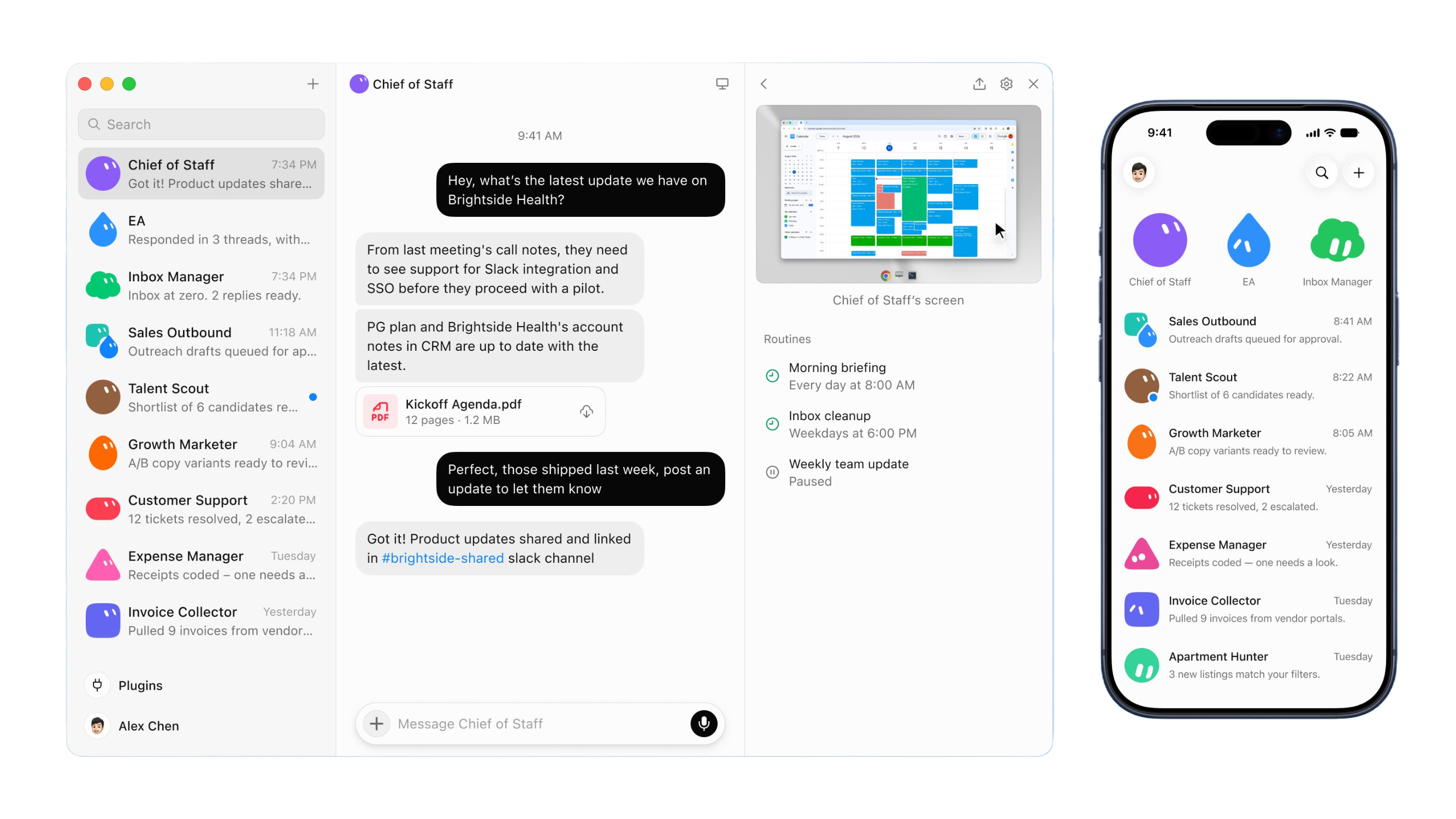
Cursor has launched Grok Bot as a new standalone AI agent app. Cursor and SpaceXAI released Grok Bot in beta across Mac, iOS, Windows, and Linux, described as “AI teammates you can give real work to.” Bots sign into a user’s existing tools, complete tasks end-to-end, and return only when approval is needed, remembering your preferences over time.
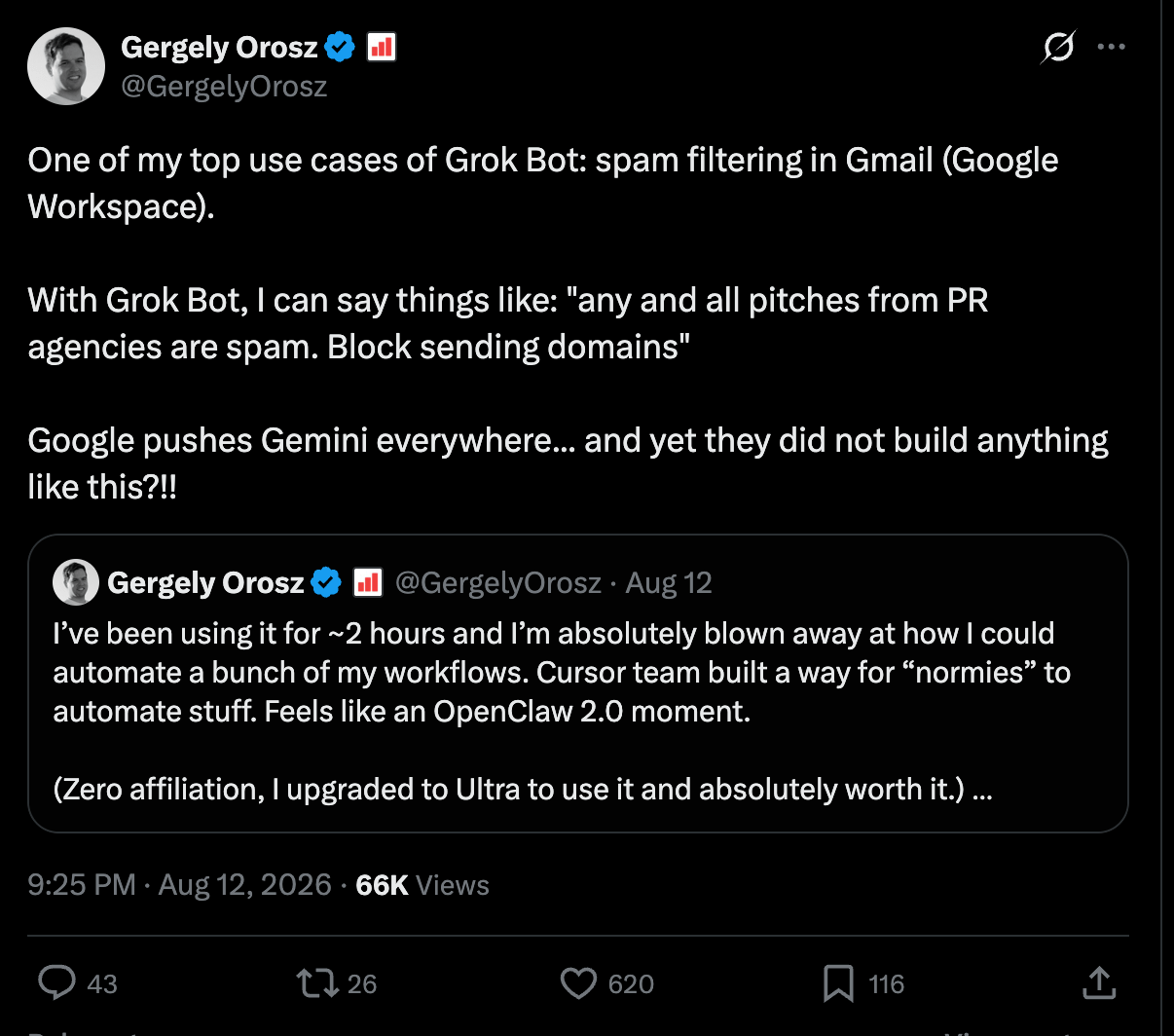
The response to the product so far has been overwhelmingly positive, with Pragmatic Engineer Gergely saying he uses it for things like spam filtering, making an important point about why Google seemingly decided not to build something so obviously valuable:
Cursor says that you can use it for product related tasks such as creating a “Product performance” bot that logs into your analytics tools, grabs the data you need and shares it with you once it’s done.
Here’s some other examples of how people are using Grok Bot:
Claude Code now has cross-instance messaging. Separate Claude Code sessions on can now message each other, sharing findings and coordinating work across parallel instances. This turns Claude Code into more of an orchestration layer for multi-agent workflows rather than a single-session assistant. For product teams, this helps for scenarios where multiple agents need to work together to build or refactor large new features.
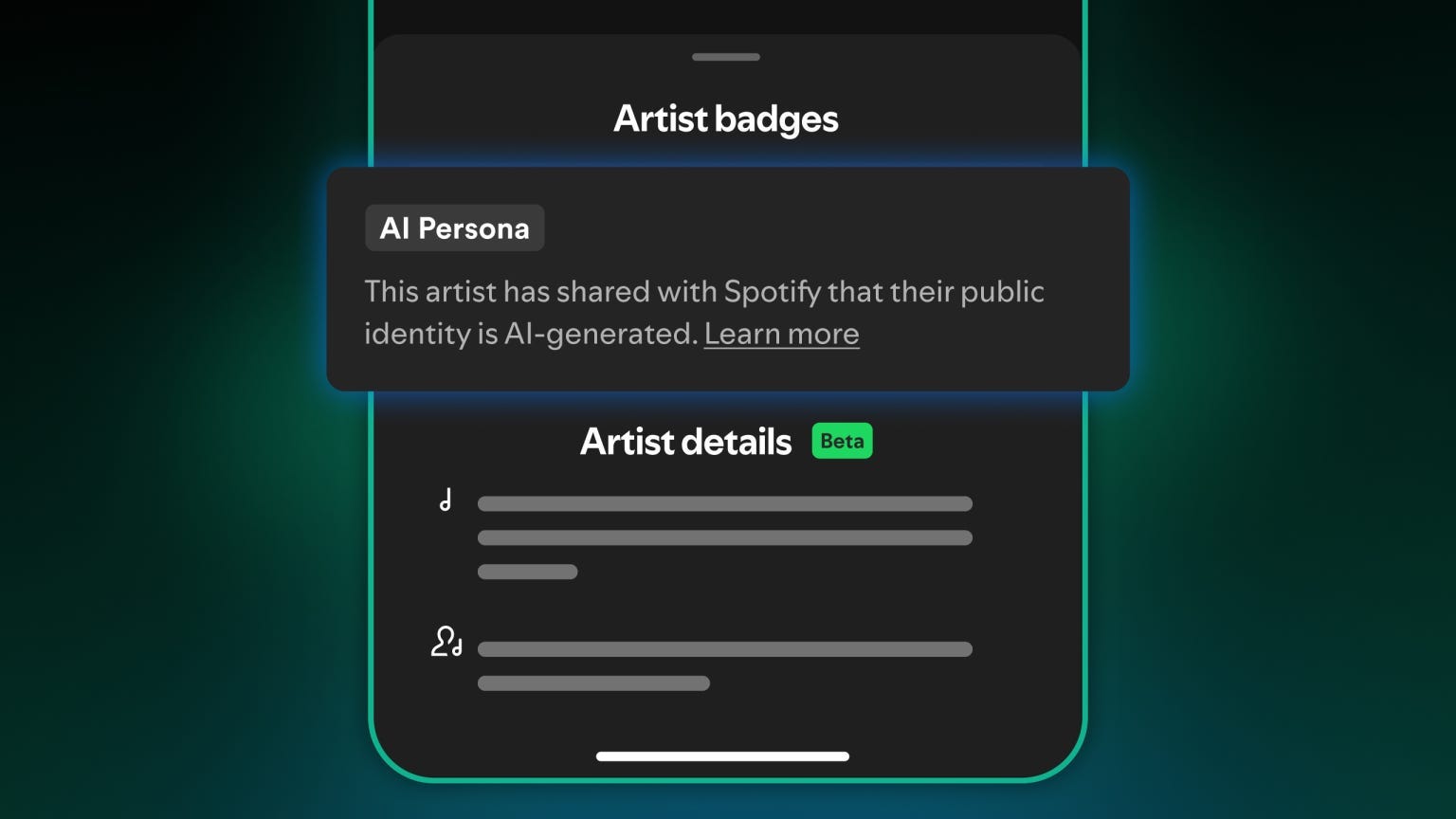
Spotify has added an AI-generated artist label. Spotify launched an “AI persona” badge identifying artists that are created or represented by AI, aimed at giving listeners a way to distinguish humans from synthetic artists. AI artists will be excluded from both editorial playlists and algorithmic suggestions. YouTube’s CEO reiterated their commitment to human-centricity, too. More on that below.
Hand picked new features you can use at work:
FullStory launched a Customer Agents product that streams real-time session context into support tools so agents see behavioral history before an inquiry lands. So, for example, instead of “what can I help you with,” the agent opens with context-aware messages like “I see the upgrade failed twice, want me to retry it on the card ending 4412?”. You can also integrate this into other third party apps like Intercom / Fin. Fullstory says one company who used it saw resolution rates hit 79%.
Google’s Ask Advisor AI agent is expanding into Ads and Analytics with a new benchmarking feature. It compares a business’s campaign performance against anonymized averages from similar businesses. In Google Analytics, you can now use the assistant to dig down deeper into automatically surfaced insights to learn more about what’s driving them (if you’ve ever struggled with GA4’s navigation like I have, you’ll appreciate this as a welcome addition!).
Intercom added an evaluation framework to Fin. The new framework includes pre-launch testing, controlled rollouts, and live conversation monitoring, aimed at giving product teams confidence before pushing agent changes live.
Linear now streams agent coding sessions as live cards in Slack, so you can watch investigation and code changes and open diffs for review without leaving a channel.
Atlassian launched Code Context, which feeds large-scale, multi-repository code understanding into its TeamworkGraph, reducing token usage and improving output quality for coding agents. As well as this, Confluence agents are now callable via @mention directly on pages, and the same agents work across Claude, Cursor, and IDEs through Atlassian’s Rovo MCP, with teams now running more than 5 million agent invocations.
OpenAI shipped the ability for Codex to delegate different sub-agents to different models, depending on the task. If it works effectively, it could have a significant impact on token spend.
Perspectives and opinions from top product leaders this week
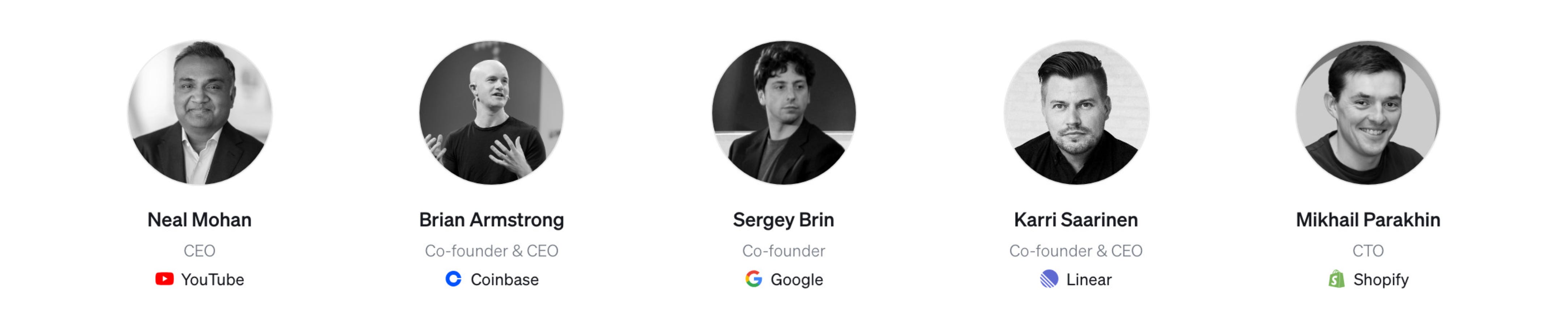
YouTube’s CEO Neal Mohan says that human centricity is essential for the company’s AI product strategy. AI’s job, he says, is to help viewers find human perspectives and creators, not to generate or substitute for that content.
Brian Armstrong, CEO at Coinbase has argued that grafting AI onto old product development workflows is fundamentally wrong, and that “the game has changed. You need to update the way that you work.” Coinbase ran an internal experiment where teams deleted their IDEs and wrote zero lines of code for two weeks, a model Linear is now citing publicly as evidence of where agent-driven development is headed.
Sergey Brin, Co-founder, Google, has directly urged key AI staff to prioritize Gemini model development, with some teams moved from DeepMind into corporate Google as part of an internal reshuffle.
Karri Saarinen, CEO, Linear, says this is the first week in Linear’s history where MCP-created issues outnumbered application-created ones, framing it as proof that Linear is succeeding as both “destination and source for agents and humans”. Linear’s growth strategy is now explicitly agent-first and the headless model is becoming increasingly necessary as a product strategy.
Mikhail Parakhin, CTO, Shopify has pushed back on the narrative that AI is cannibalizing organic search, citing Shopify data showing AI-referred sessions grew 3x year-over-year while organic sessions still grew 12% off a larger base, arguing the overall opportunity is expanding, not contracting. A useful counter-data point for anyone budgeting SEO versus AI-discovery investment. But despite this, there’s still plenty of examples of companies who have experienced major declines in organic traffic.
📈Product data and trends to stay informed
Gemini has officially hit 1 billion monthly active users, up from 950 million in Q2, matching ChatGPT’s scale and marking Google’s 14th product to cross the threshold.
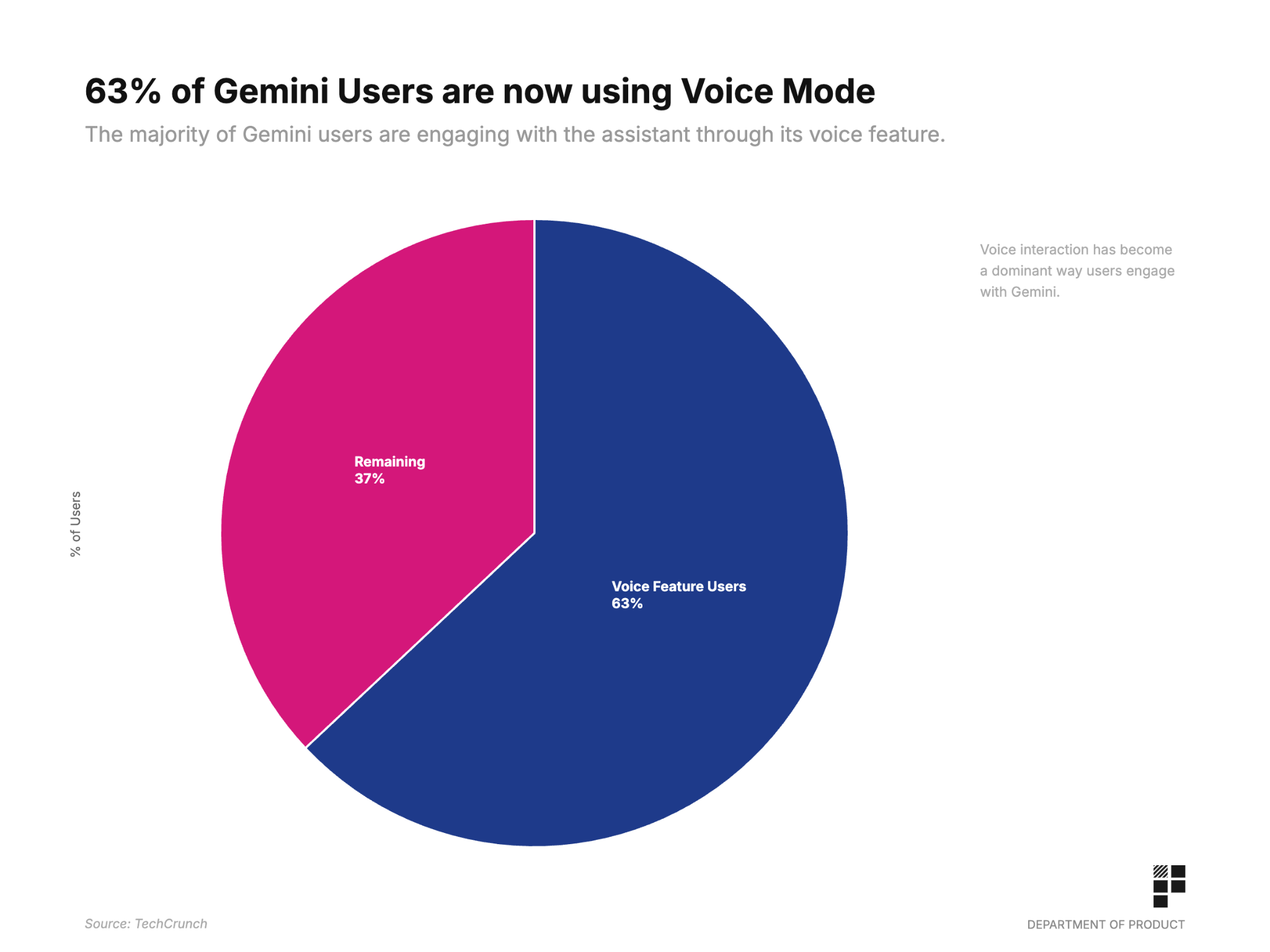
63% of Gemini users now engage via voice, the app generates over 150 million images a day, and it has more than 100 million active users on iOS, meaning Google is starting to gain distribution even outside of its own OS.
But it’s not all good news for Google…
DeepSeek has officially passed Google to become the second-largest AI provider by token volume on Vercel’s AI Gateway, capturing 25% of July volume versus Google’s 11%. The average price per token fell 13.6% month-over-month as usage shifted to cheaper models. Open-weight models more than doubled their share of gateway spend to 8.6%, the highest in the index’s history.
81% of July’s gateway tokens ran on models that didn’t exist six months earlier, and three-quarters of high-volume teams changed their model mix by 10% or more month-over-month, evidence that dynamic model routing is now a baseline operational practice, not an edge case.
DoorDash’s Flux platform now automates 130,000 engineering tasks a month. DoorDash built an internal agent platform, Flux, that runs code reviews, tests, and builds autonomously, handling more than 25,000 code reviews and 10,000-plus playbook invocations weekly, with sandboxing and permission controls to keep agents away from sensitive systems. It’s a strong internal-tooling case study for any product org thinking about standardizing agent infrastructure.
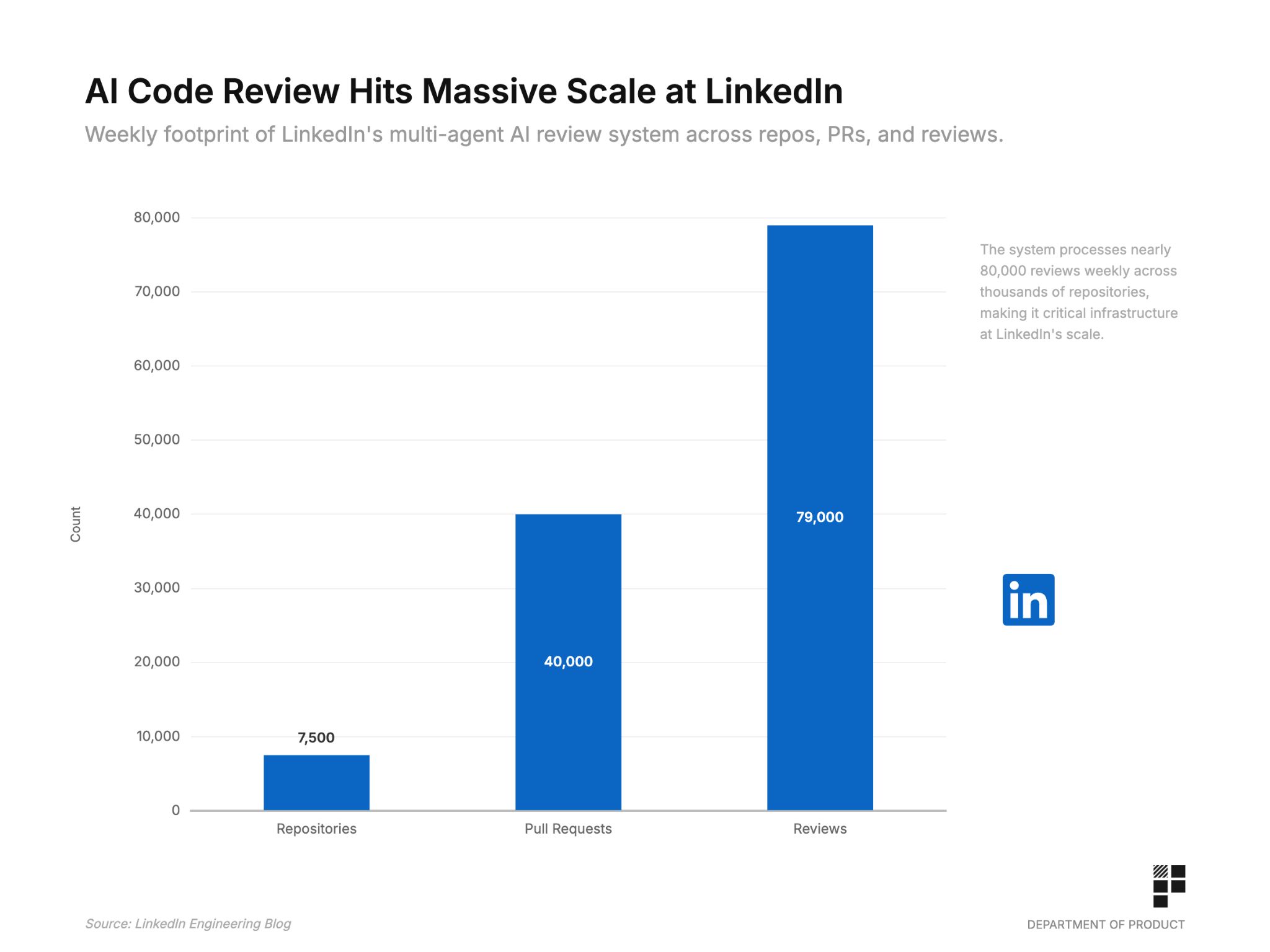
LinkedIn’s internal AI code review system handles 79,000 reviews a week across roughly 7,500 repositories, with a 63.9% acceptance rate, and most reviews now post before a human reviewer even opens the PR.
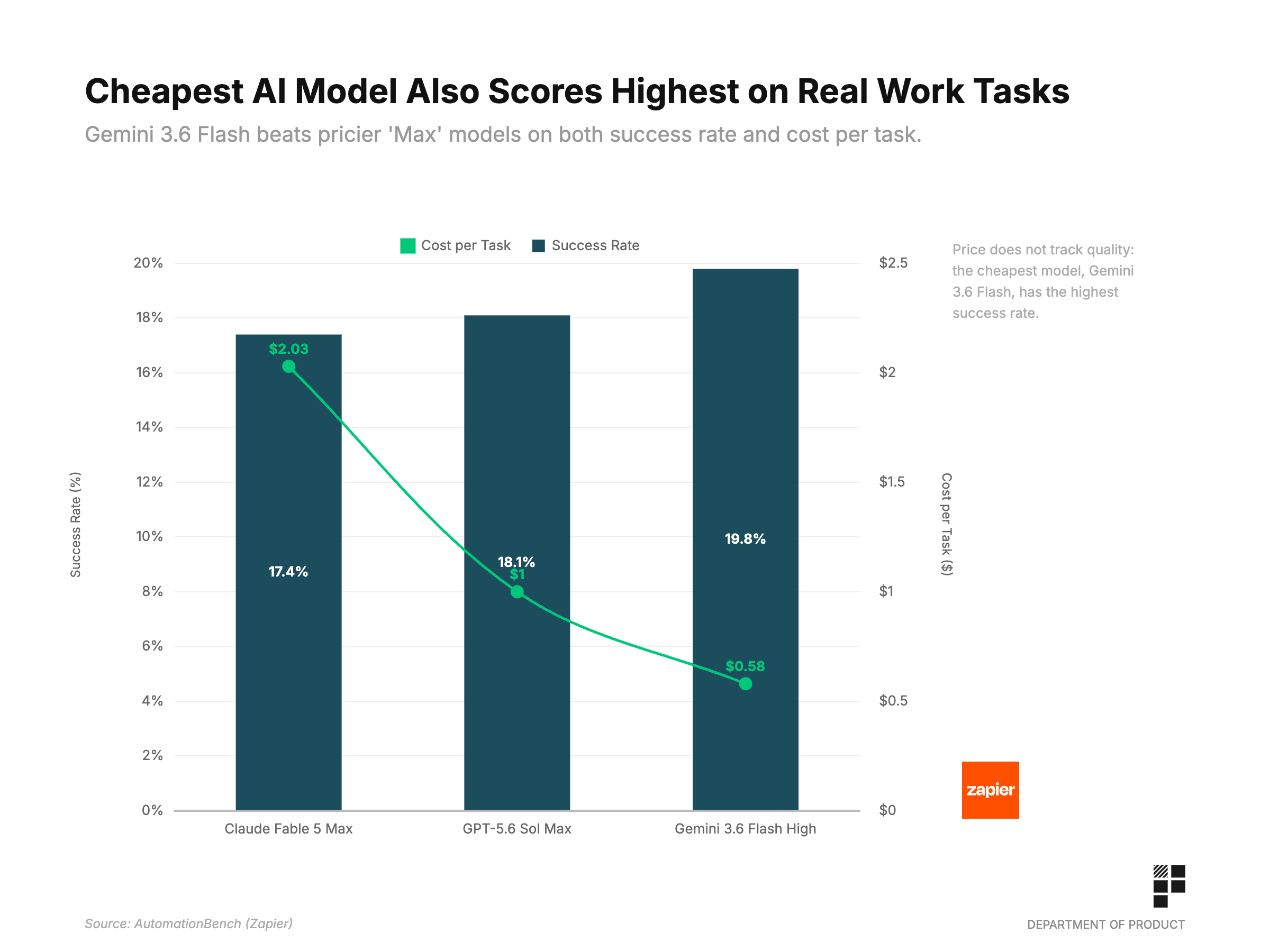
Zapier published a new study which measures task automation completion rates - and the results are actually quite surprising. Essentially, you can use reasoning settings to make cheap models outperform more expensive models. In this case, Gemini 3.6 Flash beat Fable 5 and GPT 5.6 on the Max reasoning setting at a fraction of the cost:
But, Hex published its own study arguing that more reasoning effort doesn’t always help. In Hex’s testing, Claude Opus 5 actually degraded at higher effort levels, while Claude Fable 5 was the only model where high effort didn’t backfire, and GPT-5.6 Luna offered the strongest cost-to-performance ratio.
A team’s structure impacts output more than raw AI access. A new study by Atlassian’s Teamwork Lab found teams with a single designated AI superuser were 18% more likely to produce top-scoring work than teams without one, suggesting concentrated expertise beats broad but shallow AI usage. The study ranked teams with superusers across various product-related performance metrics like innovation, customer impact and project completion rates and here are the results:
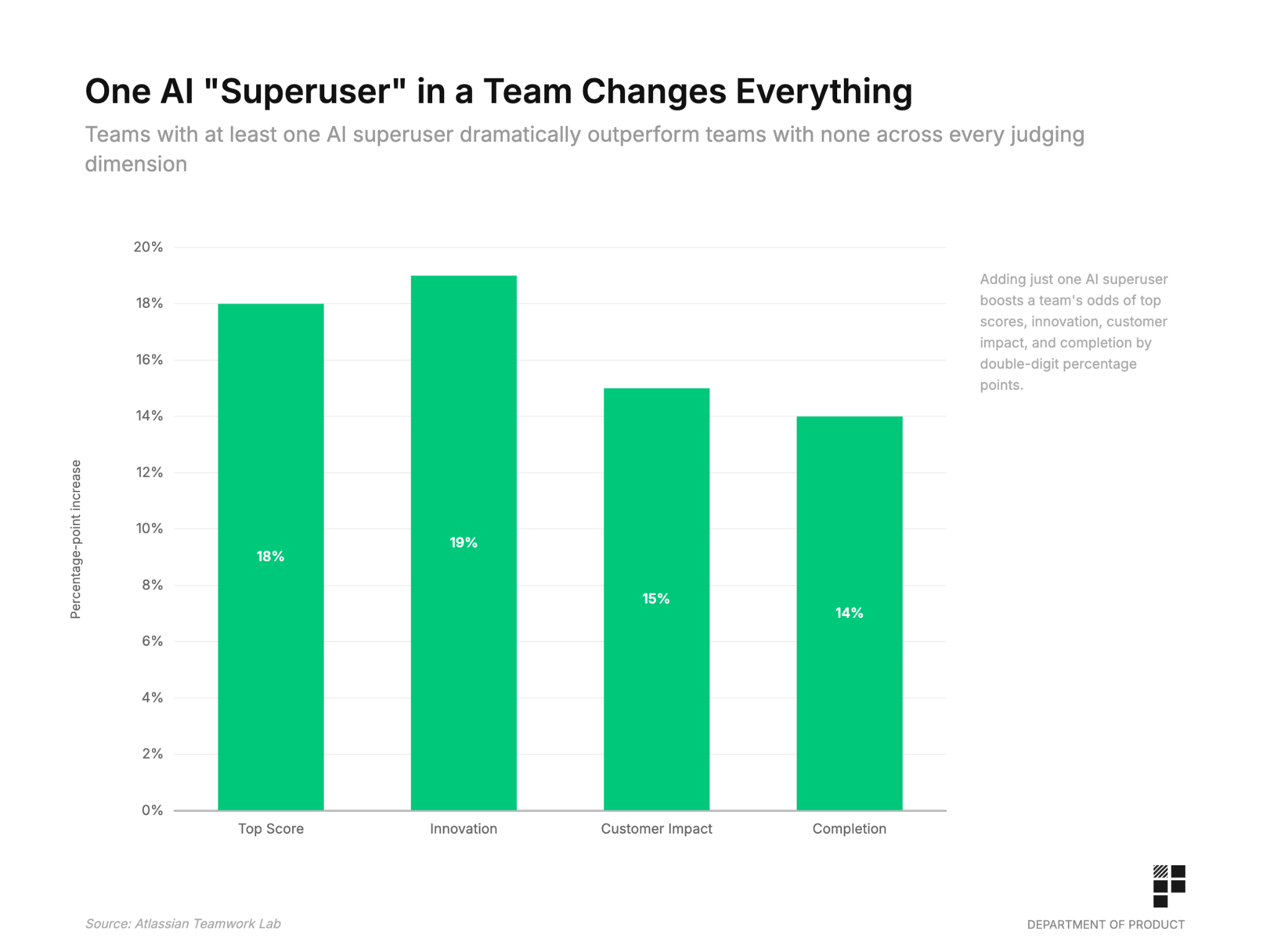
Adding just one AI superuser boosts a team’s innovation rates by a significant 19%.
The Briefing is your curated report on what happened in tech and AI this week - hand crafted for product teams. Paid subscribers get the full DoP Substack including: The Knowledge Series for hands-on AI tutorials and DoP Deep dive reports for in-depth analysis to learn lessons from the world’s top tech companies.