
🔒 The Knowledge Series breaks down emerging AI technologies with practical playbooks designed specifically for product teams. Get 100+ guides and practical tutorials covering everything from Claude Code and MCP to agentic workflows, vibe coding, and more.
It’s not always a good idea to jump on the latest AI trend, but between the 1st and 9th of October, OpenAI, Amazon, Cloudflare, Perplexity, Microsoft and Snowflake all launched a new type of AI model called a decision model.
This trend started when in September, TypeSafe released a new model called Jev. Within 24 hours of its release, nearly 13% of teams tracked through Vercel’s AI gateway were using it - twice the share of any previous model launch.
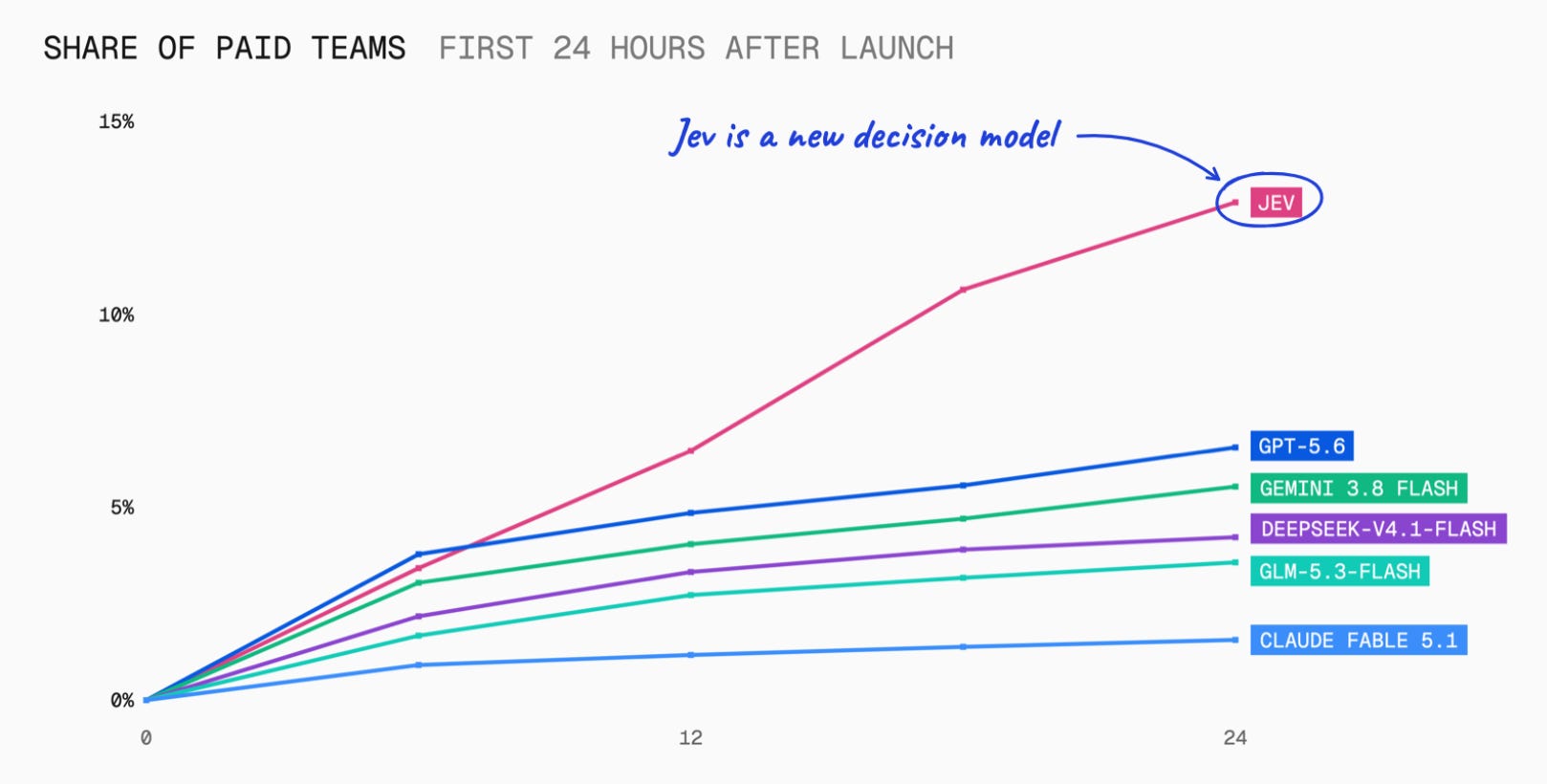
In just ten days, the latest State of AI report said Jev was now handling 27% of classifications on OpenRouter.
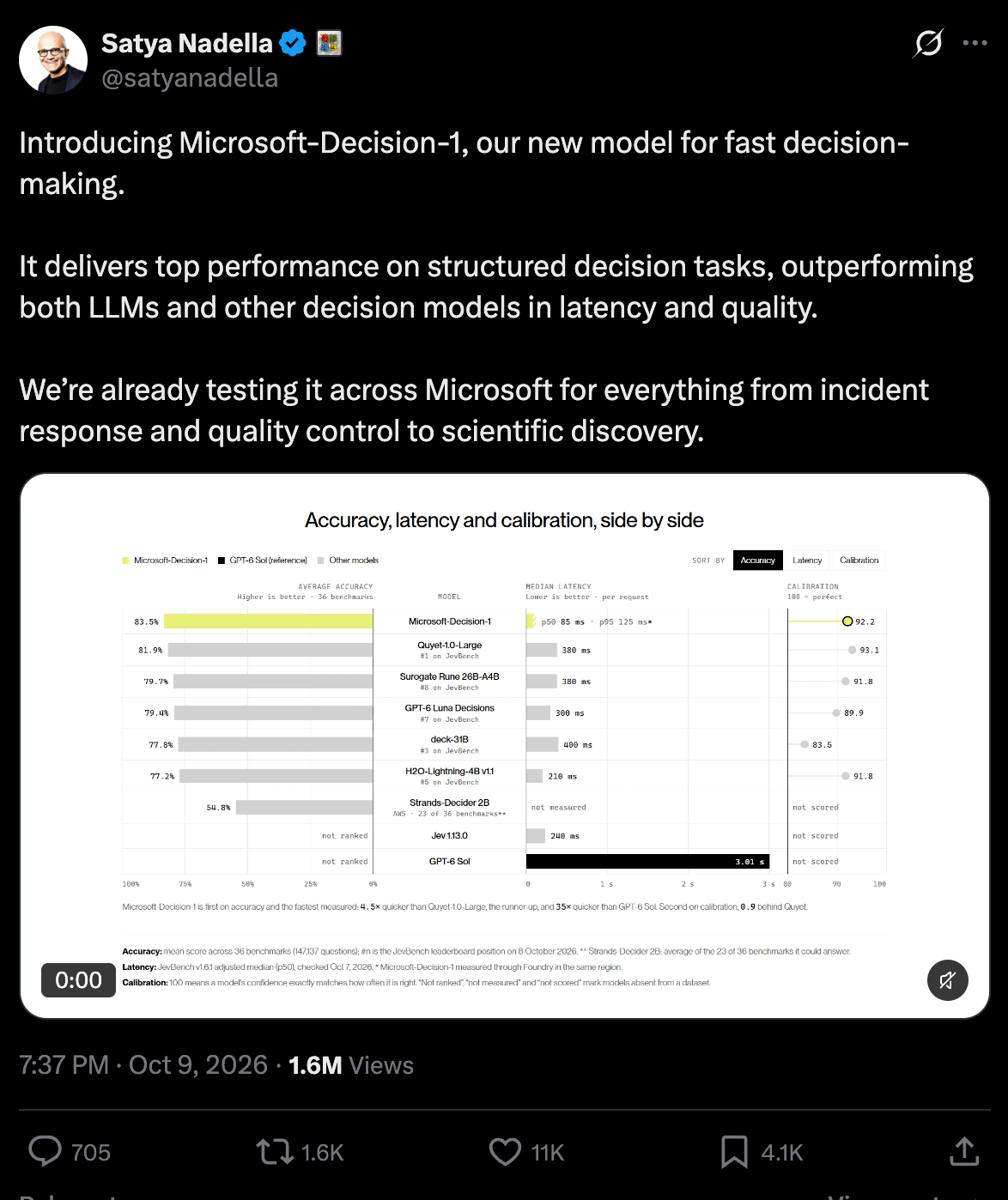
And when announcing their own new decision model, Microsoft’s CEO said that the new type of model already outperforms LLMs and other models on both speed and quality:
Most of the AI features inside products today use an LLM that writes text but a lot of what those models are actually being asked to do is to make a choice. Things like: which tool should an agent call? Is this email a complaint or refund request? Should this command be blocked?
Decision models are built to handle these types of requests - and they’re fast becoming the go-to choice for many product teams, because they’re often quicker and cheaper than a traditional LLM.
In this Knowledge Series, we’re going to explore what decision models are, where product teams are already using them, where they fall short, and how you can try one in your own product.
Coming up:
What is a decision model and why do they matter to product teams?
Why are they suddenly so popular?
The 5 jobs decisions models are doing in real world products
How to evaluate one and try it in your own product
Real world examples, tools and data sets you can use

What is a decision model and why do they matter to product teams?
Essentially, a decision model answers a question by picking from a fixed set of answers rather than generating text of its own.
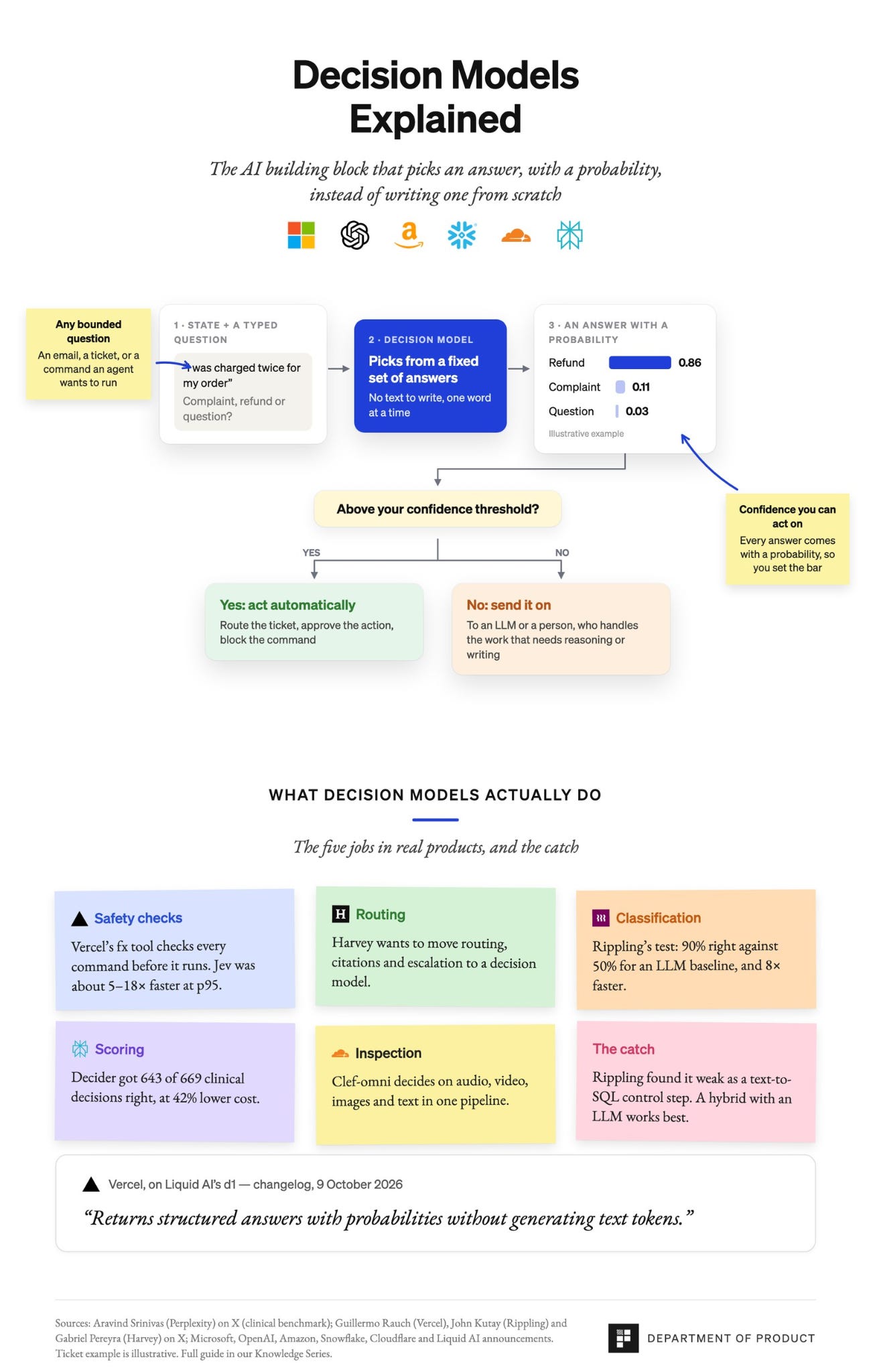
For example, you give it something to work on, which for product teams could be something like an email from a custom or a customer support ticket. This is known as the state - essentially, the situation the model needs to make a decision about.
Then you ask it one or more questions where the answer has to fit a fixed format. These are known as “typed questions”. The model then picks an answer and tells you how confident it is in each option, so for example if a customer says:
“I was charged twice for my order and want my money back”
The result might look like something like:
Refund request: 91%
Complain: 8%
Question 1%
In this example, it is 91% confident that this is a refund request and the model can then send a ticket to the customer service team without having to interpret the text with an LLM.
Vercel came up with their own definition when they announced their own decision model this week, saying that Decision Models “returns structured answers with probabilities without generating text tokens”.
The differences between a traditional LLM and a decision model

Why now? How this entire category exploded in just the last month
Jev launched just a few weeks ago but the category is now starting to get crowded. Once Vercel shared their data on how quickly product teams adopted it, the AI platforms started to offer their own, too.
A timeline of recent Decision Model launches
Here’s a breakdown of the latest Decision Model launches that have happened in just the last few weeks:
9 Oct - Microsoft launched Microsoft-Decision-1, which it’s already testing internally, including in incident response.
9 Oct - Cloudflare added Clef-omni, a multimodal decision model, made Clef up to 2x faster and cut the price of Clef-flash.
9 Oct - Vercel added Liquid AI’s d1, with vision support, to its AI Gateway.
8 Oct - Snowflake launched Snowflake Decision in private preview, for high-volume classification, scoring, routing and triage.
7 Oct - Liquid AI released two open models, d1-3B and d1-omni-600M, small enough to run on devices.
7 Oct - OpenAI released a multimodal Decision API, which Netlify added to its AI Gateway.
6 Oct - Perplexity released Decider v1.1 with open weights and halved its price to $0.02 per million input tokens.
1 Oct - Amazon open-sourced Strands Decider 2B for agent workflows.
1 Oct - Cloudflare launched Clef and Clef-flash, plus a platform to fine-tune decision models on your own data.
24 Sep - Databricks made open decision models callable straight from SQL.
18 Sep - Vercel reported Jev as the fastest-adopted model in its AI Gateway’s history.
17 Sep - Netlify added TypeSafe AI’s Jev to its AI Gateway.
The 5 jobs decision models are doing in real products
But how are these models actually being used by product teams and companies in the real world?