
Deep: How Spotify is using AI Agents to manage tech debt
AI Agents in Practice: Real world examples from Spotify DuoLingo, Atlassian, Instacart, DoorDash, Uber and more.
🔒DoP Deep goes deeper into the concepts and ideas that are covered in the Weekly Briefing to help you learn lessons from the experiences of top tech companies. If you’d like to upgrade to receive these in-depth pieces of analysis you can upgrade below. New reports are added every month.
Spotify recently published a 3 part series of in-depth posts on how it uses AI Agents internally throughout its product development process. The full series of posts are definitely worth a read but the tl;dr is that the company built a “background coding agent” that plugs into their existing Fleet Management system, which is infrastructure they’ve used for years to automate code changes across thousands of repositories. The agent understands natural language prompts, edits code, runs builds and tests, and opens up pull requests automatically. Engineers can then trigger it for large-scale migrations or ad hoc tasks via Slack and GitHub.
In other words, these AI Agents are designed to help engineering / product teams offload the bits of work they’d rather not do like tech debt management and tedious infrastructure changes to AI Agents so that engineering efforts can be spent on more valuable tasks instead.
Since the release of Spotify’s new background coding agents, 1,500 pieces of code have been merged into production, with over half those are completely automated. And overall, Spotify says the rollout has resulted in between 60-90% time savings for development tasks compared to the manual alternative.
Every part of the product development process is slowly being disrupted by AI Agents.
And while we’ve previously looked at various use cases for AI Agents in Practice, in this Deep Dive, we’re going to specifically focus on how some of the world’s top companies are using AI Agents in that product development process.
With specific, real world examples from the likes of DuoLingo, Atlassian, Instacart, DoorDash, Uber and others, if you’re interested in learning about how some of the world’s leading companies are using AI Agents throughout their product development process, this Deep Dive should help.
Coming up:
How Spotify’s background coding agents have already merged 1,500 pieces of code into production - with over half completely automated
The internal AI agent builders at DuoLingo that let non-engineers spin up new agents in under 5 minutes
Why DoorDash is experimenting with autonomous agent “swarms” that pass work between each other like an ant colony
Instacart’s design-to-code agent that turns Figma screenshots into functional code scaffolds
How one leading company’s QA agent executes 40 test scenarios weekly and catches 10 issues - all through natural language prompts
All of the companies and AI Agents featured in full
How this analysis is structured
This Deep Dive is structured specifically around the practical ways that product teams are using AI Agents during the product development process. The agent examples are hand picked to cover as much of the end to end product development process as possible, from design to engineering and QA.
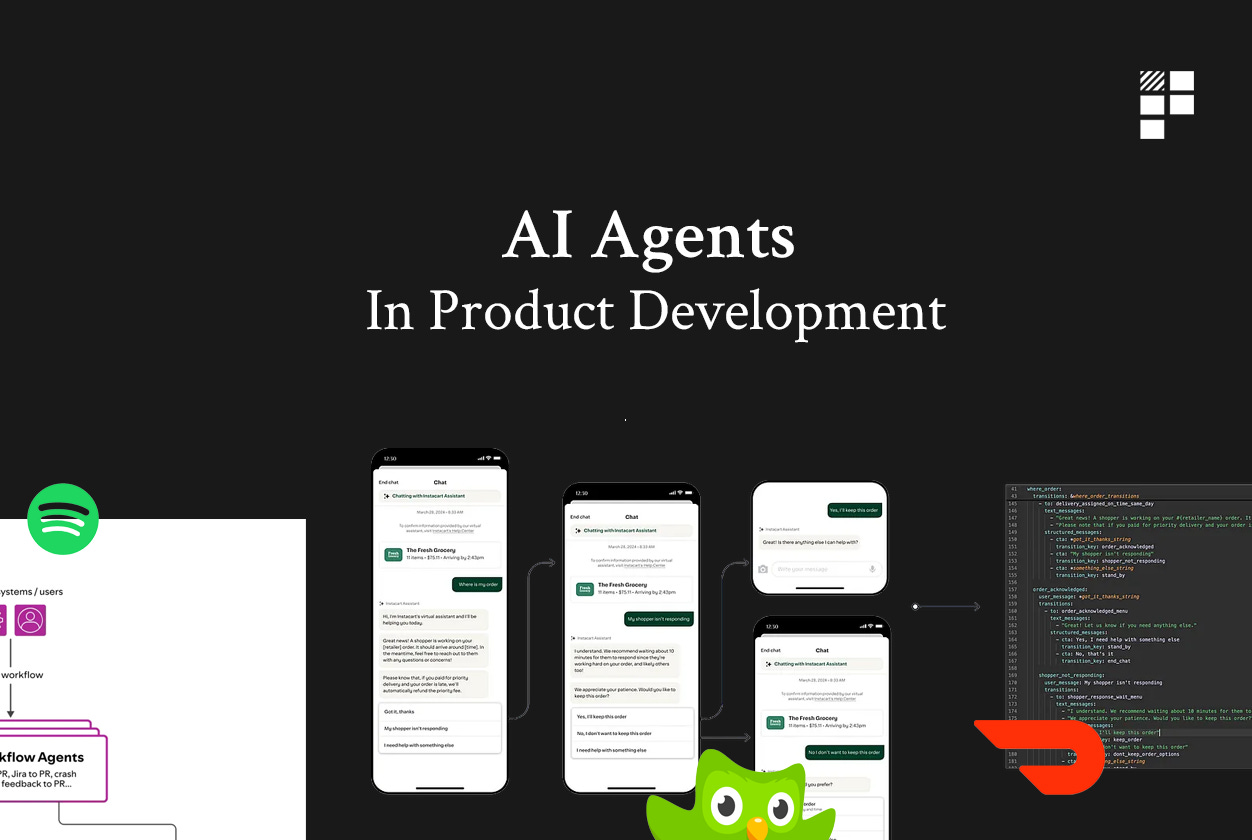
The categories include:
Code review agents
Design agents
Internal platforms built to speed up product development processes
QA agents for reviewing code output
Triaging agents that automatically categorize incoming issues, routes them to appropriate teams and assignees, working invisibly in the background
Examples of AI Agents in Practice include:
Agentic workflow builders from DuoLingo and Doordash
Security Agents
QA agents that behave like QA engineers using plain language
Design to coding agents that can interpret layouts and generate usable scaffolds, turning static mocks into functional components
A closer look at Spotify’s AI coding Agents with some key principles / takeaways for product teams
Before we take a look at some of the other examples featured in this Deep Dive, let’s dig a little deeper into the set up at Spotify along with some key principles and takeaways for product teams to consider.
To recap, Spotify built a “background coding agent” that plugs into their existing Fleet Management system. The Fleet Management system is infrastructure they’ve used for years to automate code changes across thousands of repositories. The agent handles maintenance and migration work that’s repetitive but historically requires human intervention (some of the examples cited by Spotify include things like config updates, upgrades to programming languages and migrating UI frameworks / components).
How the coding agents work
Here’s a snapshot of how Spotify’s coding agents works and how they fit into the overall software development process. You’ll notice that there are actually three agents here: the Code Workflow Agent, the Background Coding Agent and the PR Review agent:
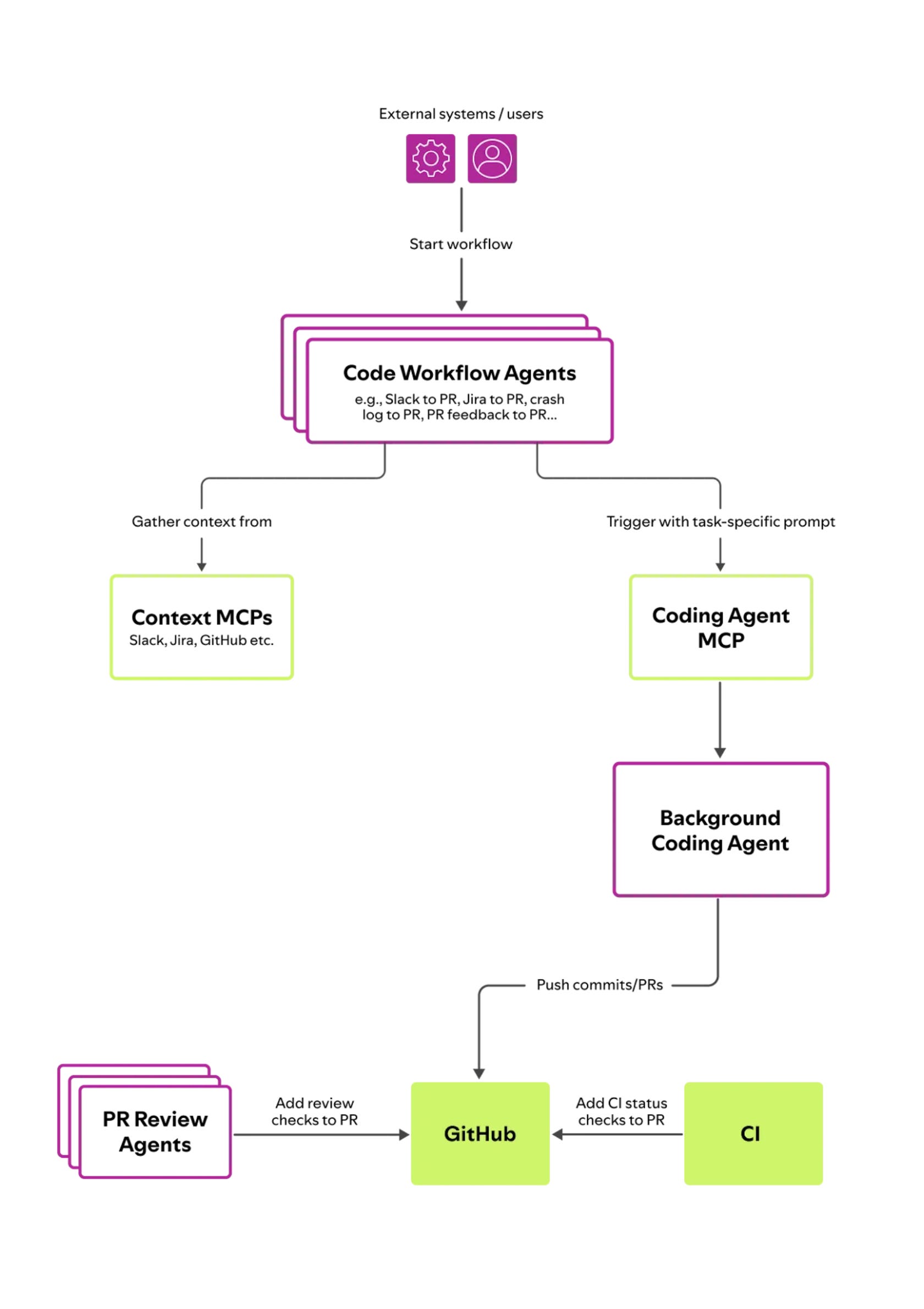
The Code Workflow agent is the first agent that users interact with. Spotify says that non-engineers including product managers use this agent since it allows them to describe, in tools like Slack, what they’d like the agent to build:
By exposing our background coding agent via MCP, Spotifiers can now kick off coding agent tasks from both Slack and GitHub Enterprise. They first talk to an interactive agent that helps to gather information about the task at hand. This interaction results in a prompt that is then handed off to the coding agent, which produces a pull request.
Once context is gathered, the workflow agent constructs a prompt and passes it to the coding agent via MCP (Model Context Protocol). The background coding agent receives a fully-formed task which means it doesn’t need to figure out what to do.
When it’s finished its task, it is available for review in GitHub and it’s here that the review agent can review the output. Spotify says it carefully designed this architecture to ensure each agent had a specific, well-defined role. In this case:
The Workflow agents handle ambiguity and context-gathering (talking to users, pulling from Slack/Jira)
The Coding agent handles execution with minimal context (just the prompt and the code)
The Review agents handle verification (catching mistakes before merge)
Principles and takeaways for product teams
This is just a single example but it demonstrates the valuable - and disruptive - impact of AI agents in the software development process. As coding agents become more sophisticated, they change the nature of work that product engineering teams find themselves working on day to day.
The middle layer of software development is disappearing