
Hello product people 👋,
It’s been described as a “concerning” development but this week, a new Chinese model rocked the stock market after it beat frontier US models on front end coding benchmarks at a significant discount. We’ll take a look at some real world examples of it in action so that you can make your own mind up.
Plus, Claude Artifacts gets some new abilities, Spotify’s conversational features go deeper and Jira attempts to fight back with a Teamwork Graph that acts as a context layer for humans and agents.
Watch on YouTube | Follow on Substack Notes
Reads, resources and case studies for product teams
New from the Department of Product Substack this week:
How Figma built a Product OS that saved Product Managers 2 hours a day
Figma’s product team built an internal AI system that cut PMs’ coordination work in half - saving them roughly 2 hours daily. The system, called Product OS, combines three core building blocks (context, profile, and experience) with reusable agent skills to turn scattered Slack messages, Asana tasks, and design files into actionable daily digests and automated status updates. (Department of Product)
Anthropic’s Product Manager Jess Yann on how to build the future of agentic infrastructure
Agents are moving from tools you prompt to infrastructure that runs your business. But what does it take to run them in production? Jess Yann (Product Manager, Claude Managed Agents), Katelyn Lesse (Head of Engineering, Claude Platform), and Angela Jiang (Head of Product, Claude Platform) discuss.
How Snapchat’s AI code reviewer went from zero to 90% adoption in a single quarter
AI code generation tools tripled Snap’s pull request volume, but created a new bottleneck: human reviewers overwhelmed with code to assess. So Snap built CodePal, an AI code reviewer that now checks 90% of all PRs before humans see them. (Snap engineering)
Replit’s CEO explains how they’re building a self-driving company
Replit’s CEO Amjad Masad calls it “the self-driving company” - not a business without people, but one where humans set direction while agents handle the work. Read how Replit wove AI through every department, turning workers into strategic thinkers. (Replit)
How designers can deploy straight to production with Figma Make
Small accessibility fixes that improve a website’s usability usually sit in the backlog - but what if a designer could ship them directly to production? This workflow shows how a team used Figma Make and GitHub integration to skip the ticket queue entirely, letting a designer refine a museum website’s navigation, date picker, and empty states while an engineer focused on major architecture work. (Figma)
5 prompting hacks from Google engineers
A selection of Google engineers share some of their go-to hacks for prompting. (Google)
Microsoft’s Satya Nadella on how you can protect your product’s IP in the AI Age
When you feed proprietary data to AI models to make them smarter, you’re essentially giving away your competitive edge - trace by trace, correction by correction. Microsoft CEO Satya Nadella calls this the “Reverse Information Paradox” and argues companies need hard boundaries around their learning loops . (Microsoft)
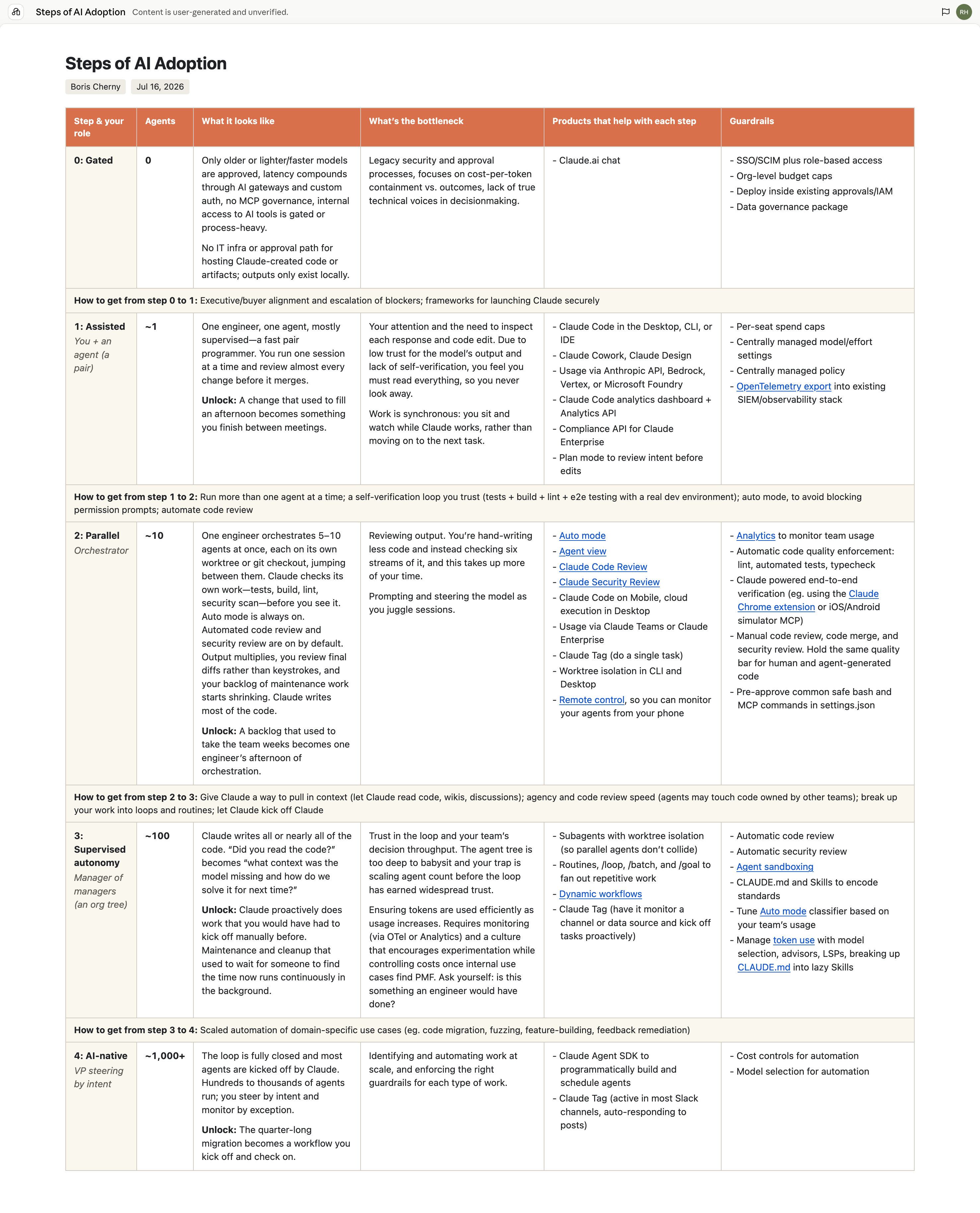
Claude Code creator Boris Cherny on the 4 steps of AI adoption
Boris says he regularly speaks to product engineering teams and hears the same thing every day: one person is 10xing their output with Claude but the rest of the org can’t keep up. He formalized the stages he sees into 4 distinct steps. (X)
New product features and innovation worth knowing about this week
Claude Artifacts have gained some new abilities. Now you can hook up these artifacts to third party tools via MCP connectors and then share them with other other people in your organization. Artifacts can fetch information and take actions for each viewer on demand, so you build an artifact once, it pulls live data via MCP, and only the viewer can see the data they have access to.
In practical terms, you could use this to build things like internal dashboards that connect to data sources or productivity tools that can connect to services like Gmail.
I tested this out for myself and built a little Dashboard that connects to Gmail, Notion and Google Drive and the results were pretty good; it successfully pulled in all of my relevant data - and built functionality on top of that so that I could do things like mark emails as read and flag senders I’m regularly ignoring to identify potential candidates for unsubscribing.
You can also now kickstart the process of building an artifact from within Slack using Claude Tag. So, for example, if someone asks for “a one-pager summarizing this decision” right in the channel, and it gets built and published without anyone leaving Slack.
One of Claude Code’s own engineers says that one of his favourite use cases for Artifacts is building a dashboard for a specific project and then sharing it with coworkers and these are the latest examples of this idea of creating software on demand, often in the form of HTML, replacing other assets we might typically create (like Docs and Presentations).
Spotify gets deeper conversational features for discovery
Spotify has launched a new conversational feature that lets you type or speak directly in the app - having a back and forth conversation to do things like choose what’s playing, learn more about the music, revisit your listening history and go deeper on podcasts or audiobooks.
This idea of a dedicated conversational assistant that can help with discovery is a pattern we’re increasingly seeing rolled out across other product categories, too.
Doordash’s CEO, for example, recently confirmed that 70% of conversations in their new AI Assistant are some form of discovery; so things like figuring out what to have for dinner, rather than explicit instructions to buy something.
A framework for identifying voice opportunities in your product
If you’re currently thinking about adding voice to your own product, here’s some assessment criteria to help identify voice UX opportunities:
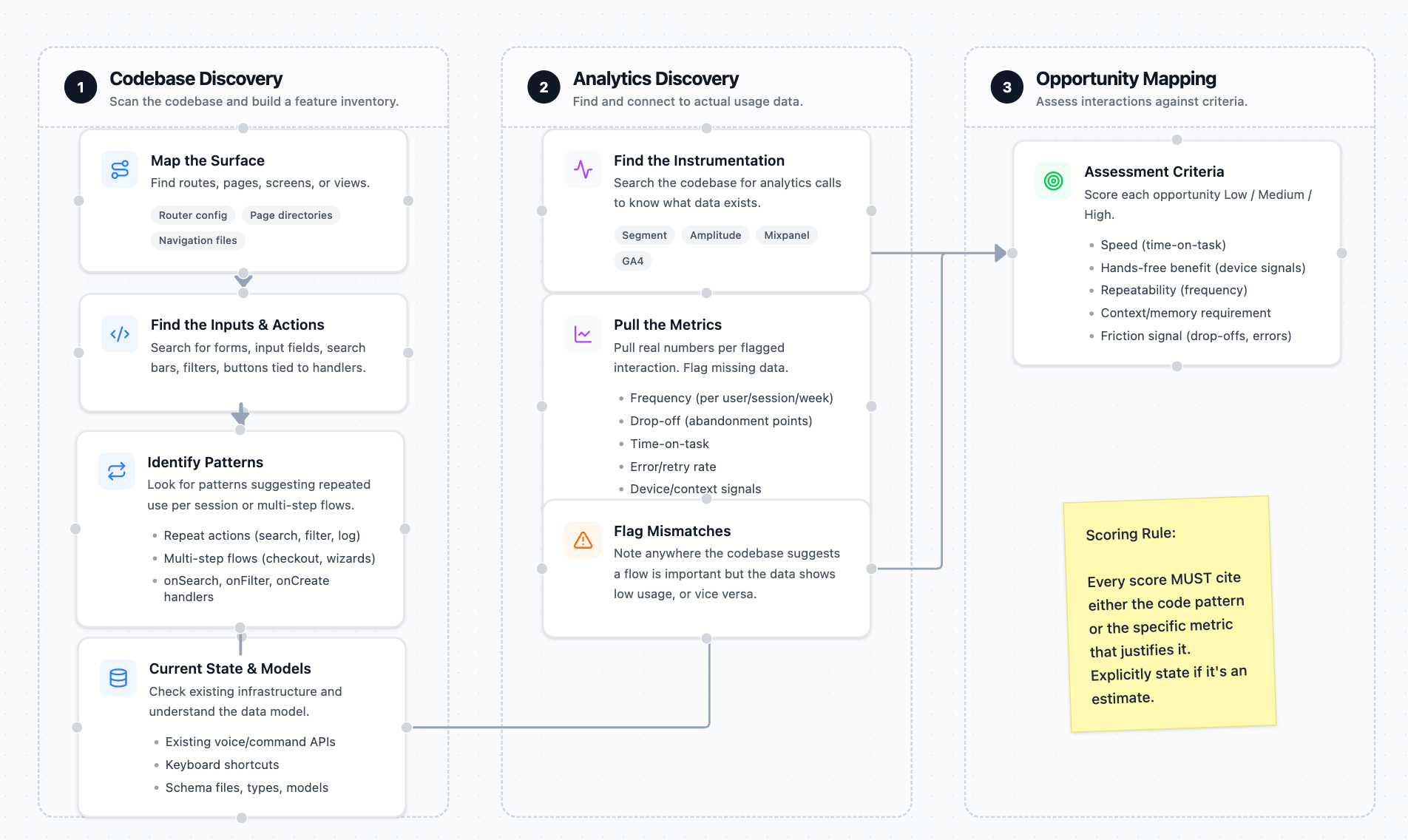
Speed: is it faster to say than to type or click? (use time-on-task data if available)
Hands-free benefit: does it benefit from hands-free use? (use device/context signals if available)
Repeatability: is it repeatable enough to warrant a dedicated voice command? (use frequency data)
Context/memory requirement: does it require context or memory across turns?
Friction signal: does the data show drop-off, errors, or retries here that voice could reduce?
Use this prompt to build a voice opportunity framework that will scan your codebase and analytics platform to identify opportunities that might be strong candidates for voice UX.
Jira is evolving to become agent-centric
Faced with some existential threats from Anthropic, OpenAI, Cursor, Notion and Linear who are all scrambling to become the place for product work, Jira is attempting to fight back. This week, Atlassian has released new agentic capabilities in Jira designed to let software teams work alongside AI coding agents.
Jira now enables teams to manage work across human engineers and AI coding agents through “Teamwork Graph” - a context layer connecting requirements, code history, decisions, and team conversations.
Jira Planner generates technical specs from codebase and documentation; agents (Claude Code, Cursor, GitHub Copilot) receive work items with rich context; Agent Sessions provide visibility into what agents are doing; and Coding Agent Automations route routine tasks like bug fixes to agents automatically.
Google Image Search evolves to take on Pinterest
Google has unveiled a radical new makeover of its Google Image Search product. Google is redesigning Images to focus on discovery and inspiration rather than just search which again, reflects some of the trends we talked about earlier where search and discovery are blending together. This update includes a “For You” gallery that shows personalized images based on your interests and browsing history. Google is also adding image generation directly into its search results. When you can’t find an existing image online, you can now create one using AI. The feature lets you visualize specific ideas - like how a room would look painted a different color or styled differently.
Google also revealed new integrations into their core app. Starting from today, you can connect your Instacart account and generate a grocery list in AI Mode based on your conversation. Then AI Mode can add the items to your Instacart shopping cart and you can check out on their app or website.
Agents can login with your passwords to perform sensitive tasks
1Password has released 1Password for Claude which lets Claude complete browser based tasks that need login credentials. Claude requests access to a credential when it needs to log into a site. 1Password shows the user which credential is being requested and why, then requires biometric approval. Once approved, 1Password injects the credential directly into the login page - Claude never receives the password or one-time code.
It sounds slightly terrifying but 1Password’s CTO is confident that it’s safe to use, confirming that a number of safeguards are built into it, including single-use task permissions which means that if agents want to use the password for a separate task, they have to ask again. Integrating 1Password with other AI providers is also in the works, she says.
Product team evolution: perspectives from the world’s top companies
Cursor’s CTO declared the famous Jeff Bezos two pizza rule over when he said “RIP to the two pizza team”. Here’s how some of the world’s top product leaders from Instagram, Block, Snap and others are changing their product team composition to cope with AI disruption:
📈 Product data and trends to stay informed
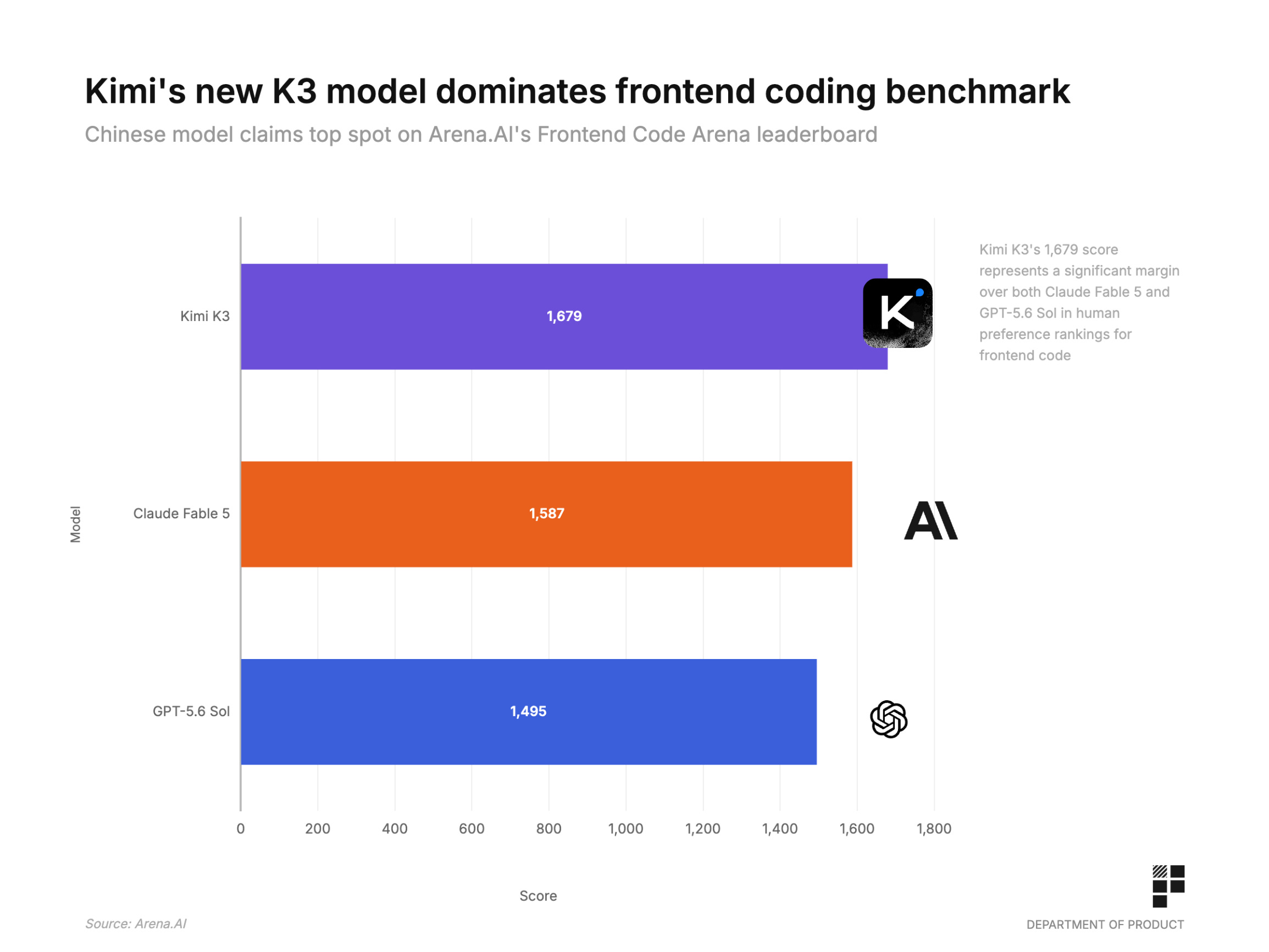
China’s open source model Kimi K3 has rocked the stock market after it beat rivals Anthropic and OpenAI on front end coding bench marks and came a respectable third in others - at a fraction of the cost of its US competitors. Kimi K3 claimed the top spot on Arena AI’s Frontend Code Arena with a score of 1,679, beating Claude Fable 5 and GPT-5.6 Sol by pretty significant margin. The leaderboard ranks models by human preference in head-to-head frontend coding comparisons:
David Sacks, the VC, ex-White House AI advisor and host of the All in Podcast said “this is concerning”.
Here’s a side by side comparison of Kimi K3 vs Fable 5 in action showing its capabilities and comparative cost:
Other examples of what people have been building with it so far:
ChatGPT’s market share is still in decline - albeit at a slower rate. Web visit market share is down from 76% a year ago to just 53% last month. That’s a huge YoY decline but the month on month numbers suggest that the rapid growth of Google’s Gemini might be starting to stall slightly.
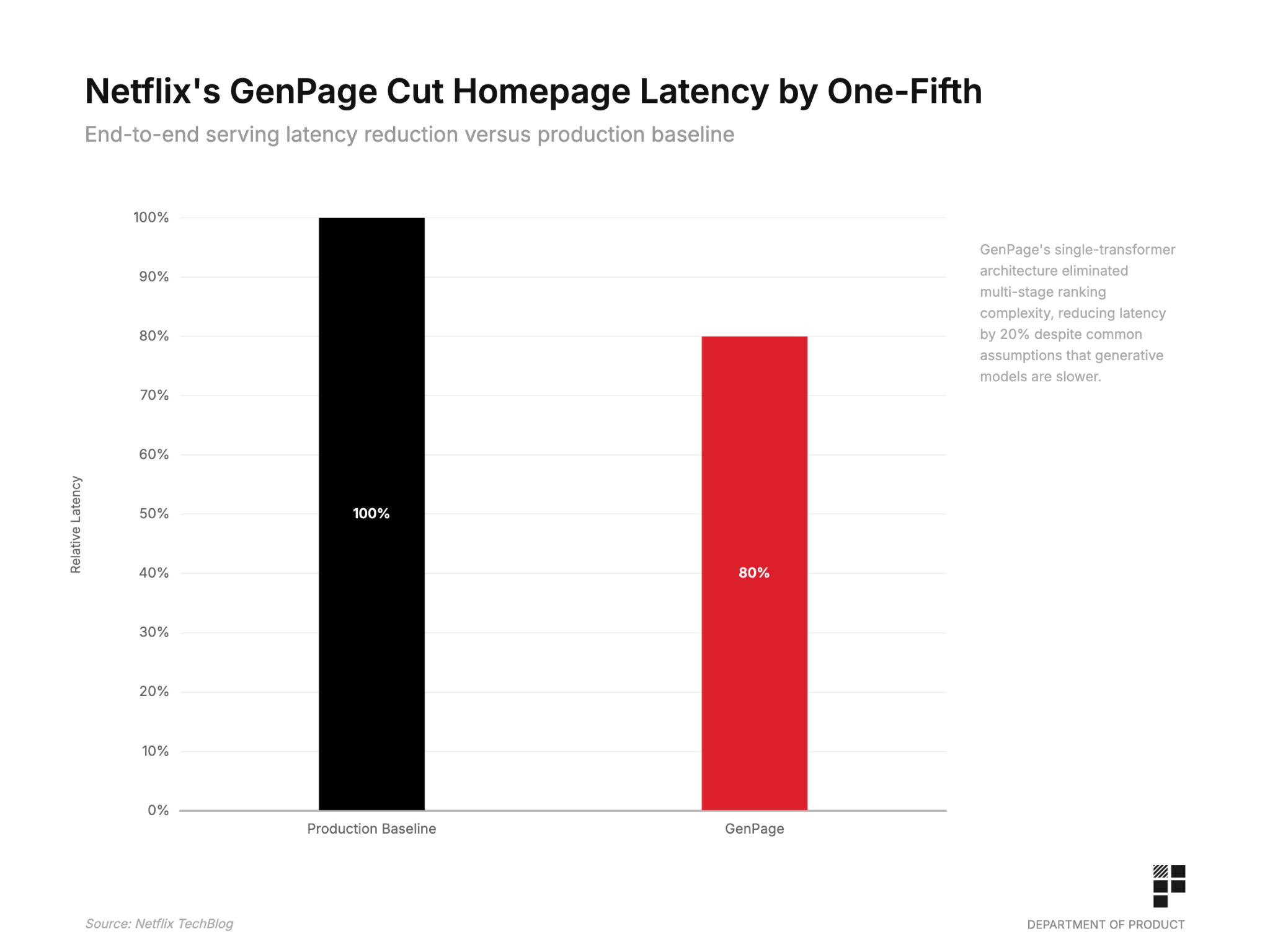
Netflix says it built a proprietary homepage generator called GenPage that cut homepage latency by one fifth and improved engagement.
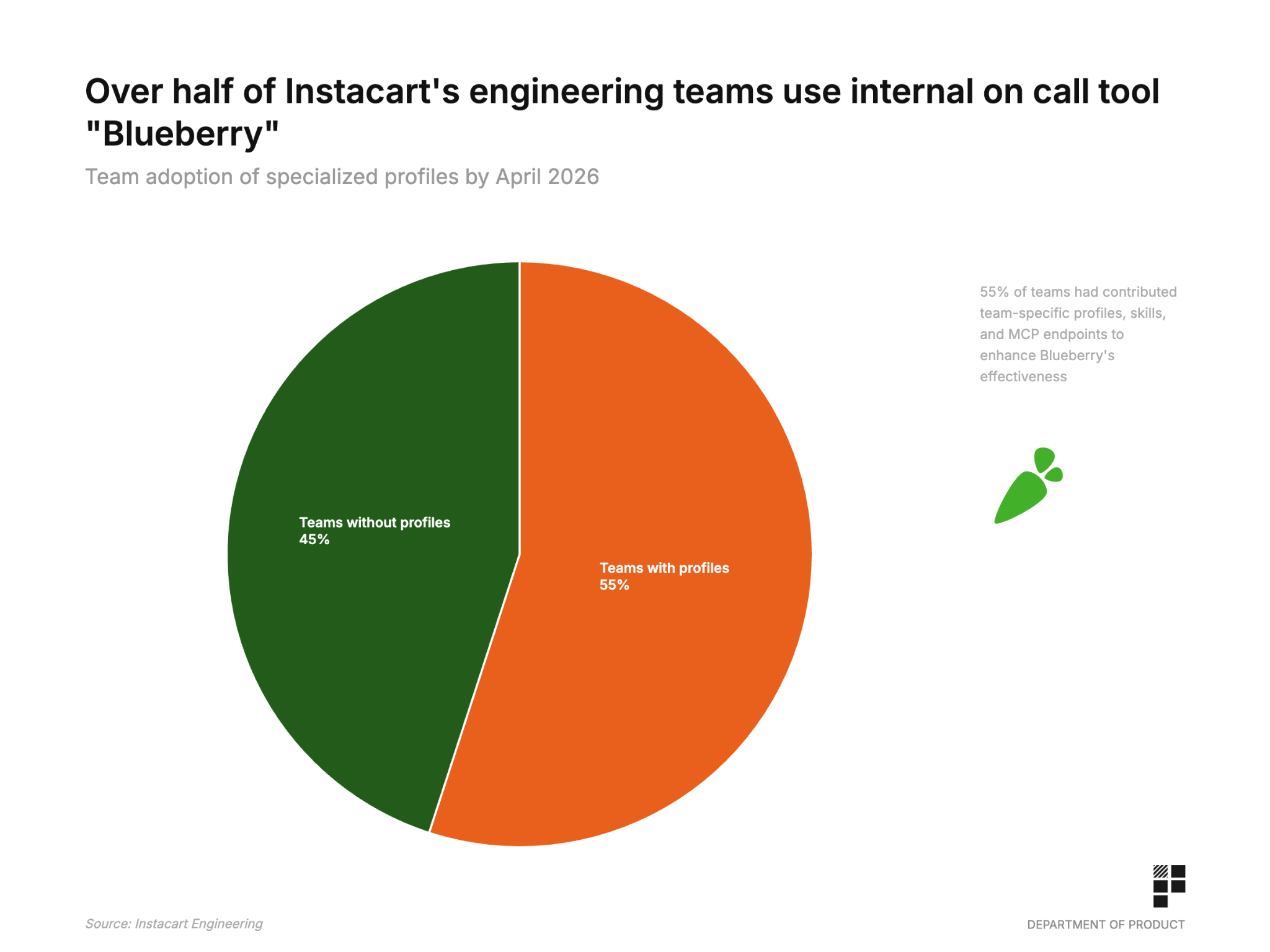
Instacart built a Slack-native system called Blueberry that helps on-call engineers resolve production issues faster by turning alerts into clear explanations in about three minutes. When something breaks at Instacart, an alert fires into Slack. Blueberry sits in that thread and does that first pass automatically. It reads the alert, pulls in relevant history and live signals, and posts a clear explanation of what’s likely happening, usually within three minutes. Over half of Instacart’s teams now use it:
54% of enterprises have already experienced security incidents with AI agents and only about a third (32%) give every agent its own scoped, managed identity.
Uber’s is buying Delivery Hero to bolsten its strategy to have both ride‑hailing and food delivery in a market because users who use both tend to spend 3x to 4x as much as users who use only one of the services.
Starbucks is planning to save $10 million a year on software - and is building its own internal products to help. So far, they’ve built an internal POS product and an alternative to a Microsoft-owned inventory management product. They’re set for release later this year. It looks like by early 2027 we’ll start to finally get a sense of how well these self-built products actually perform at scale.

The Briefing is your curated report on what happened in tech and AI this week - for product teams. Paid subscribers get the full DoP Substack including: The Knowledge Series for hands-on AI tutorials and DoP Deep dive reports for in-depth analysis to learn lessons from the world’s top tech companies.
The 54% incident rate beside the 32% identity figure exposes the real bottleneck. We're automating coordination faster than we're defining who each agent is and what it may do, so trust could become the limiting factor before model capability does.