
🔒DoP Deep goes deeper into the concepts and ideas that are covered in the Weekly Briefing to help you learn lessons from the experiences of top tech companies. If you’d like to upgrade to receive these in-depth pieces of analysis you can upgrade below. New reports are added every month.
Spotify has published a detailed piece outlining some of the key lessons they’ve learned along their AI development journey so far.
The tl;dr from Spotify is that after analysing their own performance:
They’re now shipping more code than ever with merged code changes more than doubling over a year in August.
Spotify found no direct evidence that AI assisted code caused new major production incidents and concluded that faster shipping to production with AI didn’t mean less overall investment in quality.
In fact, they found that code quality and optimization work actually grew from 27% to 31% as a share of overall engineering work with maintenance and configuration dropping from 31% to 25%.
But, AI assistance introduced other problems downstream. As AI increased shipping velocity, other parts of Spotify’s product development process and engineering infrastructure struggled to keep up with that change with automation introducing new failure risks further downstream.
This pattern of unintended downstream effects shows up elsewhere, too.
Linear’s own analysis found that coordination overhead rose alongside a 111% increase in PR output and HubSpot spent six months building automated code review specifically because AI generated code volume overwhelmed manual review cycles.
Reading about these case studies in isolation is one thing but it’s difficult to try to look across the industry to identify shifts which impact the product development process. In this Deep Dive we’re going to take a broader look across the industry to understand some of the emerging signals across some of the world’s leading tech companies to attempt to make sense of what the new product development process looks like.
Coming up:
The five emerging product development themes explored in detail
What these new themes might mean for product teams and leaders
The full data set with downloadable examples and case studies you can use to shape your own development processes

Unpacking Five Emerging Themes in Product Development
This analysis was built using over 300 different data points and signals from some of the world’s top companies from the past 30-60 days only to ensure it’s up to date and relevant given just how quickly things are changing. (The full data set that underpins this research is available to download too).
Here’s a preview of some of the themes we’ll explore:
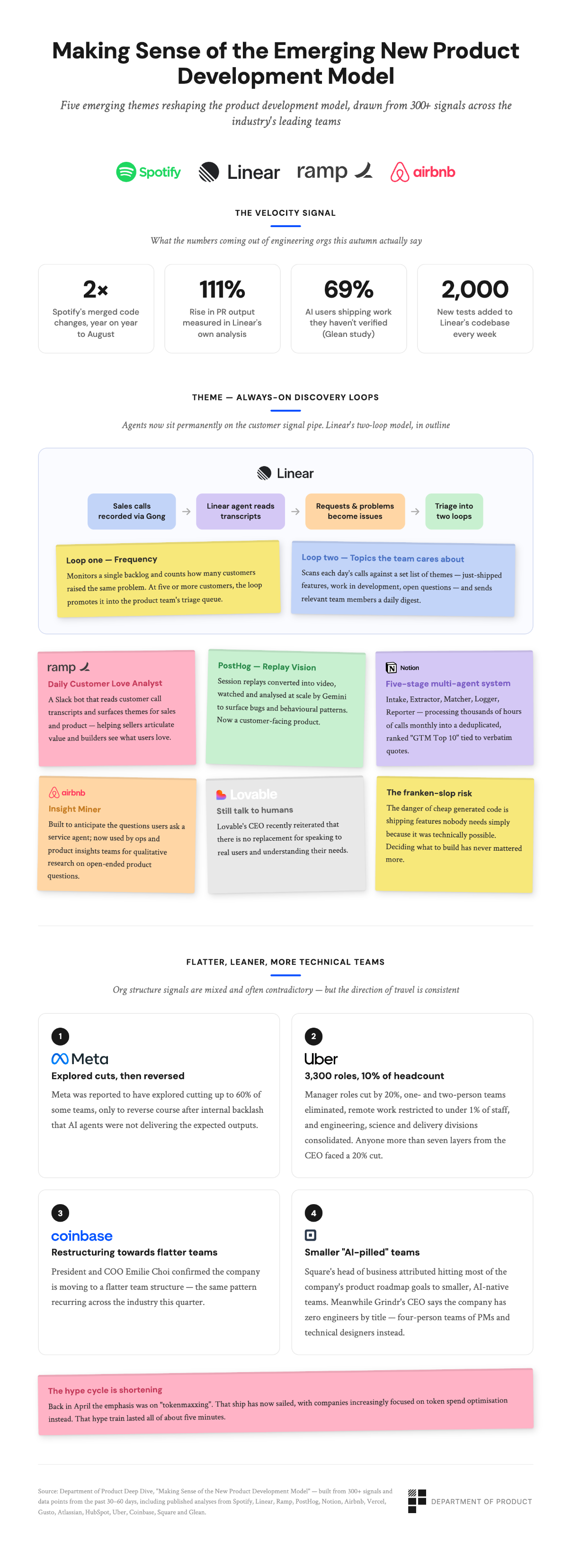
Each signal has been analysed to identify trends and themes that matter to people who build products and it is structured around five core themes that impact product teams right now.
For each theme, we’ll explore real world examples and consider what the practical impact is on the product development process.
1. The product discovery process is being transformed with always-on Agent loops
Figuring out what problems to solve for users has always been tough, and the risk with AI generated code is that product teams end up building franken-slop products packed with features that nobody really needs simply because it was technically possible to ship them.
In this sense, you could argue that figuring out what to build has never been more important.
And on the discovery side, there’s still no replacement for speaking to human users and understanding their needs. This was recently echoed by Lovable’s CEO and it’s good to see AI leaders reiterate the importance of speaking to actual human beings:

Despite that, AI can - and is - starting to play a crucial role in helping product teams solve real problems using the power of always-on agent loops that continuously discover new problems to be solved for users.