
New Agentic Payment Abilities and Features Explored
The 5 layers of Agentic Payments in 2026; what product teams need to know. Examples from Stripe, Adyen, Coinbase, Mastercard, and more.
Stripe’s Head of AI, Emily Sands, recently declared that “the internet has a new economic actor,” arguing that the economic infrastructure of the internet has changed forever.
She says that over the last six months, agents have become a new kind of actor on the internet; while ecommerce was built for humans who click pricing pages, enter cards and navigate checkout flows, agents don’t do any of that. Instead, they need a programmatic way to understand a product, including what it costs and how to pay - without manually clicking through a product’s UI in the way a human would.
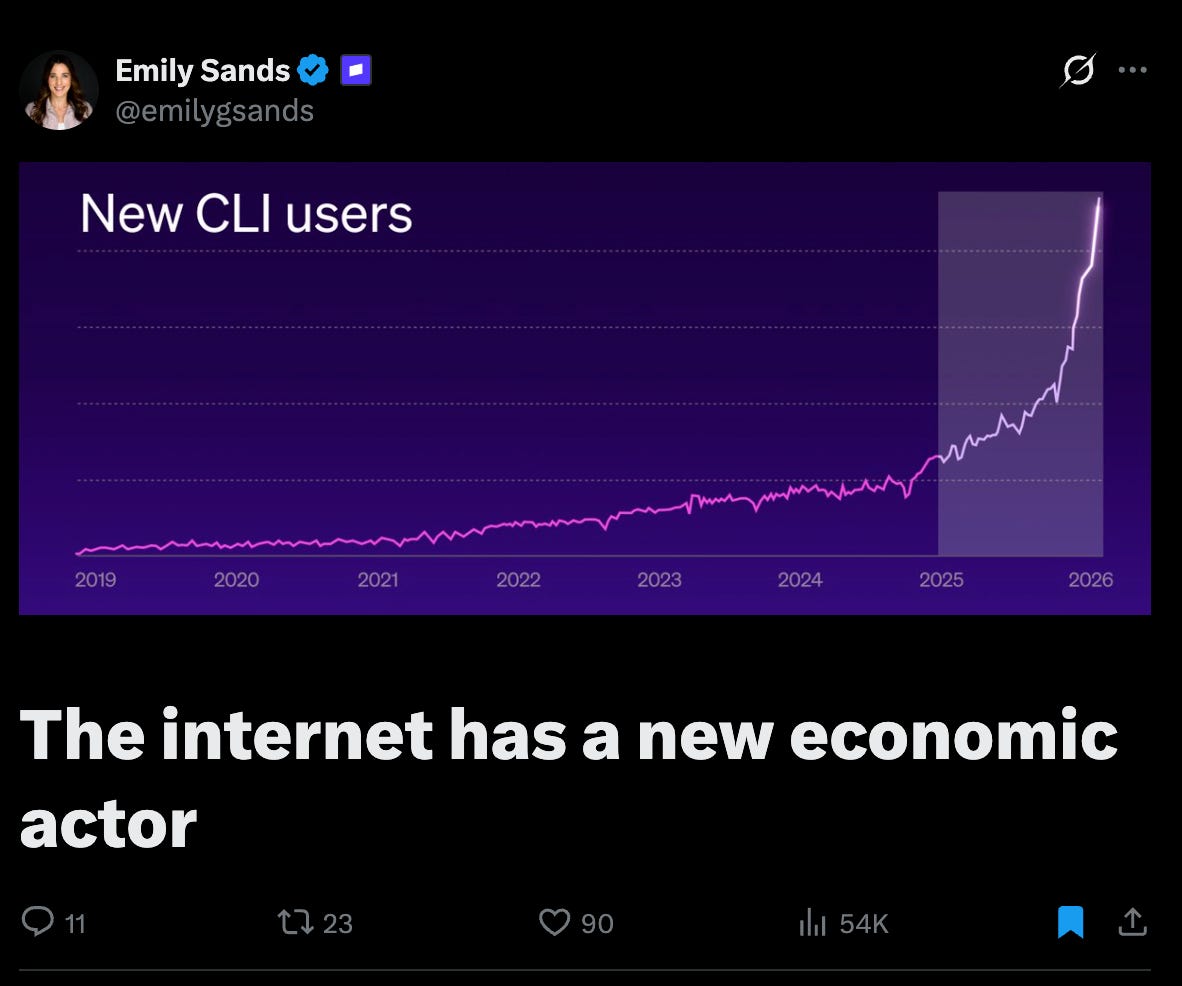
This rapid evolution of payments in recent months has led to new technologies, protocols and features that could transform our understanding of payments on the web.
And in this DoP deep dive, we’ll take a closer look at some of these new advances in payment abilities and features from a product perspective so that you’re fully up to speed with how these technologies might impact the future of in-product payments.
Coming up:
The 5 layers of the agentic payment stack explored - new payment technologies, features and protocols explained
Protocols - how agents discover your product and understand how to pay for it
Credentials and wallets - how agents pay without holding raw card credentials
Identity and trust - how agents prove they are legitimate and that a human authorised the transaction
Billing and monetisation - how businesses charge for consumption rather than seats
Settlement rails - how money moves at the speed and scale agents actually require
Considerations for product teams - what product teams need to know about these new agentic payment technologies and features
Do users care? Consumer and business attitudes towards agentic payments with deep dive reports for further reading

The 5 layers of Agentic Payments: making sense of new technologies, features and protocols
Here’s a snapshot of the 5 layers of the agentic payments stack which have seen the most disruption during the past year:
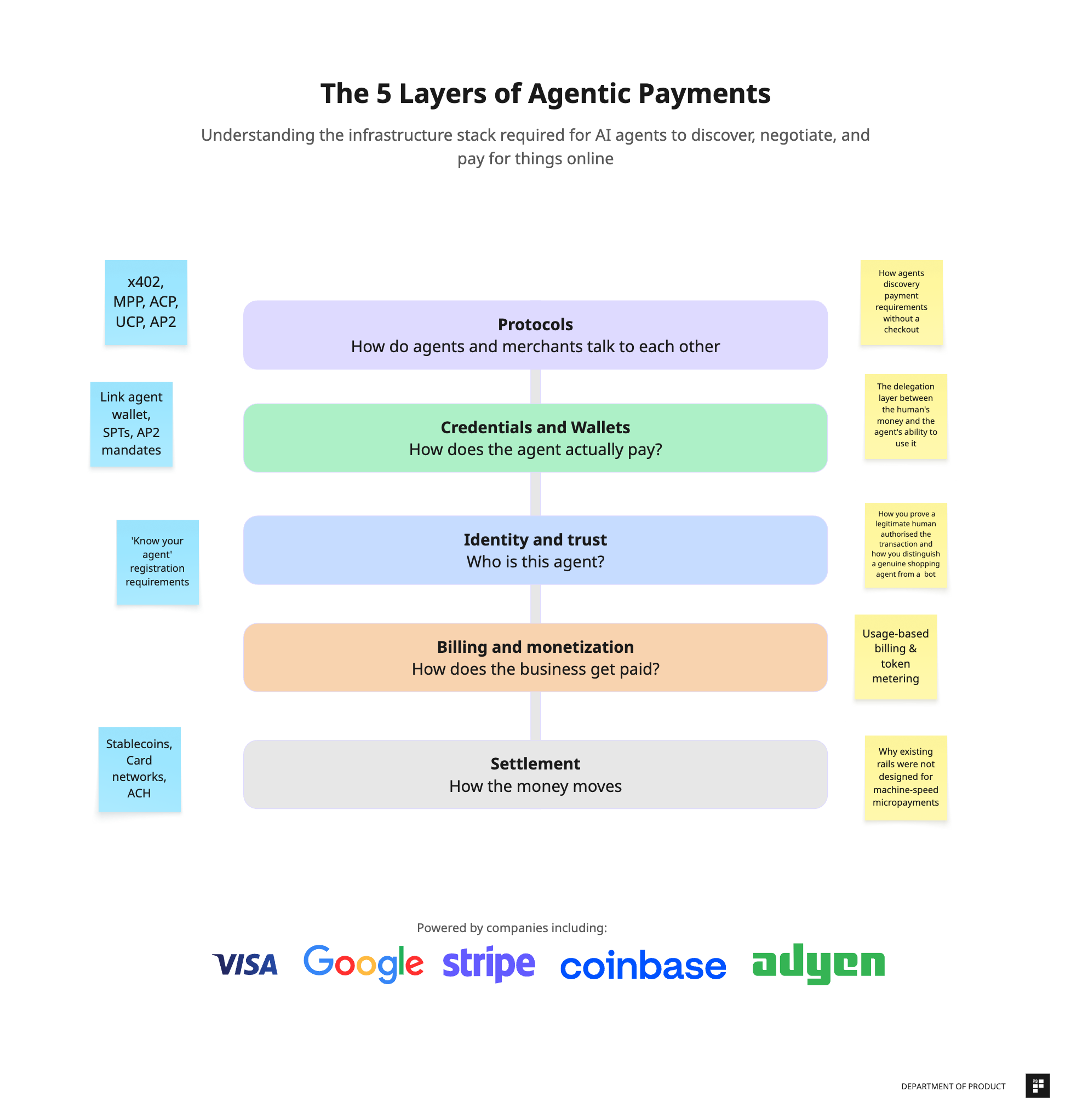
In this Deep Dive, we’ll use these layers to contextualize each of the new technologies and features that have been released in recent months in more detail, explaining what impact they potentially have on product teams.
A timeline of the most impactful Agentic Payment launches from the past 12 months
But before we dig into the details on how some of these new technologies work, here’s a summary of some of the most important agentic payment related releases from the past 12 months.
June 2025 - Adyen launches its MCP server in alpha, becoming the first major European payment processor to let AI agents call payment APIs directly using plain language instructions.
September 2025 - Google announces AP2. The first mechanism for proving a real human authorised a purchase - the human signs a spending mandate in advance, the agent presents it at checkout, and it can’t be disputed after the fact. Separately, OpenAI and Stripe ship ACP inside ChatGPT - the first production protocol for completing purchases inside a conversation.
October 2025 - Stripe launches Shared Payment Tokens: scoped credentials that give agents payment access without exposing the underlying card, capped by merchant and amount, and revocable at any time. Mastercard Agent Pay goes live. The CEO confirms on the earnings call: “our first agentic transaction took place on our network this quarter.” Visa launches Intelligent Commerce in pilot.
You can read more about the Agent Commerce Protocol and how Stripe’s Shared Payment tokens work here.
December 2025 - Stripe launches its Agentic Commerce Suite. x402 V2 releases after processing over 100 million payments in six months, adding multi-chain support and auto-discovery.
January 2026 - Google and Shopify launch UCP with 60+ backers - agents and merchants negotiate transaction terms in real time. Google deploys it in AI Mode on Search and Gemini. Mastercard announces the Agent Suite.
February 2026 - OpenAI launches “Buy it in ChatGPT” for all US users. Etsy is live at launch, with over one million Shopify merchants in the pipeline. OpenAI charges a 4% fee on autonomous agent-led conversions.
March 2026 - Stripe and Tempo co-launch Machine Payments Protocol (MPP) - a standard for how agents pay over HTTP: server returns a price, agent pays, resource is delivered. OpenAI, Anthropic, Google Gemini, and Dune Analytics adopt it at launch.
April 2026 - x402 moves to the Linux Foundation, backed by Stripe, Google, Microsoft, Mastercard, Visa, AWS, Cloudflare, Shopify, Circle, and the Solana Foundation. Stripe Sessions ships 288 products including Link agent wallet and streaming payments in Preview. Visa launches Intelligent Commerce Connect and expands its Agentic Ready program to Asia Pacific and Latin America.
May 2026 - Three major agent payment announcements in 30 days. On May 5th, Google Cloud and Solana launched Pay.sh. May 7th Amazon launched AgentCore Payments in Preview and on May 11th, Circle launched Agent Stack including Nanopayments. All three independently chose x402 and USDC - we’ll talk more about the role of both x402 and stablecoins later.
The 5 layers of Agentic Payment Abilities and Features Explored
Now let’s take a look at each of the 5 layers in more detail to put some of these new technologies into context for product teams.
The new infrastructure organises around five distinct problems that all had to be solved for agent commerce to work: