
🔒DoP Deep goes deeper into the concepts and ideas that are covered in the Weekly Briefing to help you learn lessons from the experiences of top tech companies. If you’d like to upgrade to receive these in-depth pieces of analysis you can upgrade below. New reports are added every month.
Notion’s co-founder Akshay Kothari recently shared data from a survey which asked its users “how did you hear about Notion” and the top answer was “AI tool”. ChatGPT, Claude and others now make up 25.4% of responses, cementing the rise of AI tools as a leading discovery channel for SaaS products:
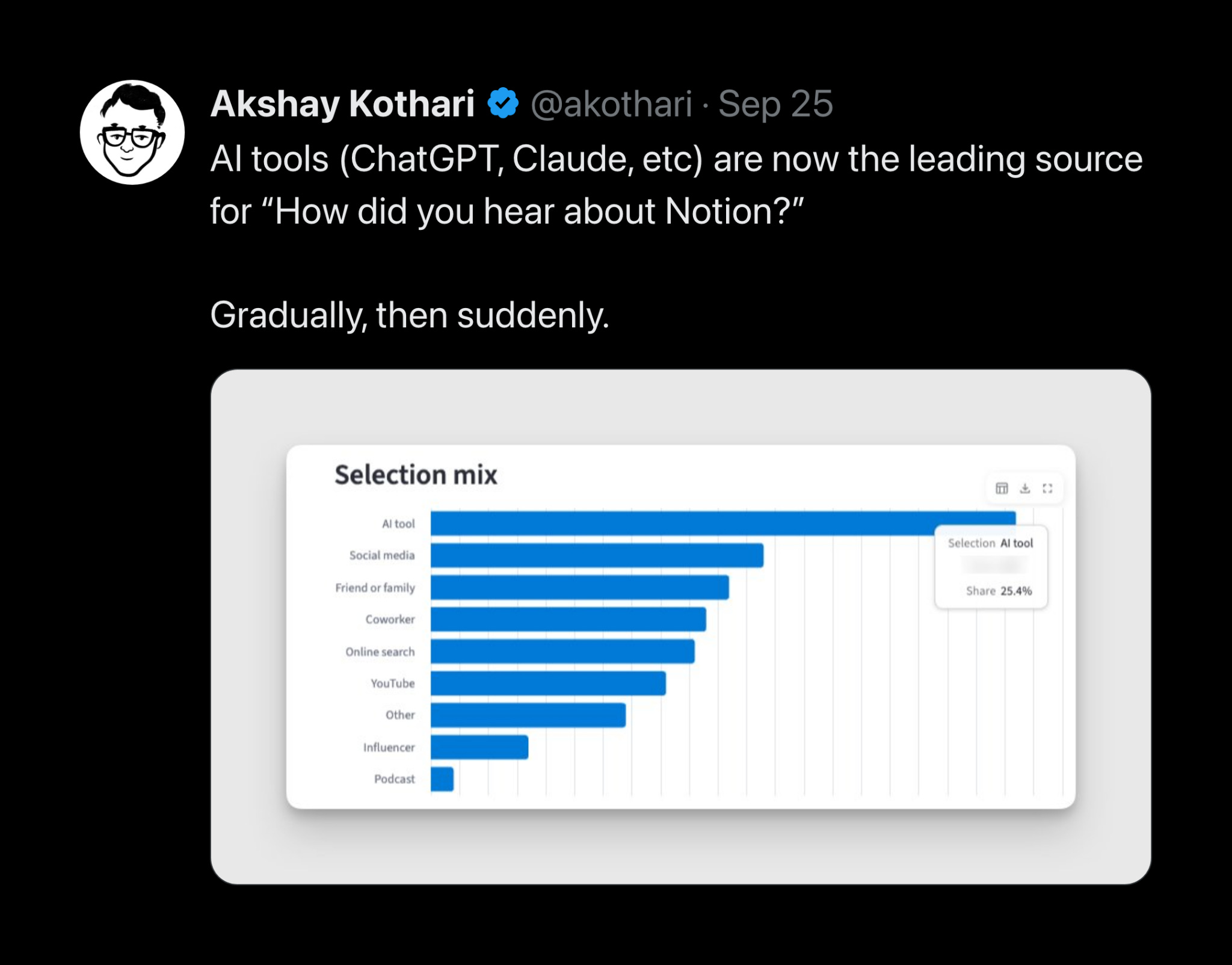
Notion isn’t alone in this either. The number of monthly activated users attributed to AI discovery at Granola rose 4,600% from January 2026 this year and at Vercel, the share of signups referred by ChatGPT grew 10x.
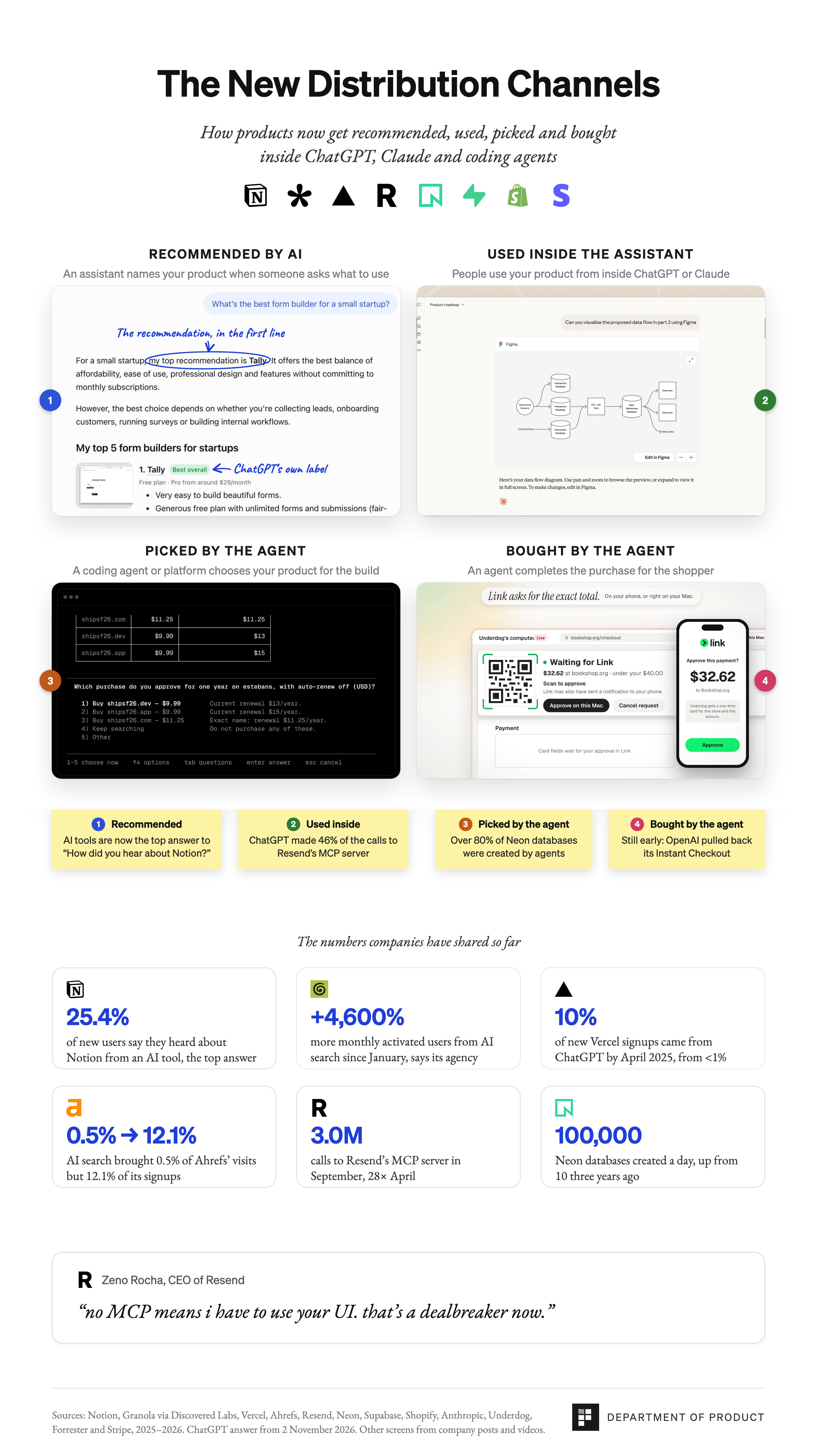
ChatGPT is only one of the new discovery channels that product teams and marketers need to be aware of, though. Assistants can now use products directly through MCP, coding agents can create accounts and they’re also starting to make purchases themselves. And new discovery platforms are emerging too; just this past week, Google unveiled a new Connected Apps platform which lets teams bring their apps into Gemini and Search from one console.
These new capabilities have a direct impact on how users / agents actually discover your product. And as we saw in the Briefing this week, for companies like Reddit, whose CEO reported a significant drop in clicks in Google’s AI Mode, it’s an incredibly volatile area that can have a significant impact on your product’s strategy.
In this Deep Dive, we’ll take a look at the new emerging distribution and discovery channels that AI has opened up, what the companies doing well in each one did, the numbers behind them and what you can do in your own product to make the most out of these new channels.
Coming up:
The 4 new product distribution channels explored in more detail
Real world examples of how these new channels are playing out in the real world at companies including Notion, Expedia, Linear, Google, Shopify, Stripe and more
Why one CEO says “Agent-market fit” is the next key to unlocking growth and what to do about it
The full 20+ examples in a downloadable format

The new product distribution channels in a snapshot
Here’s a snapshot of the new emerging distribution channels for products. These include getting mentioned / recommended in AI channels, getting used inside an Assistant / agent as a plugin, being picked by agents and being bought by agents.
How this analysis is structured
There are over 20 different downloadable examples you can use across each of the different discovery channels and the analysis is structured to give you a summary of how each one worked in the real world.
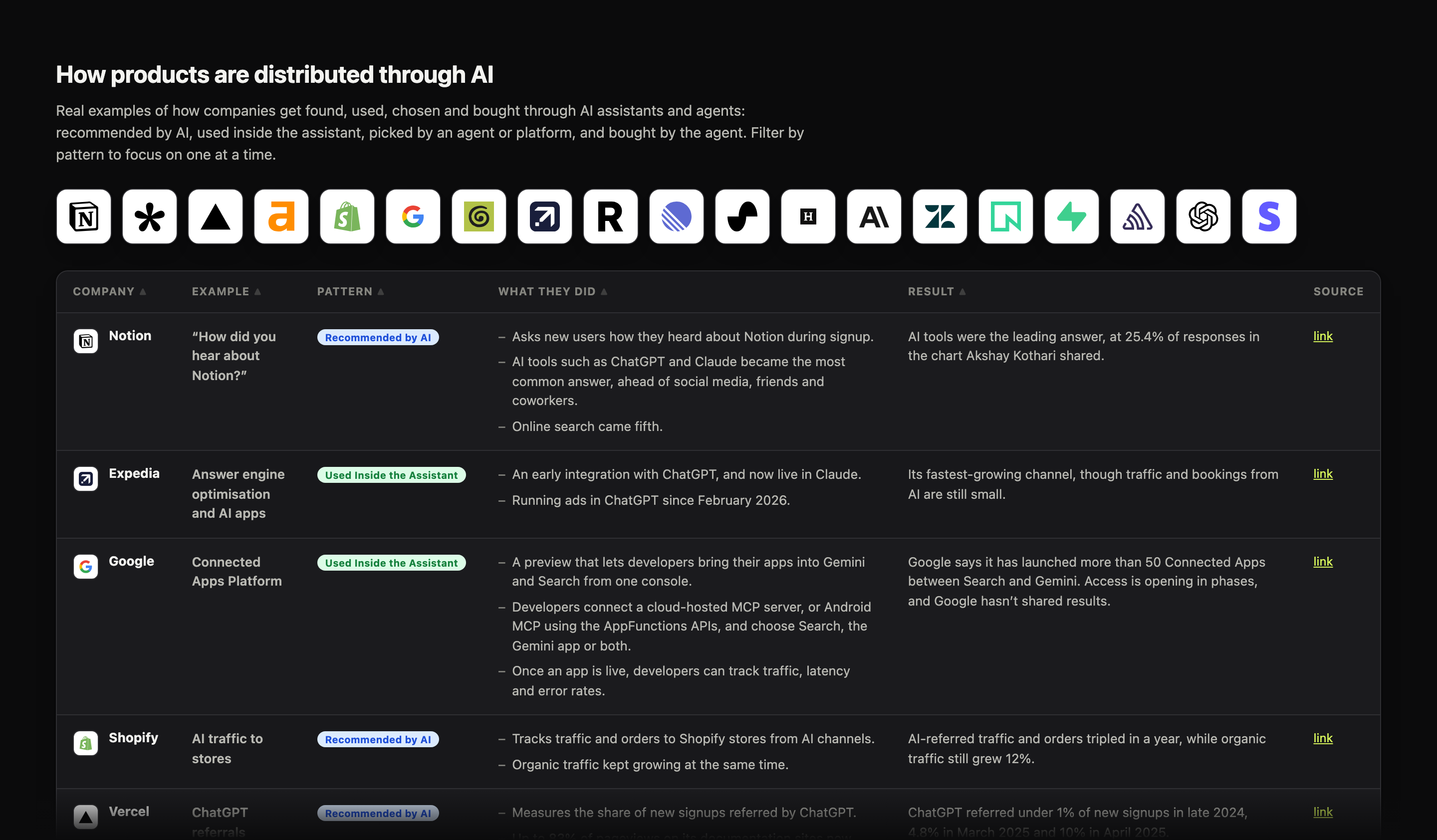
For each distribution case study you get:
Example - an example of this new distribution channel in action e.g. Notion’s survey asks the question “how did you hear about us” is classed as “recommended by AI”
Channel pattern - the pattern for this particular distribution channel; this includes things like getting recommended by AI and getting used inside the assistant. For example, Google just released a new Connected Apps platform that works as a discovery channel for products.
What they did - a description of how the channel worked in more detail.
Result - the outcome the company reported, using its own numbers where it has shared them.
Source - a link to the original source, so you can learn more.
A closer look at each of the channels in more detail
Now let’s take a closer look at each of these different channels in more detail, with real world examples and playbooks you can use for your own efforts.