
Hi product people 👋,
This week, OpenAI finally revealed what it’s been cooking up with its latest model, Astra. We’ll take a closer look at some of the things worth knowing about for product teams.
Plus, Superhuman launched a radically redesigned version of its mobile app that has proven to be pretty divisive, 1Password shipped a new unified login feature that can transform how users log into products, and Stripe’s PM reveals how agent fleets are shipping products faster than it previously took to schedule the meeting to plan them.
This is your Product Briefing. Have a great week ahead!
Rich
Key reads and resources for product teams
New from the Department of Product Substack this week:
AI Agents in Practice - 50+ examples from the world’s leading companies
DoorDash’s coding agent now handles 130,000 engineering tasks a month. Starlink’s voice agent takes 15,000 calls a day. And Amplitude just watched its own AI agent push product activation rates from 6% to 9%, with zero human steering. In this Deep Dive, explore 50+ real examples of internal AI agents at companies like Square, Cursor, Replit, Gusto and Figma, complete with downloadable examples you can use yourself. (Department of Product)
How Vercel implemented DESIGNmd into its own design workflows
John Phamous, Design Engineer at Vercel, walks through how the team built their own DESIGNmd, a single public file that teaches any agent to design like Vercel, cutting known layout failures by 57% in testing.
How Sonos rebooted itself after its disastrous app launch
Sonos CEO Tom Conrad has a blunt answer when asked if customers have forgiven the company for its disastrous 2024 app redesign: “in every measurable way, it’s behind us, but it’s a never-forget kind of chapter”. (Decoder)
The art of Perfect Launch: How Reddit manages Mobile Releases
A Reddit engineer pulls back the curtain on Reddit’s mobile release engine, from the Wednesday branch cut to the Monday go/no-go call, plus the late merge rules, hotfix triggers, and blameless post-mortems that keep it all from falling apart.
How Coinbase used Code Connect to guide agents and shrink token costs
Coinbase’s design system team had a problem where agents kept hallucinating icon names and building components from scratch instead of using existing ones. Figma’s Jenny Xie breaks down exactly how Coinbase modernized hundreds of component mappings and what the evaluation revealed about agents, tokens, and context. (Figma)
New product features and innovation this week
The biggest update from this week is, of course, OpenAI’s latest model, Astra. It’s easy to get caught up in the hype of model updates and so here’s a sober view of some of the parts of the model that matter to product builders.
According to OpenAI’s benchmarks, the new model performs exceptionally well at Computer Use and is self-described as “the world’s best computer use model”. The numbers back it up. On OSWorld 2.0, OpenAI reports 72.6% accuracy at roughly 40 minutes per task, versus 65.7% at 75 minutes for GPT-5.6 Sol.
Here’s a demo of it in action competing in the Financial Modeling World Cup challenge using computer use capabilities:
You can also use Astra to build better presentations that are grounded in tailored components rather than generic AI slop. OpenAI says its their best model yet for adhering to existing templates and producing slides that follow and match your visual style.
You give it a reference file and Astra outputs decks based on those files:
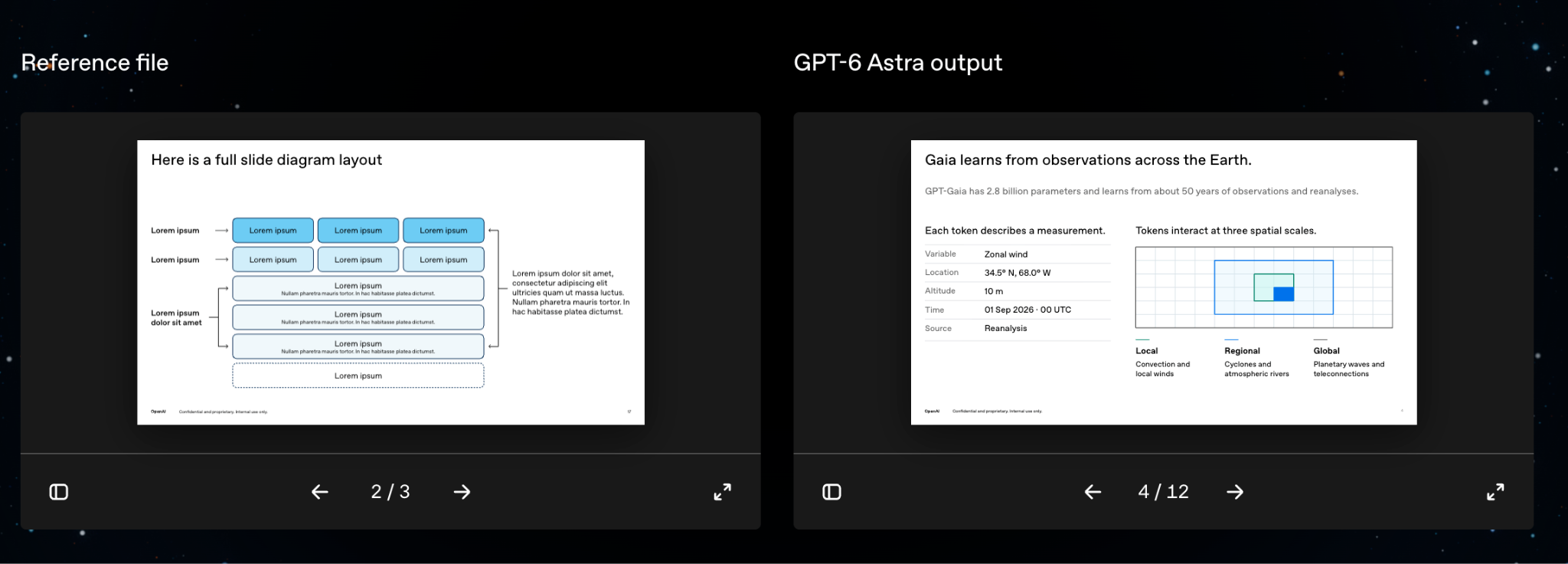
OpenAI says it is now 1.9x faster at task completion than 5.6 Sol, meaning users can delegate Astra tasks that you’d rather not do. OpenAI gives the examples of apartment hunting, childcare analysis and Visa form applications as examples of the kinds of tasks you can give it.
For product teams, these new capabilities could potentially lead to new user-facing features, too. More on how you can use computer use models in feature development here.
Other examples of Astra in use
It’s still early days but to get a sense of what people a doing with the model so far, here’s a sample of some interesting use cases:
Shopify’s designer shared an example of it generating UI components, saying it’s “really good” at it
Codex developer Tomas Ricuard shared this example of it building 3D models of a home
Greg Isenberg shared 9 prompts worth trying in Astra
MagicPaths’ CEO Pietro Schirano shared this example of it to 3D render hardware designs
Google has launched Gemini Live voice features across Gmail, Docs, and Keep. Powered by Google’s Gemini 3.5 Live model, this adds the ability to have conversations with Gemini across your emails and documents. The demo is pretty impressive with Google’s voice models clearly capable of handling conversations well, but putting these new abilities aside, the search functionality inside Google’s core Gmail product is becoming increasingly difficult to use as their product teams dump more and more features into their core navigation. I hope after this initial blitz of adding AI everywhere, they’re able to take a step back and assess the overall UX on some of their core products which seem to have suffered at the altar of AI feature worship in recent times.
Amplitude has launched Agent Analytics - a new feature which scores every production agent session on task completion, response quality, friction, safety, and negative feedback out of the box. It comes with eval agents that can autonomously file Linear tickets or PRs when they detect regressions.
Superhuman released a completely redesigned Mail app, consolidating the Mail brand under the Superhuman umbrella and emphasizing speed. The redesign introduces some interesting interactions, including the ability to search by pulling anywhere in your inbox but also removes some of the interactions that Superhuman says were difficult to discover. Some users like the redesign but the changes have alienated power users who are not happy:

Replit’s mobile app, on the other hand, has gone down well, with users praising its new swipe interactions.
1Password has shipped a new universal sign in interface that makes every sign in page use the same UI if the user has the browser extension installed. The system adapts to a user’s preferred sign-in method on each site over time, so it can prioritize what you actually use rather than showing every option every time. It can also now identify login fields and submit buttons more reliably, which lets it auto-fill and auto-submit even multi-step login flows (email step, then password step, then 2FA step) rather than just filling one field and stopping.
Given 1Password’s popularity, for product teams it’s worth being aware of this new change as it could transform how users log into your product:

Perspectives from some of the world’s top product leaders

Cristina Cordova, COO, Linear - made an observation that leading AI-forward companies are moving away from buying off-the-shelf agents and instead building proprietary ones trained on internal codebases and conventions, citing Ramp’s “Inspect” agent as an example, positioning Linear as the infrastructure layer any custom agent plugs into.
Boris Cherny, Claude Code lead, Anthropic - argues that background computer use where Claude operates a user’s machine autonomously via Claude Cowork and Claude Code, is an underappreciated capability that isn’t getting enough product attention.
Greg Brockman, OpenAI’s President and Co-Founder, outlined his vision for where Astra will have the greatest impact beyond its benchmark-leading capabilities. He highlighted entrepreneurship, scientific discovery, and enabling small teams to tackle large problems as areas where the model’s capabilities are most transformative.
Jeff Weinstein, Senior PM at Stripe, says small teams with “agent fleets” are now shipping new products in the time it used to take just to schedule a kickoff meeting, a pattern he’s observing across startups and some larger-company teams. He also flags that consumer-facing agents are hitting functional maturity (citing an agent that remembered a restaurant booking, modified it, and confirmed the change without human help) but argues most businesses aren’t operationally ready for agent-driven transactions at scale.
Anton Osika, CEO, Lovable, argues that the era of AI model selection is coming to an end. He says Lovable’s platform will move toward automatic model routing based on 1B+ prompts of learning data, rather than requiring users to pick models. The feature learns which models, tools, and instructions work best for each task and handles retries and replanning automatically.
📈 Product data
OpenAI’s ad business hit a $1B annualized run rate roughly 200 days after launch and is now live in 40+ countries.
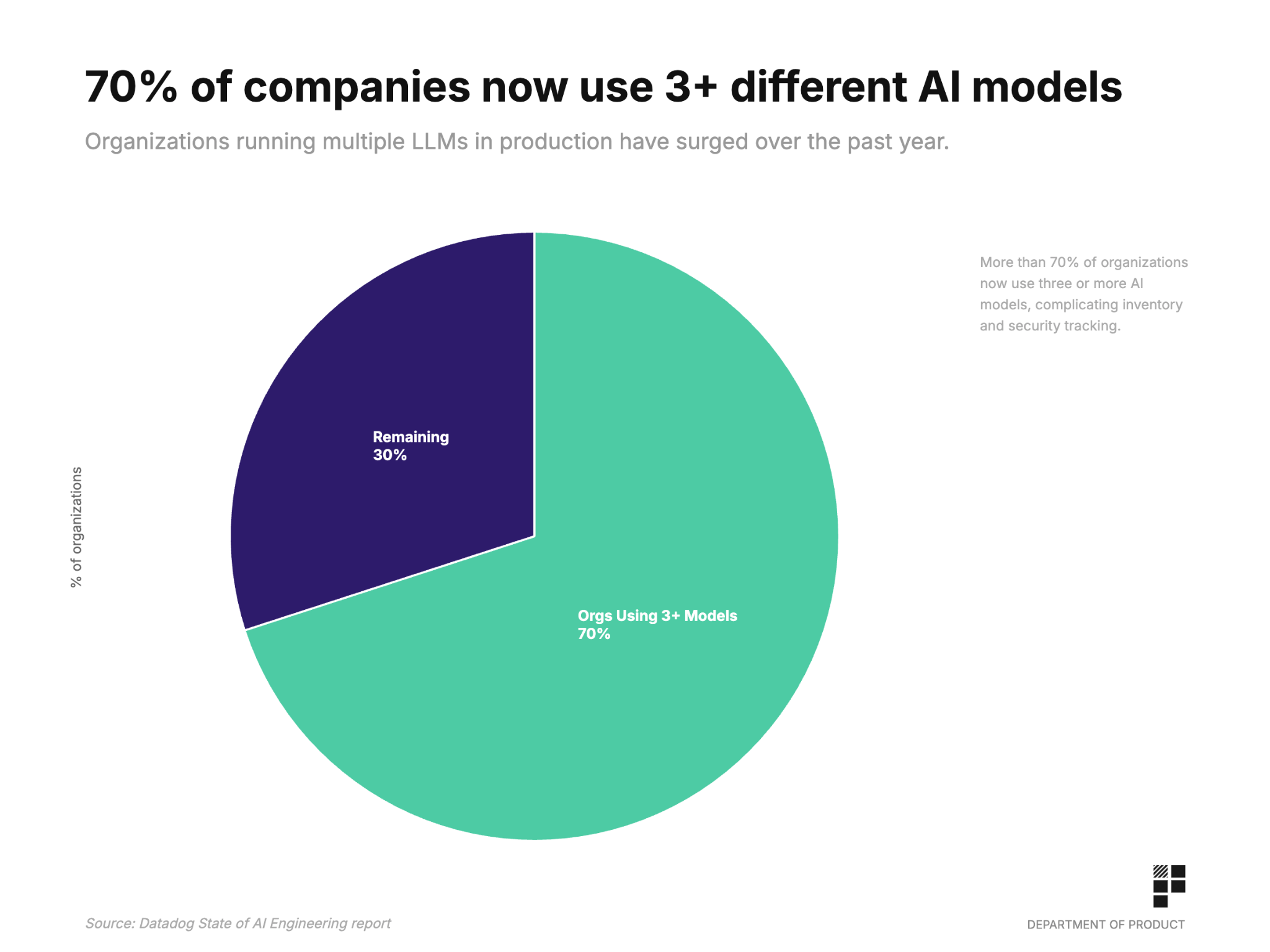
Datadog says 70%+ of organizations now run three or more LLM models concurrently, and the share running six or more nearly doubled year over year. Multi-model deployment is now the operating assumption, not the edge case.
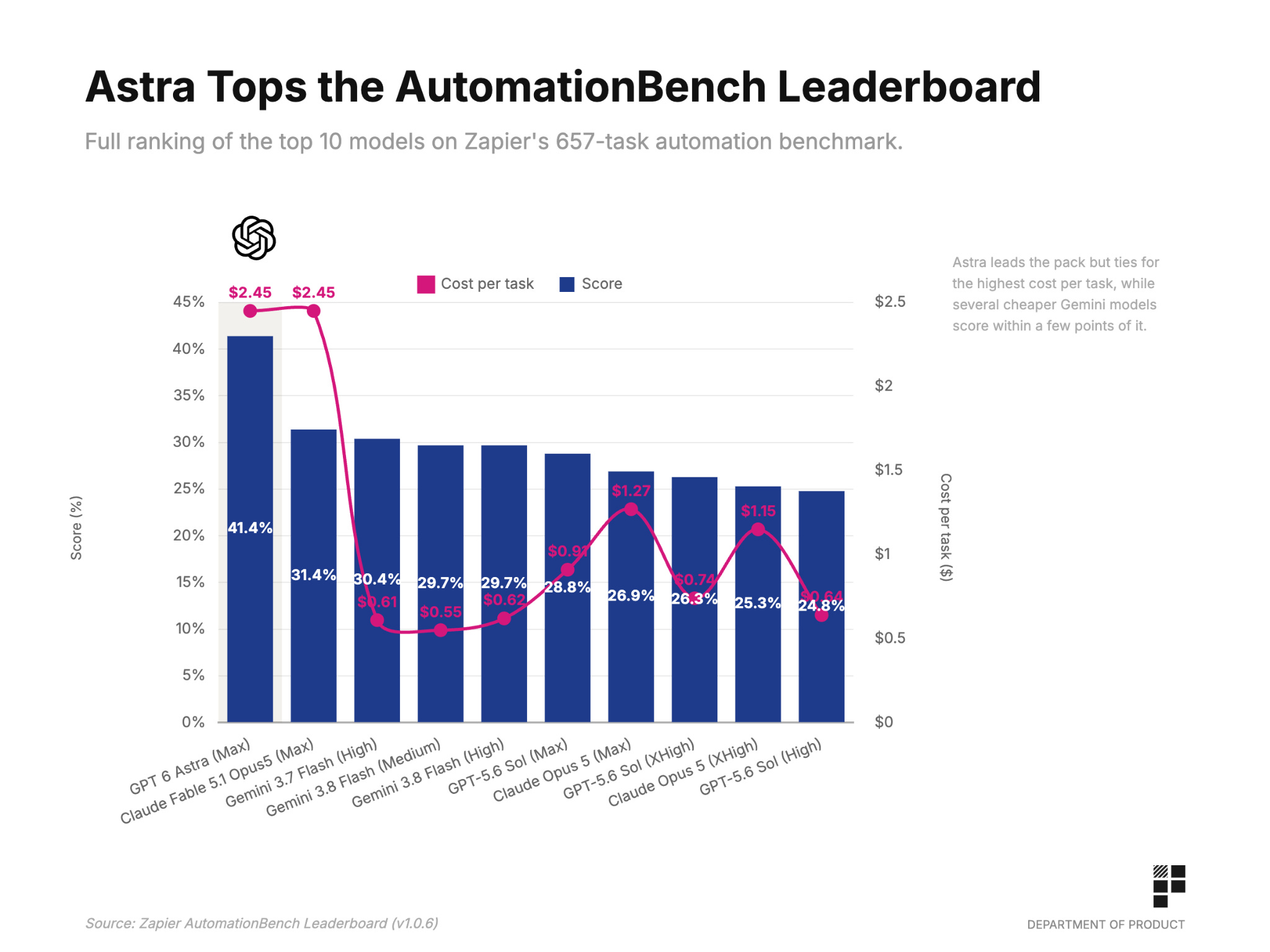
GPT-6 Astra scored 41.4% on Zapier’s AutomationBench, the first model to clear the 40% threshold, versus a prior high of 28.8% from GPT-5.6-Sol. AutomationBench scores AI agents on end-to-end completion of realistic, cross-application business workflows (Sales, Marketing, Operations, Support, Finance, HR) where the agent has to discover the right REST API endpoints itself, follow policy documents, and avoid potential distractors.
Stripe’s Tempo stablecoin product crossed $1 billion in 30-day transfer volume.
Salesforce says Agentforce + Data 360 combined ARR hit $3.9B in a single quarter, with MCP call volume up 6x and customer attrition near an all-time low during the transition. This suggests agentic products are consolidating into a single unit of customer value rather than cannibalizing existing revenue.
Uber is cutting 3,300 jobs, around 10% of its global headcount, including a 20% cut to manager roles and restricting remote work to under 1% of staff.
Google’s agentic video understanding for Gemini cuts token consumption up to 88% and cost up to 66% on video analysis while improving accuracy up to 7%, particularly on long-form content.
🔮 Emerging trends to be aware of
1/ Shadow AI usage is continuing to grow
81% of mid-market leaders (500-4,999 employees) report shadow AI use inside their companies despite official governance policies.
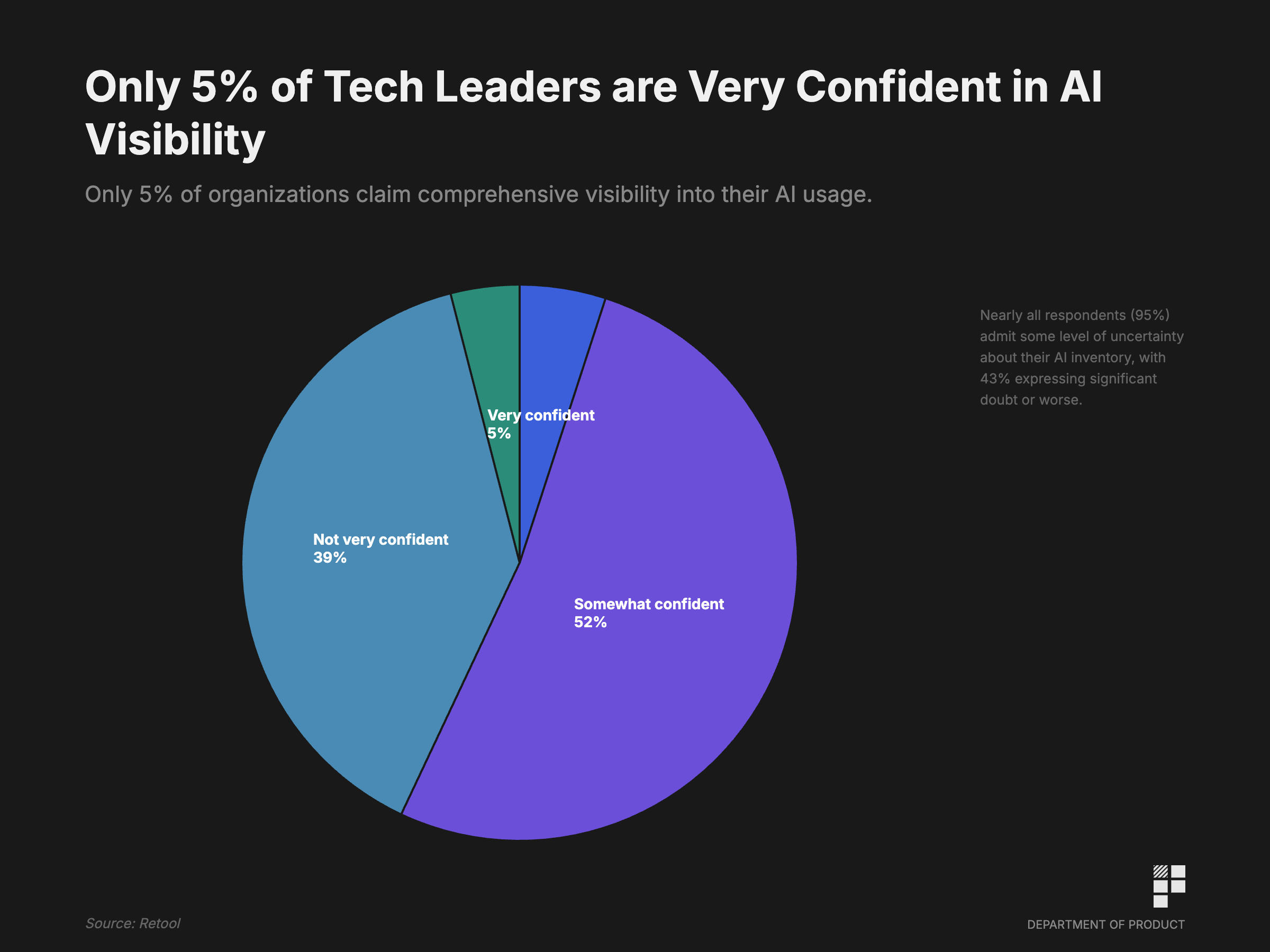
Retool’s survey of 307 CTOs, CIOs, and CISOs found only 5% were very confident they had full visibility into AI-generated tools running in production, and that ten agents alone create 45 possible connections before external databases and APIs are even counted.
2/ Model-provider allegiance is becoming a strategic liability
After its takeover by SpaceX, OpenAI has formally confirmed that it plans to end support for its models in Cursor. Replit’s CEO used the moment to pitch itself as the “independent, multi-model alternative,” even offering to fund customer transitions.
For product teams and leaders, the termination is an insight into the pitfalls of relying on a single vendor, which makes it hardly surprising that the data shows that companies are increasingly relying on more than 3 models to power their AI efforts.
Legal tech startup Harvey’s co-founder shared a practical version of de-risking allegiance where rather than betting on one frontier lab, Harvey composes inference providers, neolabs, and eval infrastructure from multiple specialized vendors so no single provider can become a point of failure.
3/ Physical-world robotics for infrastructure operations is moving from pilot to deployment
Meta is testing robots designed for cable-swapping and server resets in data centers, with one estimate suggesting a working cable-swap robot could replace up to 80% of some workers’ current tasks. This sits alongside Uber’s London robotaxi launch with Wayve and Zoox’s airport expansion in Las Vegas, suggesting physical automation is no longer confined to warehouses and roads, it is reaching into the data centers that power AI itself.

The Briefing is your curated report on what happened in tech and AI this week - hand crafted for product teams. Paid subscribers get the full DoP Substack including: The Knowledge Series for hands-on AI tutorials and DoP Deep dive reports for in-depth analysis to learn lessons from the world’s top tech companies.
Greg Brockman will end up destroying us all so not really interested in what he has to say.