
Hi product people 👋,
This week, Reddit’s CEO warned that Google’s AI Mode “does not drive traffic” - and he’s changing the company’s product strategy accordingly.
Plus, how non-engineers shipped 7,000 pull requests at Ramp, a Skill you can use to de-slop your Claude designs and a new startup that attempts to transform how we interact with computers by allowing us to talk to them without actually speaking.
This is your Product Briefing. Have a great Sunday!
Rich
Watch on YouTube | Follow on Substack Notes
Key reads and resources for product teams
New from Department of Product Substack this week:
Live Voice Blueprints - 5 features you can build with GPT-Live, Gemini Live and more
What live voice and vision models are, what they make possible, and five features you could build with them, inspired by real demos from OpenAI, Google, Yelp, Twilio, HeyGen, Block and more. (Department of Product)
Claude Unslop - a free skill to make your designs look less like AI slop
This is a free skill that audits an AI-looking design, proposes a direction, then fixes it pass by pass. It’s gained over 4,000 GitHub stars in just a few days. (Skill)
How Figma is training its own model to edit designs
Figma’s Josh Clemm explains why the company started post-training when frontier models couldn’t understand Figma’s syntax, and how an early model trained on more than 250,000 examples competed with the top models of the time. (Figma)
Stripe’s CEO shares how he collects feedback for his vibe coded apps
He built a new freeform text input that has already implemented over 150 improvements over the course of a few days. Is this the future of how users shape their own UX? (X)
Atlassian’s Context Quality Score Explained
Atlassian has built a framework for measuring and improving the context AI systems receive. Helpful if you need a measurable way to explain why an AI feature underperforms. (Atlassian)
Ramp says non-engineers authored 7,000 pull requests last quarter
More non-engineers than ever are shipping code, with Ramp’s CEO saying that non-engineers shipped over 7,000 PRs last quarter. What does this mean for the future of product development?
Reddit is closing its open doors and says AI mode does not drive traffic
Reddit’s stock fell a massive 29% on Friday which is its single worst day since its IPO, after it missed revenue targets. Their CEO explained that one major cause of this underperformance was Google traffic declining “meaningfully” saying that “AI Mode does not drive traffic. Not for us, and not to anybody as far as I know.”
As a result, the company is shifting its product strategy and will work on making Reddit itself a destination, rather than a result in search / AI engines. The company is making two decisions to drive this forward. The first is the creation of an algorithmic For You page and the second is to force users to log in to view content.
Right now, 59% of its daily active users aren’t logged in and in the coming months, Reddit will require users to log in to view content:
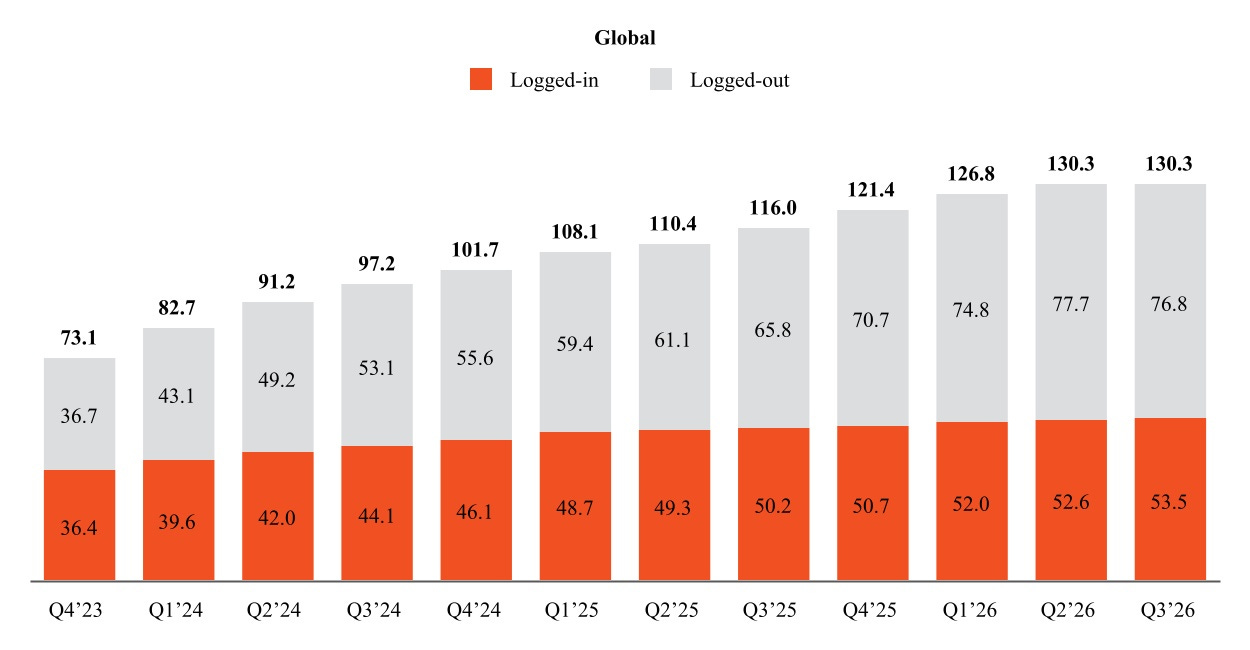
A logged in user is more valuable to advertisers than a logged out one with logged in users representing 80% of monetized users, and with AI Mode traffic declining, Reddit is looking for ways to increase revenue per user. It also acts as a barrier of protection for its rich corpus of user generated data which it licenses to AI companies.
For product teams, Reddit’s warning about the lack of clicks from AI Mode is a further signal that teams now needs to diversify away from traditional SEO for organic growth and potentially focus on the network effects of their own product - as well as other distribution channels that are starting to emerge inside AI Assistants.
Product innovation - is this the future of UX?
This week, a new startup called Subvocal raised $1.3 million for a new type of glasses that let you talk to your computer without actually making a sound. The company says they track your speech muscles without touching your skin and turn that into text at more than 200 words a minute. It’s been backed by Y Combinator and pre-orders for the device are open now. Here’s a demo of it in action:
It’s clearly (very) early days for the company, but whether or not it succeeds, it makes sense to at least try to build a device like this, given how awkward using your voice can be, especially at work.
More launches worth knowing about
Stripe’s Link balance lets an agent spend on your behalf within a limit you set. You choose how much to add and the agent handles purchases such as concert tickets or a whole shopping list.
Google has announced Gemini 4 Carbon, which ranks first on the Artificial Analysis Intelligence Index at 59. It will launch at $2 per million input tokens and $10 output, and this week it’s going to a subset of cyber defenders while Google works on guardrails. Zapier’s Wade Foster says it scored 53.9% on AutomationBench, and Perplexity says it set a new high on the WANDR research benchmark.
Google has also opened its Connected Apps Platform to US developers in public preview, so apps can plug into Gemini and Search.
New features you can use at work
Granola has launched a new dictation feature across all apps on Mac. Users can press the function key and it cleans up the text and lets you use it as an input.
Cursor’s design mode now has Annotate, which lets you give agents visual prompts. You can edit elements, draw on the page and review designs at different screen sizes, When you’re finished, you can send it all to the agent:
Figma’s agent can now connect to Google Drive on all plans. So for example, it can pull in Docs, Sheets and Slides files so you could summarise user research notes or bring a PRD directly into a design session.
Google’s Gemini can generate, preview and edit files inside the chat. Once you’re done editing, you can export as a PDF or Google Doc.
Notion’s AI Meeting Notes Chrome extension now labels every speaker in a Google Meet call. Previously it labelled it as “you and everyone else” so this could come in handy for things like user research sessions where it’s not always clear who is speaking.
Anthropic has launched reporting tools which allow managers to see what a team produced, what it cost and where workflows broke down. This could be useful if you’re currently being asked to demonstrate ROI on your AI spend.
📈 Product data
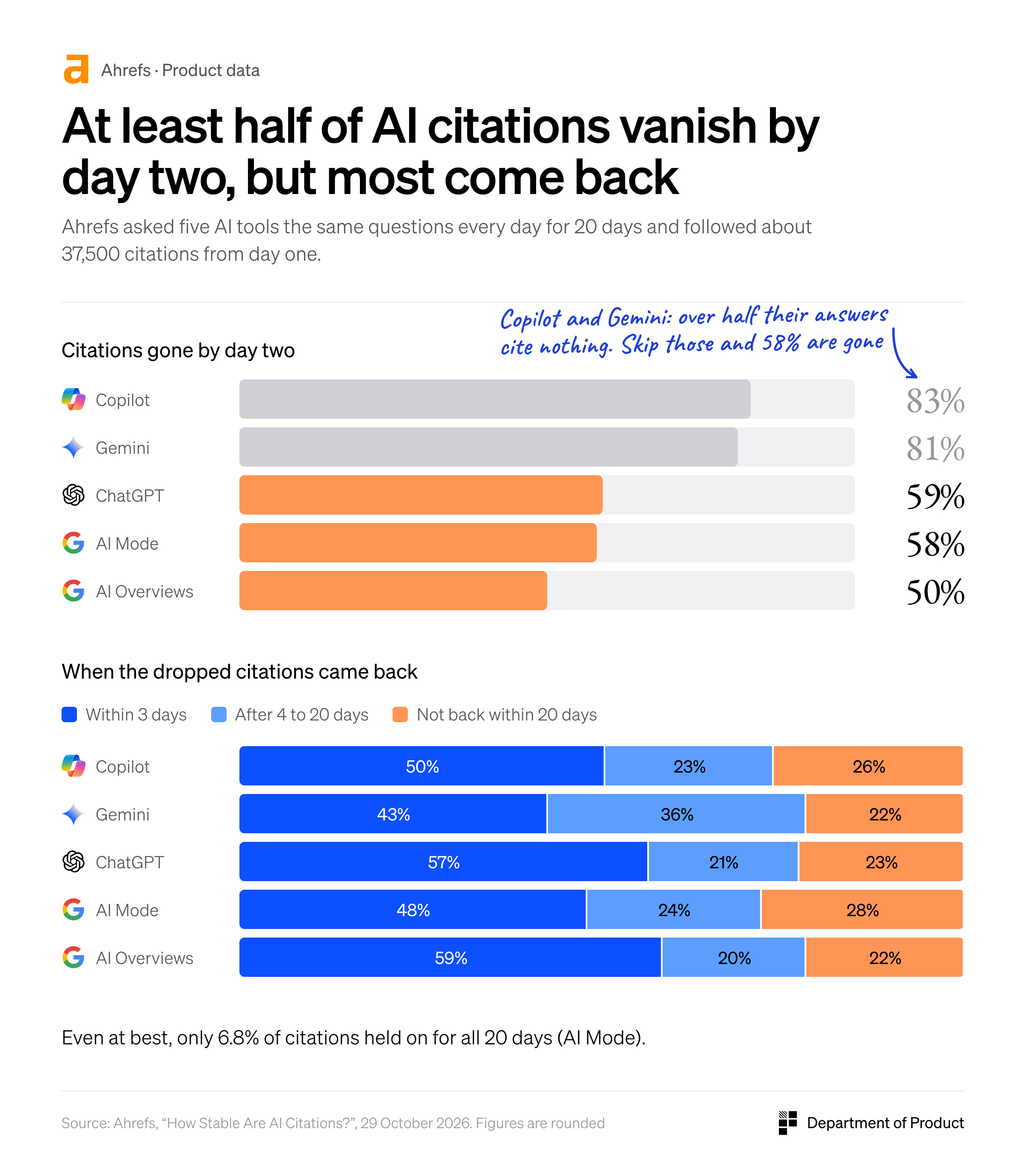
AI search visibility is extremely volatile. Ahrefs followed about 37,500 AI citations for 20 days and found at least half were gone by day two, from 50% on AI Overviews to 83% on Copilot. About 75% of the ones that dropped came back, so if you want to know how your product is performing on AI search, it’s something that needs to be monitored continuously:
Glean’s Work AI Index shows 75% of workers report productivity gains, but only 13% see significant value for their organisation.
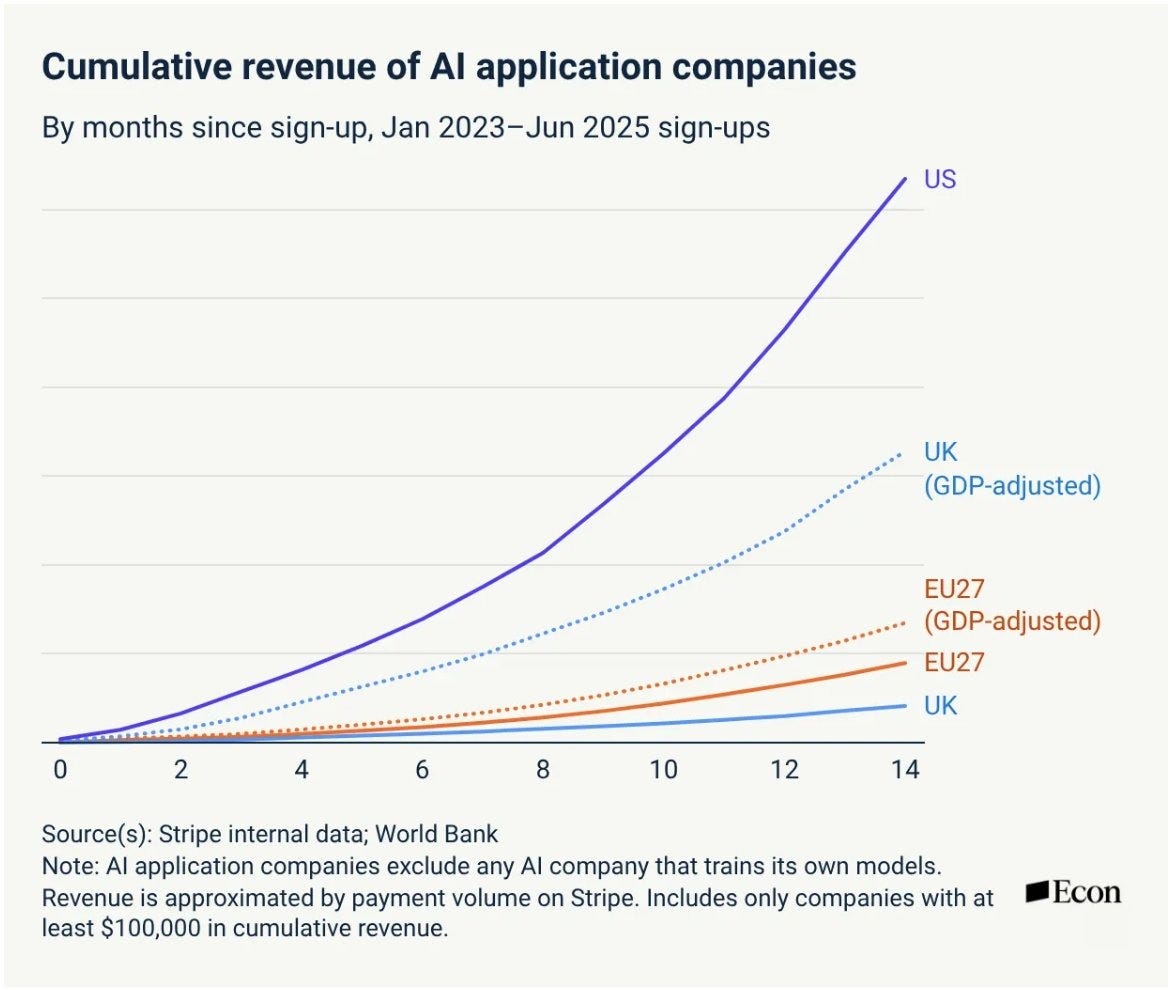
US AI application companies on Stripe have made roughly 7x the revenue of EU peers and 15x that of UK ones, Stripe’s Eileen O’Mara says. After adjusting for economy size, that falls to 5x and 2x, which is a slightly kinder story for Europe, but the gap is still pretty telling:
PostHog says 11% of its merged pull requests in October were “self-driving”, opened by its own product after a scheduled agent found something worth acting on.
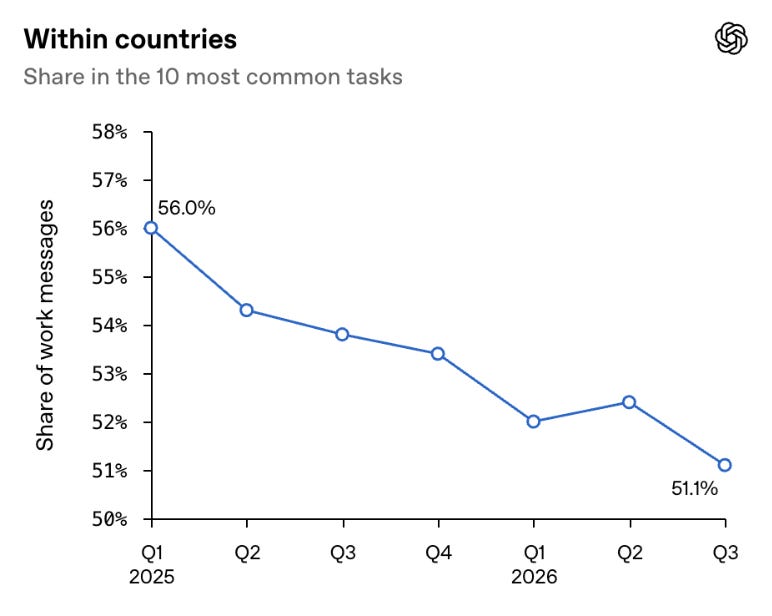
OpenAI says its latest data shows the top 10 work activities fell from 56% of messages in Q1 2025 to 51.1% by Q3 2026, meaning that usage at work is spreading across more types of activities:
🔮 Emerging trends
A selection of emerging trends, powered by analysis of over 20,000 signals in Product Intelligence.
1/ The rules for how AI reads the web are being rewritten
Anthropic has confirmed it is adopting a new way for publishers to opt out of web scraping. OpenAI has confirmed it too will honour it in the coming months and Google and Microsoft also plan to support it next year.
2/ Internal tools are turning into products
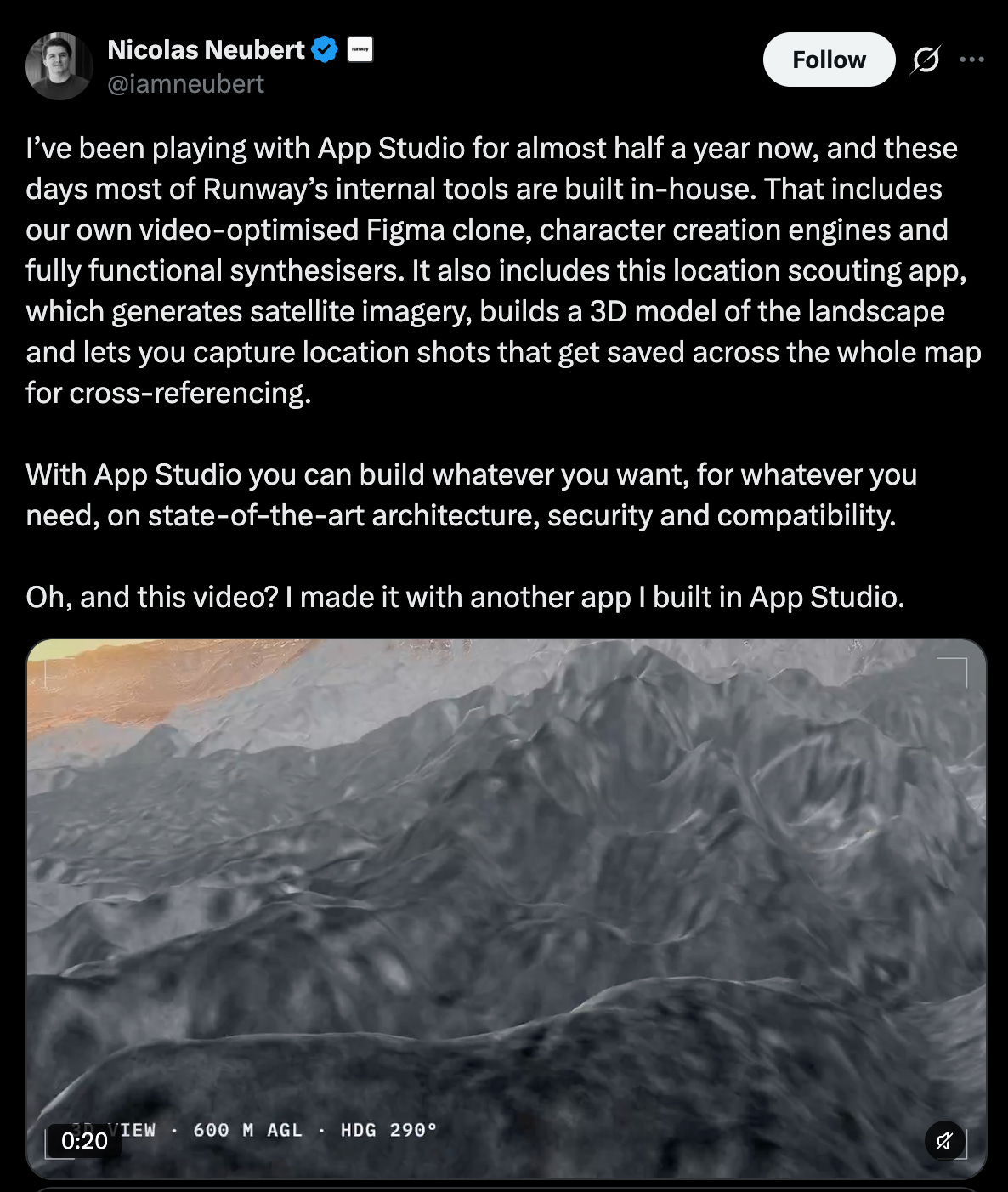
More companies are productizing their internal tools. Runway confirmed that its new App Studio started as something it built for its own teams and that the company now makes most of its internal tools in -house:
Ramp is now taking sign ups for its own internal tool, Inspect and Replit has launched Cloud Agents, saying its own design team used Replit to ship over 250k lines of code in six months
3/ Coding tasks are disappearing from the interview process - which might be good news for juniors
Anthropic’s Felix Rieseberg has dropped the coding interview from his hiring process. He says a small React challenge now tells him about as much as a quiz on assembly, because Claude is better at both.
He now looks for prototypes that show “taste, empathy, and principled thinking”. Earlier this month, Business Insider reported that Google’s pilot of AI-assisted interviews has spread more widely across the company, and HeyGen said in September that it has a dedicated round where candidates work with agents, even for nontechnical roles.
Rieseberg’s more hopeful take for junior engineers is they’re less bounded by years of framework knowledge, and he’s watching newer engineers fly past better developers who’ve been around much longer. “Hunger beats tenure”, he says.

The Briefing is your curated report on what happened in tech and AI this week - hand crafted for product teams. Paid subscribers get the full DoP Substack including: The Knowledge Series for hands-on AI tutorials and DoP Deep dive reports for in-depth analysis to learn lessons from the world’s top tech companies.