
The New Product Development Operating Model
How the product development processes we took for granted are being disrupted. Examples from Spotify, Linear, Claude Code and more.
🔒DoP Deep goes deeper into the concepts and ideas that are covered in the Weekly Briefing to help you learn lessons from the experiences of top tech companies. If you’d like to upgrade to receive these in-depth pieces of analysis you can upgrade below. New reports are added every month.
For the past decade or so, the rhythm of product development was pretty much settled into something like this: gather requirements, generate ideas, prioritise them, ship them, measure them, and iterate.
But in recent weeks, this model has quickly started to fracture.
Companies like Linear have declared that “Issues are dead”, Spotify’s CEO recently said that its best engineers “haven’t written a line of code in months”, and just last week Claude Code’s Head of Product published a set of principles outlining how the product development process has fundamentally changed at Anthropic, saying that PMs are encouraged to take on “side quests” and build prototypes because wrong bets are cheap.
Given the pace of change, it’s difficult enough to keep on top of what companies are doing, let alone implement these changes into your own product development processes.
But in this Deep Dive we’re going to try and make sense of it all by exploring some of these new emerging rhythms of product development, using recent examples from companies like Linear, Spotify, Zapier, Coinbase, Claude Code and others.
We’ll explore what each of these companies is doing and then identify recurring themes to try to build a new model of what modern product development looks like in April 2026.
Coming up:
The six emerging new product development themes explored in more detail
Downloadable case studies across each of the leading companies including Figma, Google, Stripe, Anthropic, Notion, Meta and more to understand how their product development process is changing
Making sense of it all with a blueprint you can use to introduce these new themes and development principles into your own product development workflows

The Six Emerging Themes in the Product Development Process
This Deep Dive takes recent examples of new emerging product development processes from leading companies and buckets them into six core themes.
Here’s a preview of some of the themes in the product development process that we’ll cover during this Deep Dive:
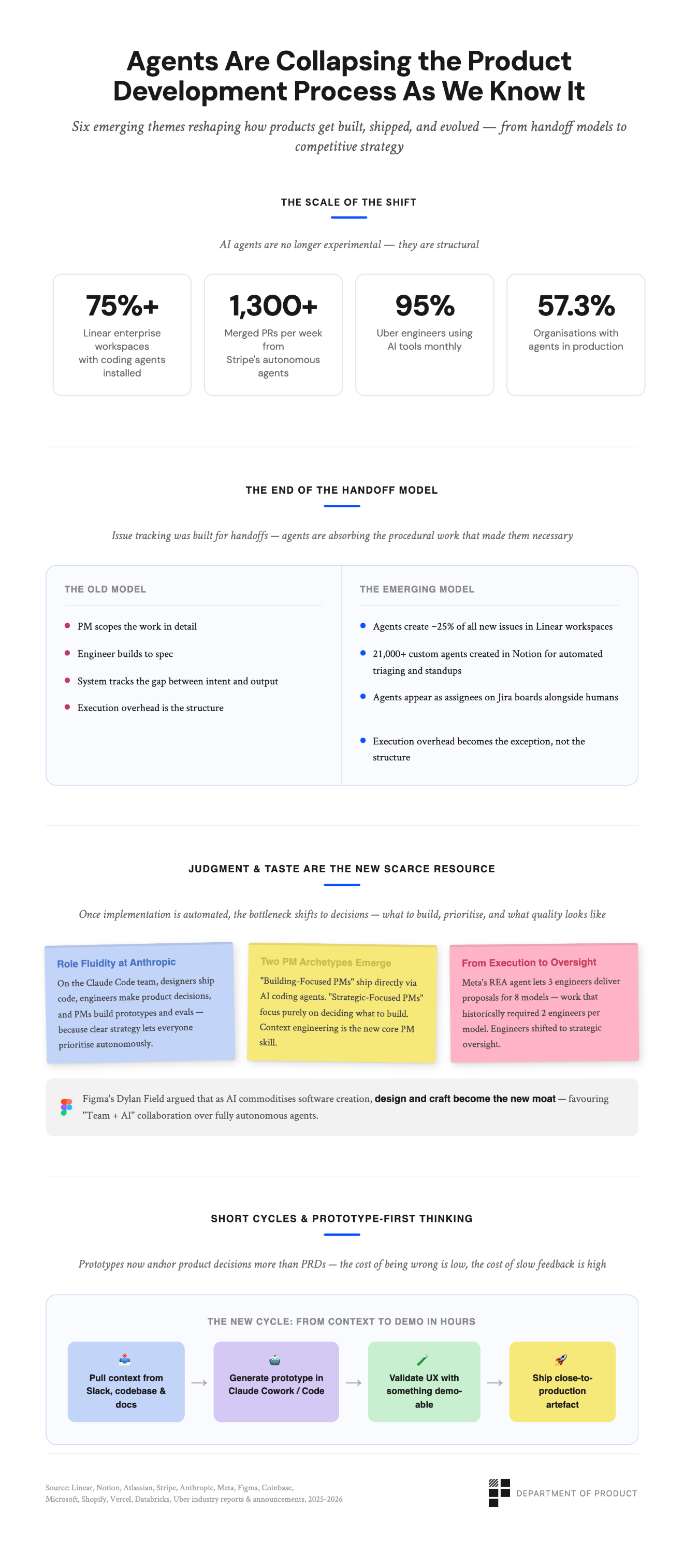
As well as thematic analysis, you’ll get access to 25+ real world case studies and examples with more information from companies like Linear, Uber, Spotify, Coinbase, Stripe and others - as well as a practical blueprint to help shape your company’s own efforts.
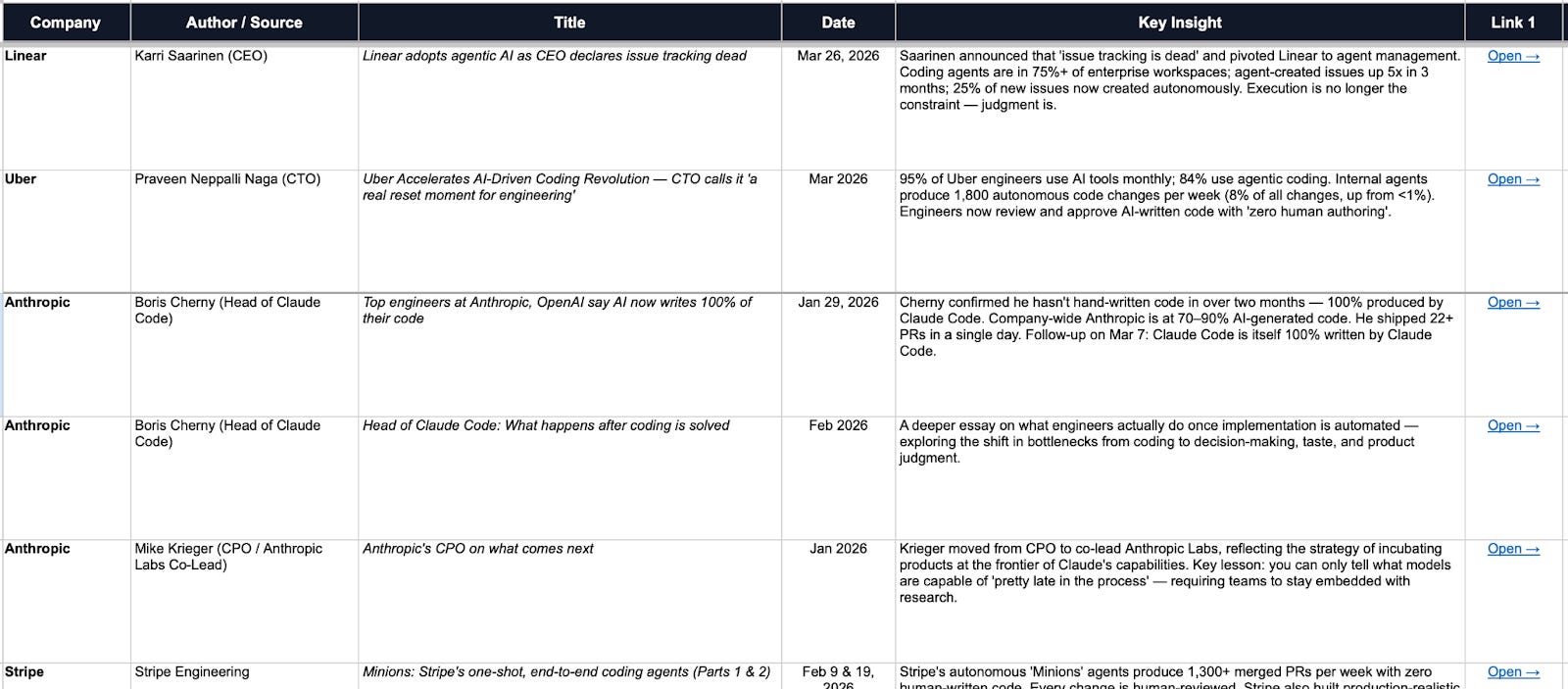
We’ll kick off with the first of our themes that emerges from some of the recent announcements from top companies: the beginning of the end of the handoff model.
1. The beginning of the end of the hand-off model
The traditional handoff model was a sequential, role-based approach to software development where work moved in stages from one function to the next.
The PM scopes and shapes the work along with designers, informed by user research to ensure you’re building the right thing and a few weeks later, engineers would pick up the work, build the feature and ship it. This workflow was built around the central idea that engineering time was precious and engineering resources were scarce. And it was built on the assumption that broadly speaking, the technological constraints at the start of development spring were broadly the same by the end of a sprint.
What’s replacing this model
As you’ll see from some of the examples we’ll look at shortly, there are two major forces converging right now that mean this model is being disrupted.