
🔒 DoP Deep goes deeper into the concepts and ideas that are covered in the Weekly Briefing to help you learn lessons from the experiences of top tech companies. If you’d like to upgrade to receive these in-depth pieces of analysis you can upgrade below. New reports are added every month.
It’s been seven months since we last looked at WebMCP Explained for Product Teams, and at that point, Chrome had only just published its first guidance - and most product teams hadn’t used it.
Since then, we’ve started to see some real world use cases emerge.
When Shopify gave browser agents a set of WebMCP tools to use at the checkout, the agents finished a checkout 2.7x as fast at 58% lower cost. Stripe added it across payment pages, Lovable added it to apps people build on its platform and infrastructure companies like Cloudflare now lets any site turn it on with a simple switch.
WebMCP, alongside other new protocols like the Personal Agent Protocol, is part of a new set of tools that product teams can use to make their products agent accessible.
In this Deep Dive, we’ll take a closer look at what companies have shipped with WebMCP, its impact on them and what they learned so that you can learn more about its capabilities and whether it’s suitable for your product, too.
Coming up:
How product teams are actually using WebMCP today - 20+ real world examples from PayPal, Lovable, Chrome and more
The difference between WebMCP and the Personal Agent Protocol
How to decide whether your product needs it and a checklist to review
20+ examples to download in full in HTML, CSV and Markdown to use in your own product’s strategy

What is WebMCP? A quick recap
Without WebMCP, when an agent in the browser wants to do something on a site, it typically has to behave like a person and read from the page (often a screenshot), work out which field or button to use and then read it again to figure out what changed.
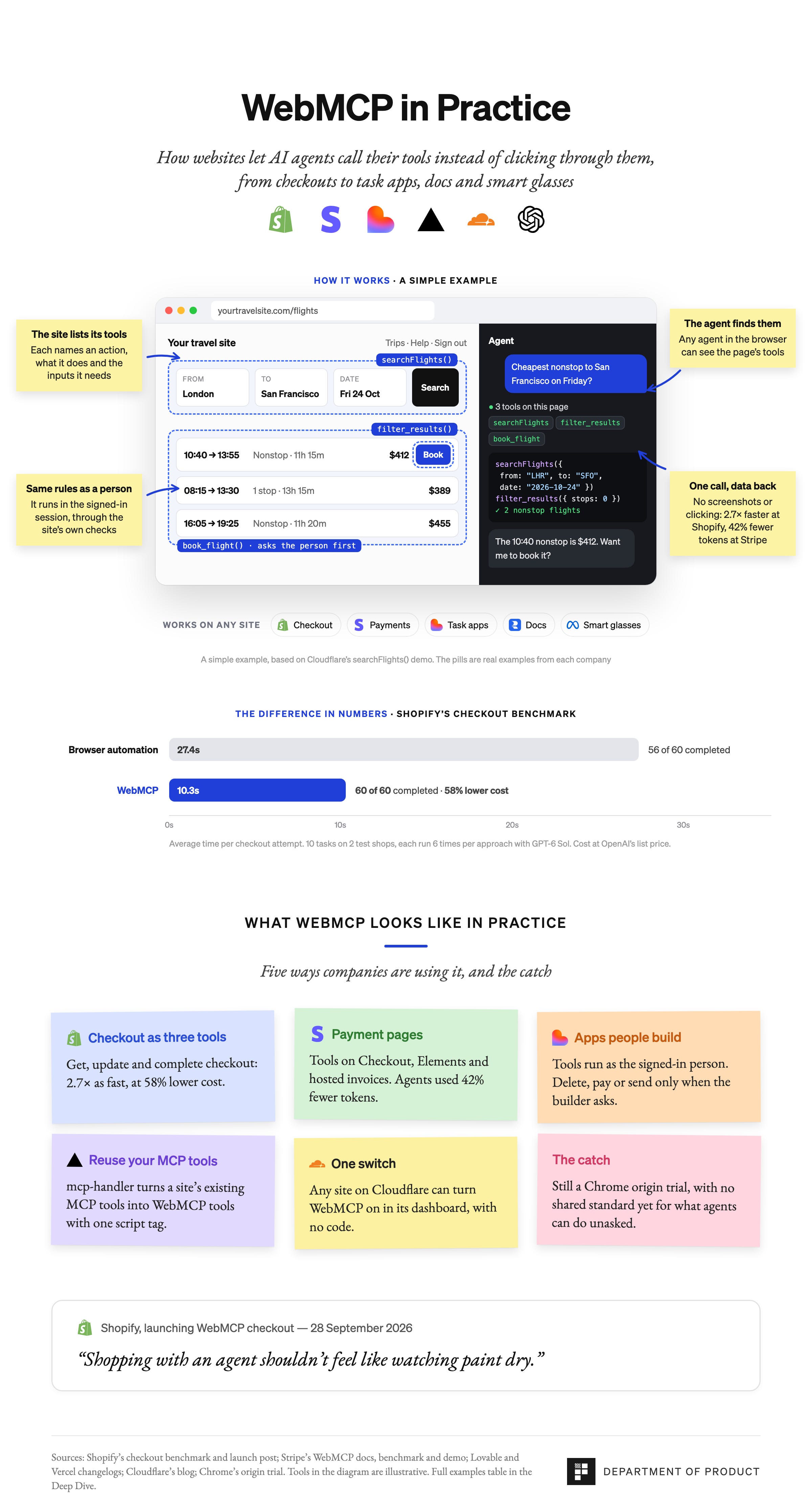
WebMCP makes this process a lot cleaner by telling the agent what it can do instead. The site registers named tools along with a description and the inputs it needs. With this set up, an agent in the browser can discover them and call them directly in the user’s own session.
Here’s a snapshot of some of the use cases emerging so far:
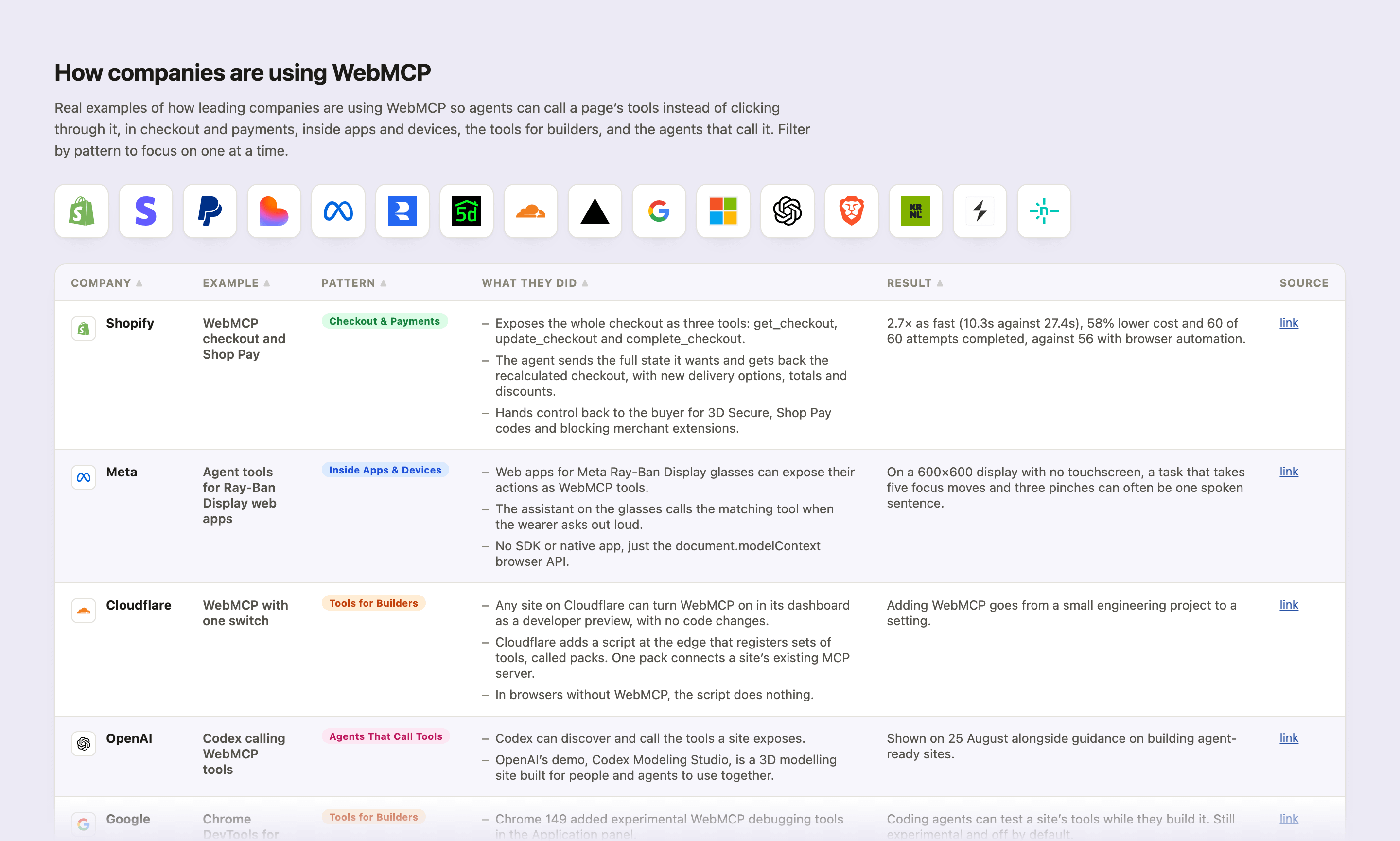
Each WebMCP example is broken down into distinct emerging categories including:
Checkout and payments - sites exposing their checkout or payment steps as tools so agents can complete purchases.
Inside apps / devices - products putting WebMCP inside apps so the agent can act on a user’s behalf.
Tools for builders - ways for developers to test WebMCP functionality before adding it to your product.
Browsers - a closer look at how browsers are evolving to support it together with industry benchmarks.
A closer look at real world examples together
In the past month alone, we’ve seen WebMCP adoption increase significantly with companies like OpenAI, PayPal, Meta and more all showing how they’ve incorporated WebMCP into their products - and product development process.
Let’s take a closer look at some of them together.