
Generative Engine Optimization (GEO) Explained - a simple guide for product teams to get up to speed quickly
🧠 Tactics, terminology and tools for navigating AI Search. Knowledge Series #94
🔒The Knowledge Series is available for paid subscribers. Get full ongoing access to 90+ technical explainers and AI tutorials to grow your technical knowledge at work. Multiple new guides are added every month.
ChatGPT recently marked its 3 year anniversary and regardless of whether or not it will ultimately emerge victorious, you could argue that one of its biggest achievements is disrupting (and potentially destroying) the organic Search model that many product teams relied upon as an acquisition channel.
This week, Google’s VP of Search, Robby Stein, cemented this transformation by announcing a new test that merges the company’s AI mode with AI overviews. According to Stein, this test is a “step towards” the company’s vision of Search in the future.
Needless to say that for some product teams reliant on organic Search, these shifts have the potential to be catastrophic. New data released last month suggests that Google’s AI Overviews have led to a massive 61% drop in organic CTRs and research published earlier this year suggests that since the introduction of Google AI overviews Trip Advisor organic traffic dropped 34%, Netflix traffic dropped 23% and Business Insider cut 21% of its staff because of organic traffic drops outside of its control.
The general consensus right now is that this organic traffic isn’t coming back.
But there are ways that product and marketing teams can change their organic acquisition strategies to ensure that their products rank highly in AI tools. Investors seem to agree the future is in Generative Engine Optimization - not Search Engine Optimization, with one startup called Searchable raising $4 million just 12 days after launching. Their co-founder said that in less than two weeks, the tool had 4,800 sign ups, hundreds of paying users and $40,000 in monthly recurring revenue.
The truth is nobody really knows what the future for organic traffic dependent products looks like, but if startups like Searchable are indicative of anything, it’s that companies are scrambling to try to find out.
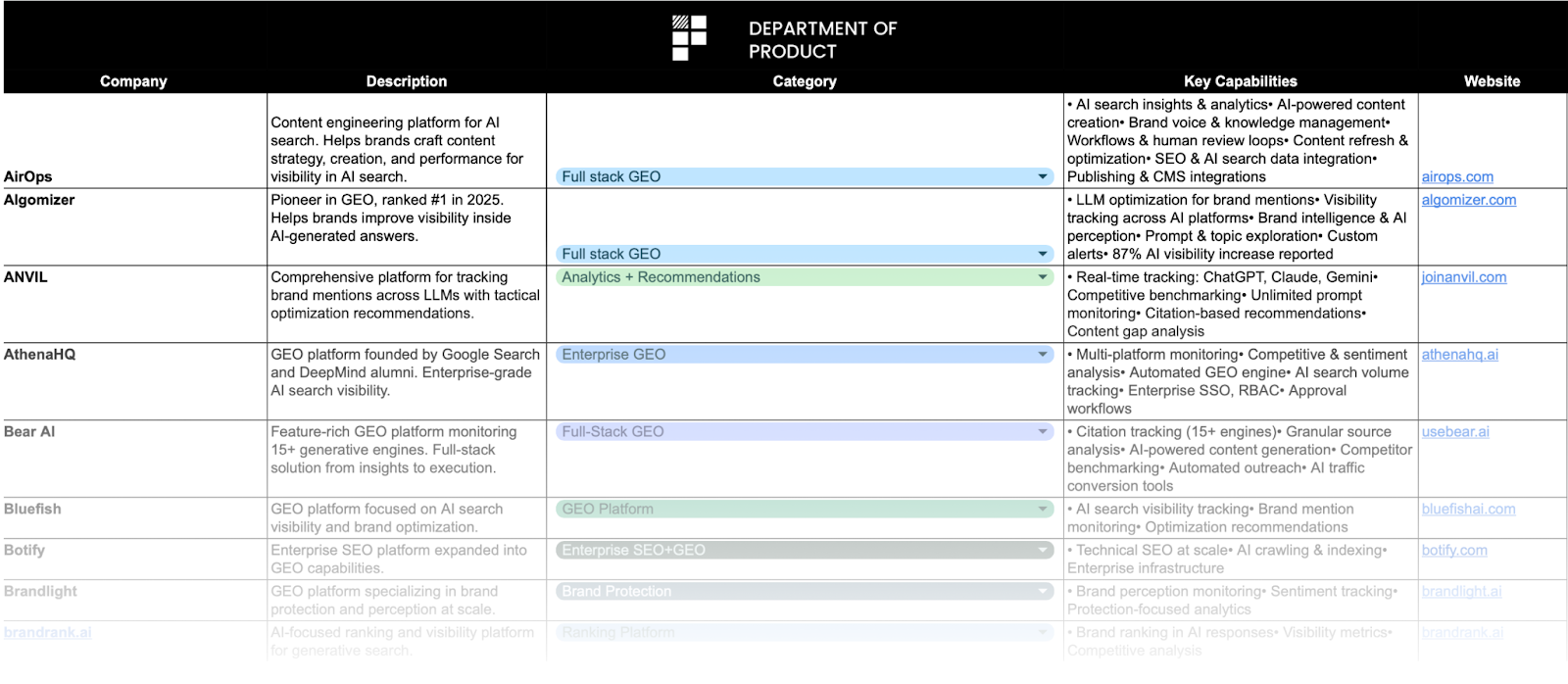
In this Knowledge Series, we’ll bring you up to speed with what the “GEO” space currently looks like. We’ll take a look at some of the new technical terms emerging around GEO, how it differs from SEO, along with some practical tactics that real world companies are deploying to try to stay at the top of AI-driven results. As well as this, you’ll get a curated product database of 25+ of the leading tools you can use to monitor (and potentially improve) your product’s current GEO performance.
Most guides right now are heavily geared towards marketers but this is focused on bringing product development teams up to speed quickly instead.
Coming up:
What exactly is GEO? A simple explanation
Why should product teams care?
Key terminology and concepts worth knowing about right now
What product teams can do to rank higher in ChatGPT, Perplexity and other AI tools.
3 key steps you can take to rank higher in AI Search tools
One mistake other companies are making that should avoid
Expert insights from an industry leader in GEO / AEO
GEO Product database - the new products and tools you can use to measure and optimize your GEO / AI Search performance.

What is GEO? A simple explanation
In simple terms, Generative Engine Optimization (GEO) is the practice of designing and structuring your content so that it is favored, cited, and surfaced inside answers produced by AI tools (like ChatGPT, Claude, Perplexity, Gemini, and Google’s AI Overviews), rather than only trying to rank in traditional search results.
Some people also refer to it as AEO - Answer Engine Optimization - since you’re optimizing your content as answers to user’s questions. But for the purposes of this Knowledge Series, we’ll refer to it as GEO.
Traditional Search vs AI Search
In traditional search engines, a user types a search query which is semantically different to an AI prompt. Search queries assume you’ll navigate through the result to find answers yourself. In this sense, they’re fragmented and keyword focused e.g. “best prototyping tools 2025”.
AI prompts on the other hand, tend to be more natural in their expression e.g. “what are the best prototyping tools for people with little technical knowledge?” - and often contain multiple different prompts throughout the course of a conversation. With over a billion people now using AI tools, users have developed a muscle memory for having conversations with AI tools like ChatGPT, Claude, Perplexity and others - and organic product discovery is changing as a result.
Here’s a snapshot of a comparison between traditional search (as it is today) and AI prompting / searching on ChatGPT:
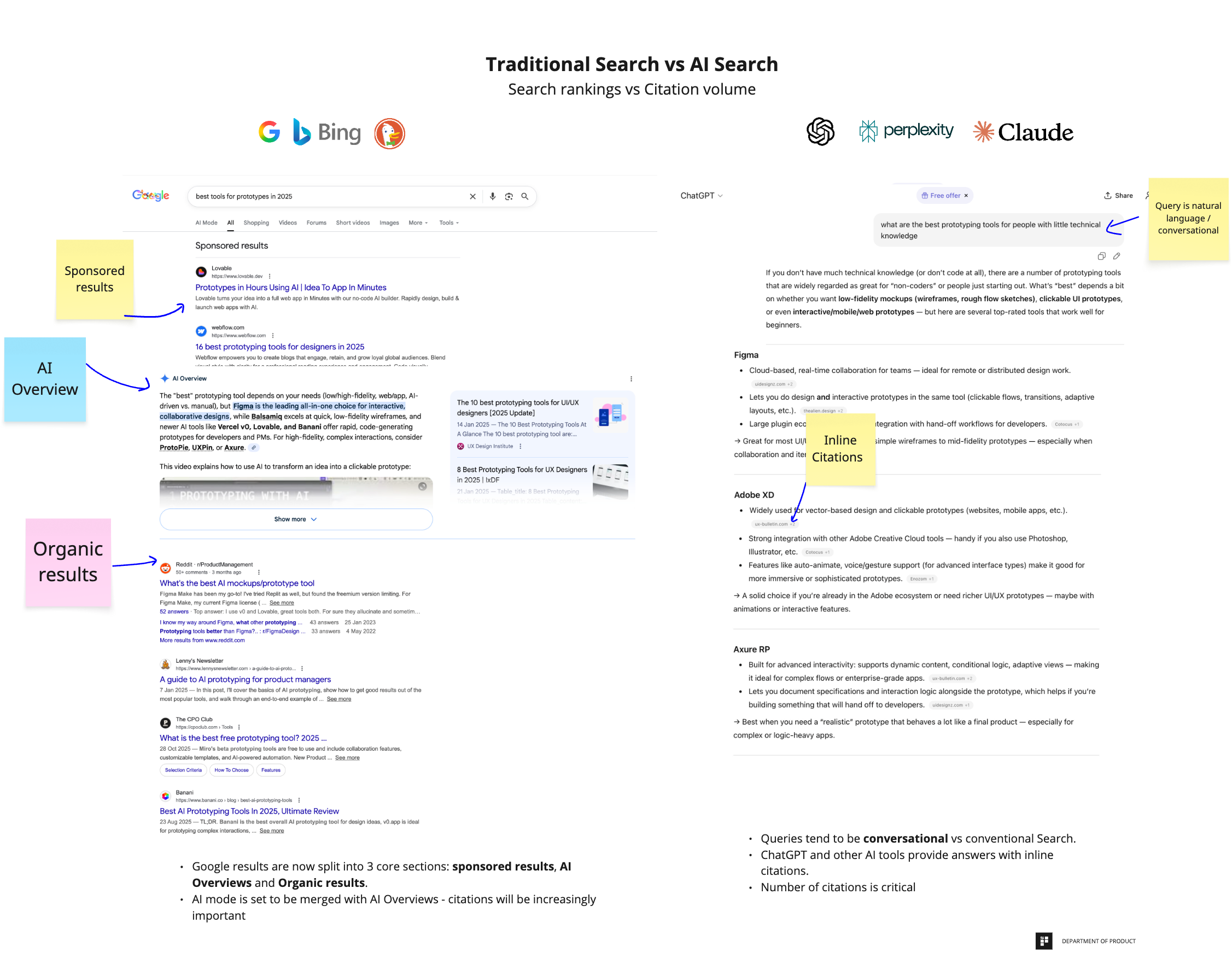
A Google Search results page (for now at least) comprises 3 core elements: the sponsored results, the AI overview and organic results. A ChatGPT or Perplexity conversation, on the other hand, may contain multiple different citations referenced in its answers throughout a single conversational flow.
And it is these citations that play a big part in influencing a product team’s GEO / AEO strategy.
Why should product teams care?
AI tools are transforming how users discover products and traditional search is being eroded as a result. Here’s the latest data on the impact of AI overviews on organic click through rates:
AI tools are transforming how users discover products and traditional search is being eroded as a result. Here’s the latest data on the impact of AI overviews on organic click through rates:
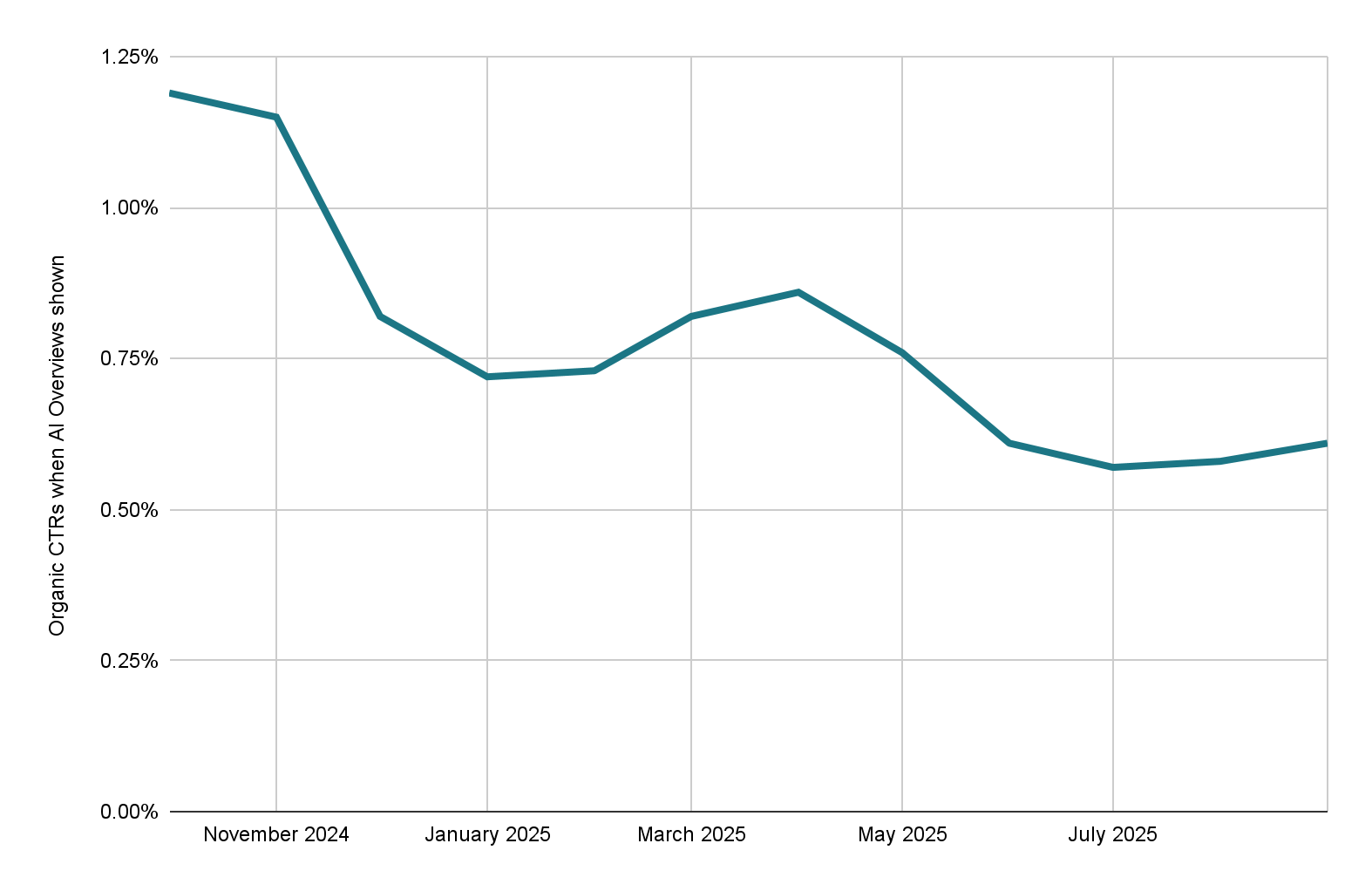
This graph shows the percentage CTRs of users clicking when AI Overviews are shown in traditional Google Search results. You can see that over the past year or so, the overall CTR has dropped significantly - and if Google does go ahead with merging AI Overview with AI mode, this will likely drop further.
Some product teams may decide to do nothing about their AI citations, which can be perfectly reasonable if their acquisition / distribution channels are focused on other platforms. But for the companies who do manage to get cited, the impact can be pretty significant.
Earlier this year, Vercel’s CEO confirmed that ChatGPT now refers an impressive 10% of all new Vercel sign ups:
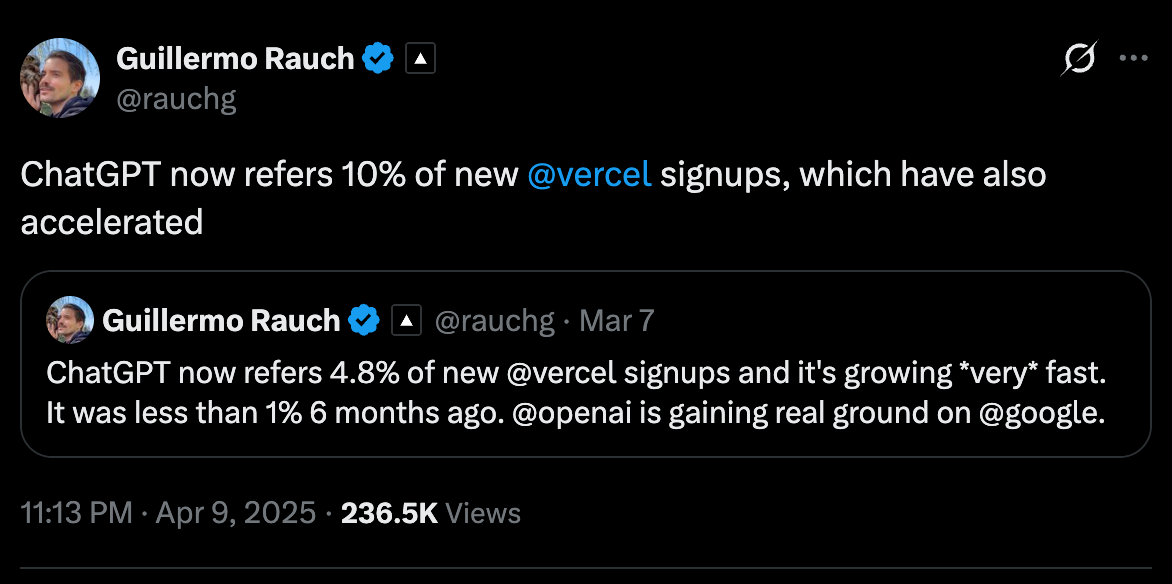
And more recently, he went further to break down the AI referral traffic, confirming that ChatGPT makes up almost 80% of the company’s AI referral traffic, with Perplexity in an impressive second.
Important terminology and concepts worth knowing
Before we move onto the tactics and playbooks for what product teams can actually do to rank higher in AI Search results, let’s first explore some of the key terms and concepts about AI Search that are currently emerging.