
🔵 Linear says Issue Tracking is Dead
What does this mean for the future of product development processes? Plus: Claude Code’s PM on how product is evolving, new Gemini models, design debt is the new tech debt.
Hi product people 👋,
This week, Linear’s CEO announced the death of issue tracking in product development - a move that could have significant consequences for the product‑building process. We’ll take a closer look at what he said and how one company is adapting to this new context-driven development.
Plus, Claude Code’s PM shares her views on how the product role is evolving, why design debt is the new tech debt and why a new model from Meta trained on human brains could transform how we test new features.
Happy Friday and enjoy the weekend!
Rich
Watch on YouTube | Follow on Substack Notes
Key reads and resources for product teams
New from the Department of Product Substack this week:
Deep Dive - New Multimodal AI Features Explored
Using 30+ examples from Google, Pinterest, Spotify, Headspace, Lyft, Replit and more, this Deep dive explores where voice works, why multimodal agents like Google Stitch feel like collaborators instead of tools, and gives a practical five‑step framework product teams can use to decide which modalities to ship next – and which to avoid.
New in the AI library - Dependency Tracker and Release Blocker Visualizer
Use this visualiser for instances when you’re trying to release a new feature but you’re blocked by dependencies like third parties, compliance or internal, non-product related blockers. This visualiser brings these dependency blockers to life so that you can share them visually with your stakeholders and everyone can understand what’s required before you’re able to ship your feature. It will nudge the people responsible for the blocker on a regular cadence until it’s unblocked so that you progress. Prompts and example mini app files included.
(Department of Product)
UX - Outcome-oriented design explained
Outcome-oriented design shifts how we approach UX in the AI era. Instead of designing single interfaces, designers now define adaptive frameworks that respond to individual user goals rather than optimizing for average user needs. (NN Group)
Opinion - Design debt is now as dangerous as technical debt
As AI interfaces reshape what users believe, not just what they can do, every “quick” design shortcut compounds into broken trust, misleading certainty, and slower iteration across teams. (Medium)
Management - Why the best PMs will be Agent Managers in 2026
Most teams still treat AI agents like one-off tools or fancy APIs, but the people who’ll win in 2026 are treating them like direct reports: designing clear roles, giving structured feedback, evolving “employee files,” and letting corrections compound until agents run most of the workflow themselves. The piece argues that this is exactly the skillset great PMs already have, and that the edge won’t come from clever prompts, but from building and managing an actual team of agents that gets better every week. (Google AI Product Manager, X)
Tools you can use - Marcus - the AI thinking system for C-suite and leadership teams
120+ precision-crafted prompts tailored to real executive decisions, a Prompt Builder to turn your best thinking into reusable playbooks, an Executive Bookshelf that distils 100 essential business books into actionable prompts, and a structured Decision Maker for stress‑testing high‑stakes calls. (Marcus)
Case studies - Claude Code’s Head of Product on how the role of product management is evolving
Claude Code’s Head of Product shares how product management teams are adapting their workflows and roadmaps in the face of rapidly evolving model intelligence.
Interview - Superhuman and ex-YouTube CPO Shifhir Mehrotra on the future of product development and SaaS
Why Superhuman thinks it can be the layer that sits over all your tools, whether that moat holds up against the big model providers, and how much of SaaS survives a world where anyone can vibe‑code a clone in an afternoon. (The Verge)
New product features and innovation this week
Linear’s CEO has officially declared that Issue tracking as we know it is dead. In a post published on Linear’s official blog, co-founder and CEO Karri Saarinen explained that the idea of Issue tracking was built for a hand-off model of software development where a PM scoped the work, engineers picked it up later and the system used prioritisation, negotiation and workflows to bridge the gaps.
With AI engineering agents now installed on over 75% of Linear’s enterprise workspaces, Linear believes that the next system is not built around hand-offs but around context and agents. For product teams, this context includes things like customer feedback, internal ideas, strategic decisions and your codebase, and Linear is pitching itself as the best place for product teams to build this rich context.
Here’s how the company visualizes this new vision of context-driven product development:
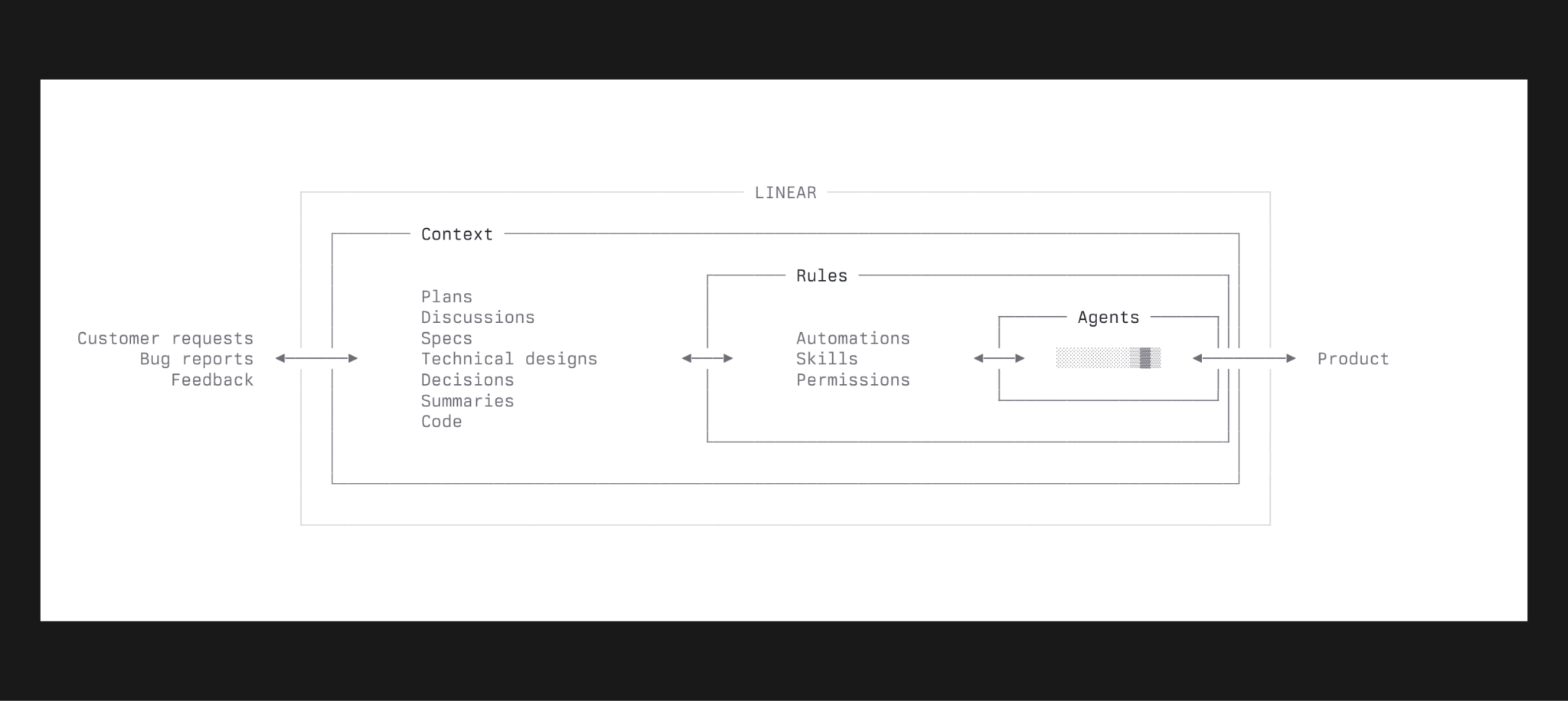
The company’s major release to bring this vision to life is Linear Agent - a new built-in agent that has access to the context already living in your workspace (things threads, backlog, customer requests) without having to manually piece it all together. It understands your roadmap, issues, and code, and can help you synthesize context, make recommendations, and take action.
The Agent also comes with in-built Skills abilities. Skills are Linear’s way of letting teams save AI workflows that worked well and reuse them with a single command. So, for example, you have a conversation with the Linear Agent e.g. you ask it to read your backlog, group themes by customer impact, and draft issues for the top three. That’s a multi-step workflow. Instead of typing all that out again next sprint, you tell Linear to save it as a skill. Now it lives in your workspace, triggerable via slash command or automatically when Linear detects the right conditions.
Linear says Coinbase is one of the early adopters of “agent-first” development and they published a piece from their Head of Engineering on how they managed to roll this out.
It’s certainly an ambitious and bold idea that reflects where things are headed, backed up by Linear’s own data. But, as some people have argued, what happens if IDEs like Cursor also decide to bolt on additional product-oriented features to become an alternative place to build the rich context that AI Agents need? Could we potentially also see tools like Claude Code or Figma do the same? As the differences between traditional product roles like PM, Engineering and Design start to collapse, so too do the traditional separating lines between the tools that would traditionally be associated with each of these disciplines.
Claude gets interactive apps on mobile - useful for grabbing nuggets of data and status updates quickly
Claude has rolled out interactive connector apps on mobile. Interactive connectors let Claude render live, usable interfaces directly inside a conversation so instead of describing your Asana board, Claude shows it, and you can take action on it without switching apps. For example, this could include real Amplitude dashboards you can filter, Figma files you can annotate, or Slack messages you can send - all from within the chat window.
For product teams, this mobile release along with the “Dispatch” feature opens up an opportunity for PMs to get stuff done on the go. You can ask Claude what’s blocking a sprint, get a live task board, update it, and keep moving. It’s an interesting concept and ideal for people who want quick answers to questions in meetings or before important catch ups but desktop is still probably the best medium for most tasks.
Google’s new models give developers new voice, music powers
Google released a new version of its multi-modal API, Gemini Live which beats previous benchmarks. The API supports audio and visuals which gives product teams the opportunity to build multi-modal AI agents. Here’s a demo of it in action where it shows an insurance company’s user speaking to a voice agent to resolve their issue.
Google also unveiled Lyria 3 Pro - a new music generating model. Deepmind CEO Demis Hassabis shared one use case that could be helpful to product teams: a productivity boosting background music app that’s designed to keep you in a flow state:
Meta’s new model could change how we test product experiences
Meta is also trying to claw back some of the limelight this week with a major new model release of its own. Meta released TRIBE v2 this week - a foundation model that predicts how the human brain responds to video, audio, and language. Trained on over 1,000 hours of brain scan data across 720 people, it can simulate which parts of the brain activate in response to a given stimulus, without running a single new experiment.
Right now, if you want to know whether a design, ad, or onboarding flow is genuinely engaging - not just tolerable - your options are surveys, behavioural metrics, or expensive lab studies. A model like this points toward a future where you could simulate how engaging something is before any user research runs, using it to triage candidates rather than test everything.
It’s slightly terrifying but their demo is worth a look to understand it in more detail.
📈 Product data and trends to stay informed
Cisco’s VP of operations said the company replaced a presentation software tool with its own AI agent, saving nearly $5 million annually in license costs.
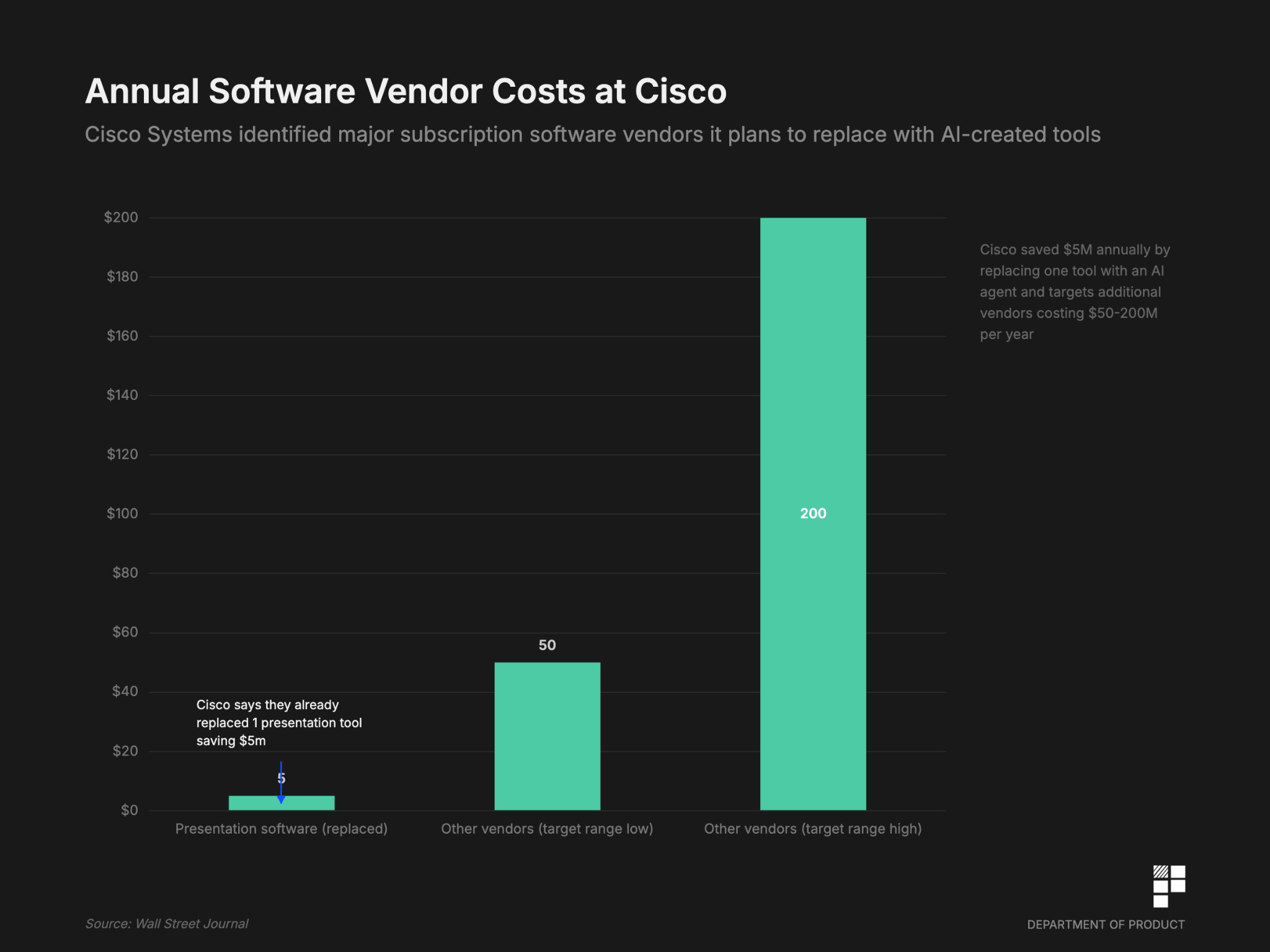
He says that the company is also looking at replacing other SaaS products internally, saving the company between $50 million and $200 million: “You need to look at all the applications that you’re using and say, ‘Which one of these can become automated workflows where we don’t need this application anymore?’”.
10% of pull requests at high AI adopters are now entirely AI generated according to the latest JellyFish Engineering Trends report.
Anthropic just published their latest Economic Index Report. Here’s some stats which might be of interest to product teams:
Coding is the dominant use case and developers are increasingly using the Anthropic API over the Claude interface. Since August 2025, the share of coding tasks has increased by 14% in the API and decreased by 18% in Claude - suggesting developers are increasingly integrating Claude directly into their tooling rather than using it through the chat interface.
Experienced users have meaningfully higher success rates - people who have been using Claude for 6 months or more have a 10% higher success rate in their conversations, an association not explained by task selection, country of origin, or other factors.
Users self-select more powerful models for complex work - Among paid Claude users, 55% of Computer and Mathematical tasks use Opus, compared to 45% of Educational tasks. For every additional $10 of hourly wage associated with a task, the share of conversations using Opus increases by 1.5 percentage points. This suggests some users are developing intuitions about model capability - something worth considering when designing model selection UX.
Apple has added more than 100 new metrics you can use to measure the performance of your iOS mobile apps including monetization and subscription data in App Store Connect Analytics to better understand the performance of your In‑App Purchases and offers.
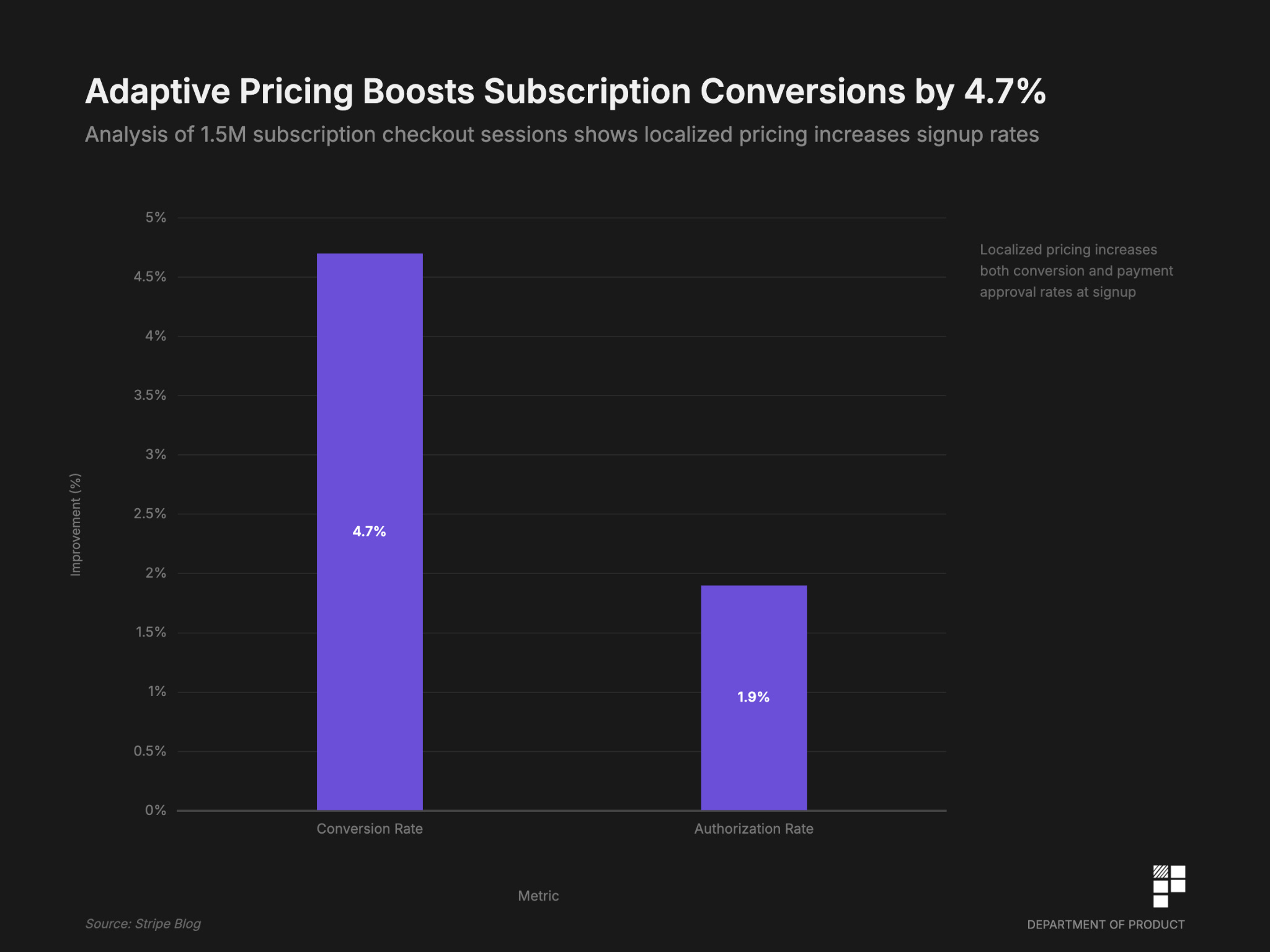
Stripe says offering Adaptive Pricing increased conversion by 4.7% on average. Some businesses saw LTV increases of more than 30%.
OpenAI’s Sora app is officially dead after downloads plummeted. But despite its troubles, OpenAI is reported to be planning to double its workforce.
The battle against the AI slopification of the web continues. Wikipedia is banning AI generated articles, Reddit is rolling out a series of new initiatives to help users prove they are human and Spotify is testing a tool to help artists verify their music and fight off AI clones.
Revolut cut their support ticket resolution time by 8x using ElevenLabs AI voice agents.

Paid subscribers get the full DoP Substack including: The Knowledge Series for sharpening your tech / AI skills, the AI Prompt and Skills library and DoP Deep dive reports for in-depth analysis to learn lessons from the world’s top tech companies.