
WebMCP Explained for Product Teams
🧠 How this new technology could transform how AI Agents interact with your product. Knowledge Series #102
🔒 The Knowledge Series breaks down emerging AI technologies like this into plain English - so you can stay ahead. Get 100+ guides and practical tutorials covering everything from Claude Code and MCP to agentic workflows, vibe coding, and more.
With Gemini 3.1 Pro and Google’s Nano Banana 2 grabbing most of the attention over the past week, Google has been quietly developing a potentially groundbreaking new technology that could transform the web as we know it.
It’s called WebMCP (Web Model Context Protocol) and it’s a major new project developed in collaboration between Google, Microsoft and W3C. If all goes to plan, it could fundamentally change the way users interact with your product by making it easier for AI Agents in the browser to understand what features and tools your product offers - and then acting up on them.
Strategically, this means that for the first time, product teams will have a real opportunity to own how AI agents understand and interact with their product. Rather than leaving agents to interpret your UI through screenshots or other clunky methods, WebMCP lets product teams tell AI agents what your product can do and what features an agent has access to in your own words in the browser.
Chrome published its first guidance on WebMCP in February and opened an early preview program, but most product teams haven’t come across it yet.
In this Knowledge Series, we’ll explore what WebMCP is, how it works, the strategic implications and opportunities for product teams and how you can get some hands-on experience of your own with some live demos.
Coming up:
What is WebMCP? The core concept explained simply, and why it could transform how agents interact with your product
How it works - a plain-English breakdown of the technologies and APIs involved, with real code examples to bring the concept to life
The strategic implications for product teams with three steps you can take right now regardless of how the standard evolves to prepare your product
Practical Ideas on how product teams might be able to use WebMCP and how to get some hands-on experience yourself - a live demo to try
Further reading - curated links to the official specs, reference implementation, and perspectives from engineers and PMs at Microsoft, Google and more

What is WebMCP?
To understand WebMCP, it’s helpful to first consider what browser AI agents currently have to do to interact with a website.
Typically, right now, if an AI agent in the browser wants to ‘book a flight’ or ‘add an item to a cart’ on your website, it essentially has to pretend to be a human. This can often mean taking screenshots of your UI, running those screenshots through a vision model to figure out which button to click, and then simulating that click.
This is often expensive, fragile and inaccurate. WebMCP proposes a fundamentally different model. Instead of forcing agents to guess how your website works, your website tells agents exactly what it can do.
How it works
Here’s a high level snapshot of how it works:
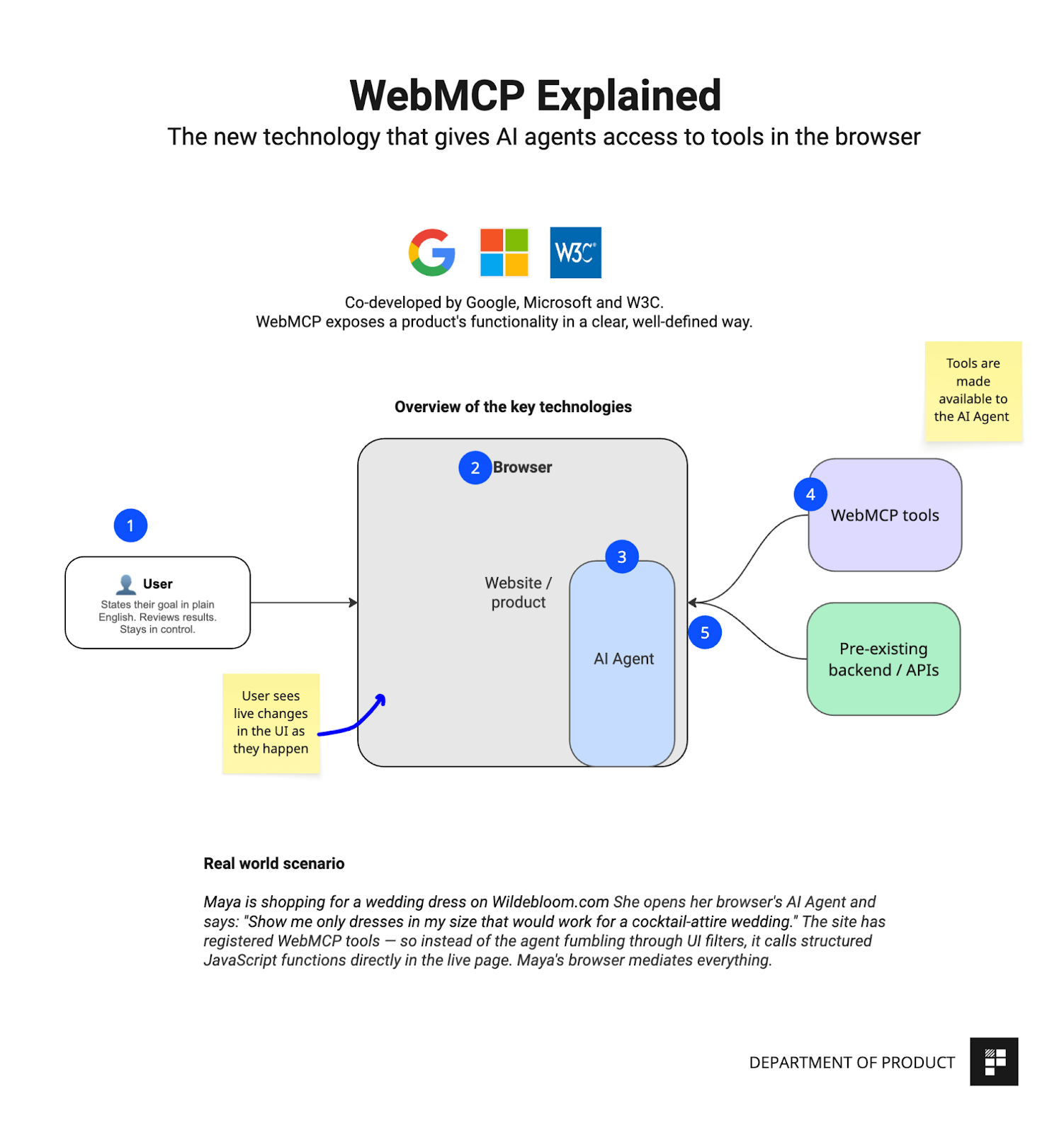
WebMCP lets browser agents understand exactly what tools a product has by making them available to the AI Agent.
It does this through two new APIs that could make your product either visible or invisible to AI agents - and since it’s still early days, most product teams don't know about them yet.