
What is parallel AI agent coding? An in-depth guide for product teams
🧠 “A recipe for insane development speed”. Why tech leaders at Chrome, Cursor and more believe this is the next big shift in software development. Knowledge Series #91
🔒The Knowledge Series is available for paid subscribers. Get full ongoing access to 80+ technical explainers and AI guides and tutorials to grow your AI and tech knowledge at work. Multiple new guides are added every month.
Parallel AI coding agents were recently described as “a recipe for insane development speed” and a “game changer” by engineers.
Just a few days ago, Google Chrome Engineering lead Addy Osmani echoed this sentiment, saying that asynchronous coding agents are “the next big thing” which transforms engineers from Conductors who manage single agents to Orchestrators who manage multiple AI coding agents in parallel:
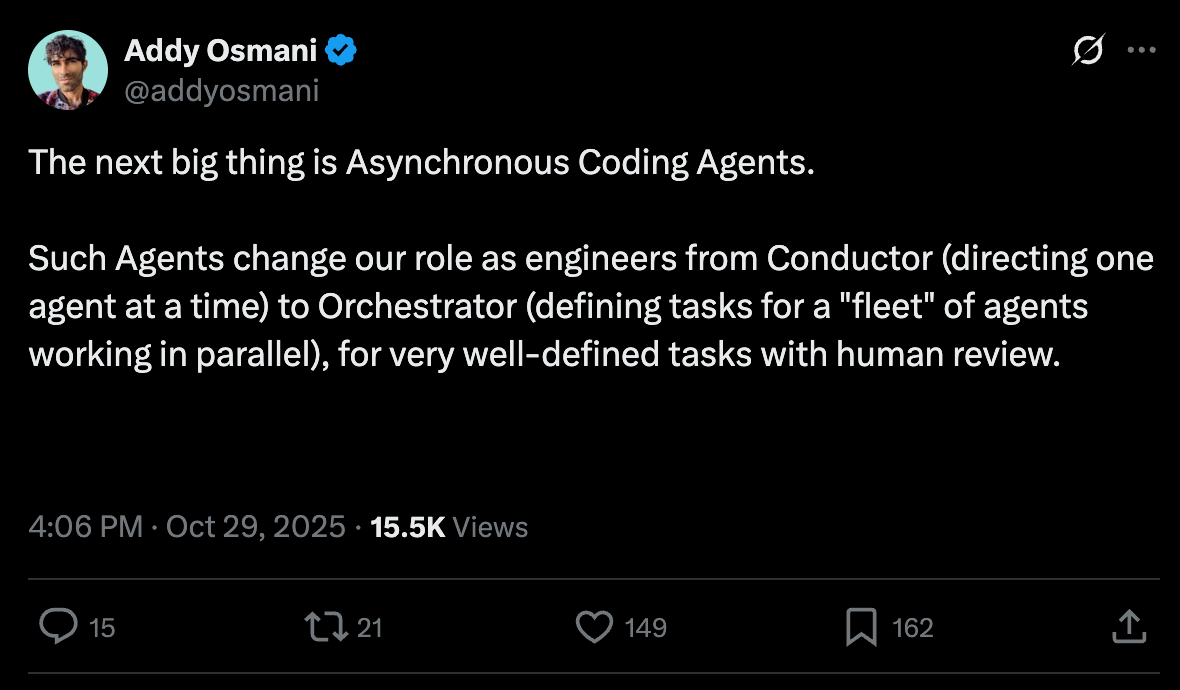
Sure, this vision of a shift towards a future where engineers orchestrate AI agents has been with us for a few months now, but recent developments mean this futuristic vision is starting to become more real.
Cursor’s latest iteration of its core product, Cursor 2.0 has been redesigned around the idea of parallel coding agents, allowing engineers to delegate tasks to 8 different AI software development agents at a time and similar principles underpin the recent rollout of Claude Code for the web which allows developers to delegate tasks to agents in a browser.
We’re even starting to see some smaller companies reduce their software development teams to shift towards an orchestration model. In a piece by the WSJ last week, one company director said that he reduced his team’s headcount by 80% after transitioning to an AI Agent orchestration model.
This is unlikely to be the case in larger companies, with Anthropic’s CEO saying that despite 90% of the code at the company now being AI generated, he actually expects demand for software engineers to increase. Nevertheless, the shift towards orchestration now seems inevitable.
But what does this all mean for product teams? In this Knowledge Series, we’ll cover the essentials of parallel AI agents, including the core technologies used, architectural patterns and how this might impact the future of product development. We’ll also explore some real world examples of parallel AI coding agents to understand how some of the world’s leading engineers are using them today.
Coming up:
What is Parallel AI Agent Coding? The core technical pieces explained
Why should product teams care?
Ideas on the types of tasks suitable for parallel AI agent coding
How parallel AI agent coding could transform the software development process: exploring the future roles of product managers and designers in teams with AI parallel coding agents
Real world examples of parallel AI agent coding in practice: perspectives from Google engineers, CTOs and more

What is Parallel AI Agent Coding?
In simple terms, parallel AI agent coding refers to the practice of running multiple AI coding agents at the same time to tackle different tasks. In software development, different agents can be assigned distinctly different tasks like writing the code, writing tests and researching solutions.
In parallel architectures, agents operate independently and at the same time, with their outputs often aggregated at the end. Sequential agent workflows, on the other hand, resemble a pipeline where each agent processes the result of the previous one, building up stepwise towards the solution.
Multiple agents are assigned to different subtasks and they operate independently without needing to share state or communicate during execution.
The results from each agent are collected and then combined or synthesized by a central orchestrator or human developer, who ensures the final output is coherent and meets requirements.
The benefits of parallel AI coding agents
The principal benefit for product teams is, as you might imagine, speed. Since these parallel agents can complete multiple tasks concurrently, the overall time required for task completion is reduced. Agents can either work on different tasks or on the same tasks, with the results assessed to decide which one works best.
For developers, this frees them up to potentially focus on less repetitive tasks which they offload to agents and instead focus on software development at a higher level of abstraction.
But, not all tasks are good candidates for parallel AI coding agents; some tasks are better suited than others. We’ll take a look at some examples of tasks that are suitable for parallel AI coding agents vs tasks that are less suited later.
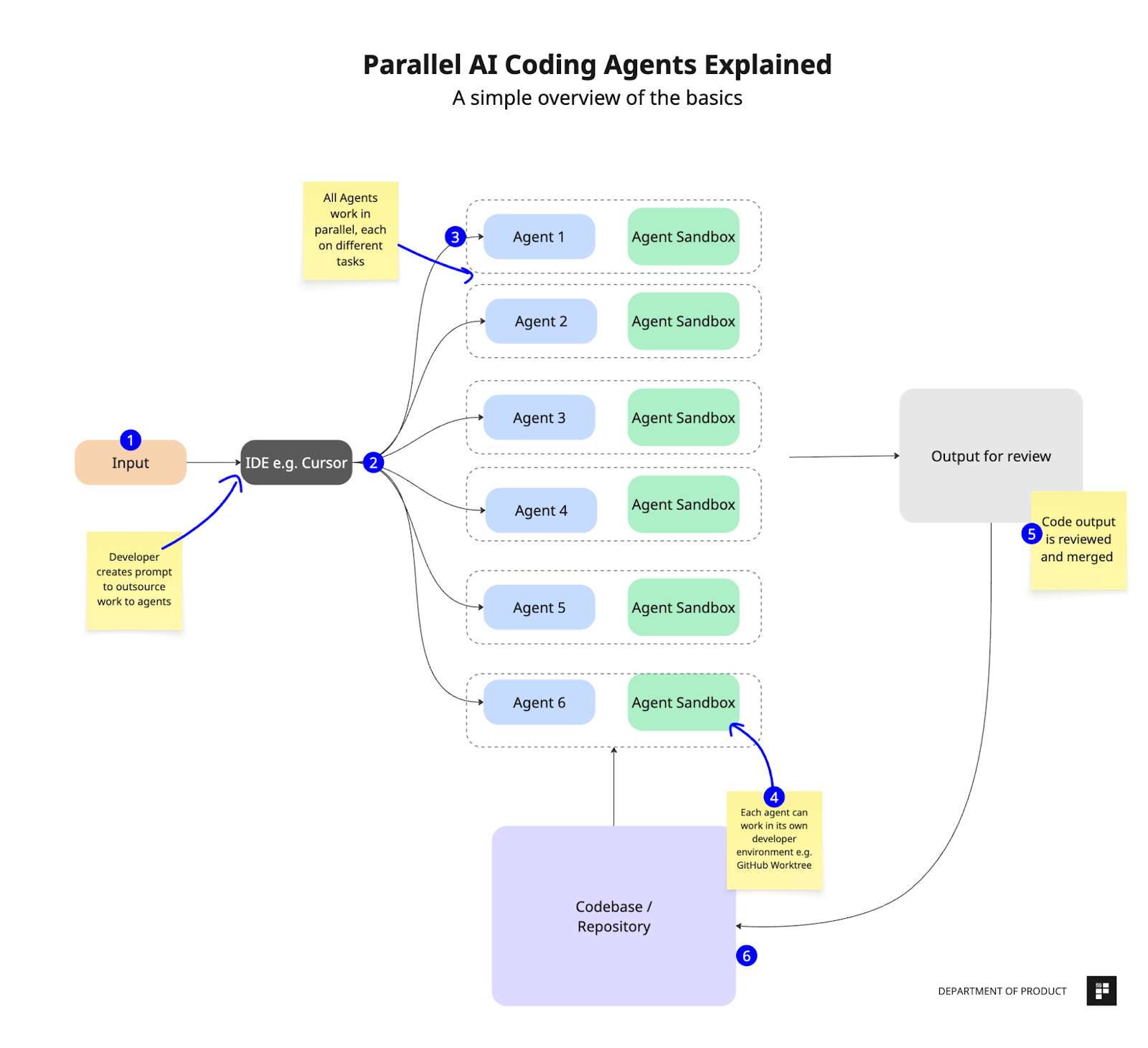
The core technical pieces explained: a 6 stage step by step example
But before that, let’s break down the core technical pieces involved when an engineer delegates work to parallel AI coding agents.
For this example, we’ll use Cursor 2.0 as our reference point since they recently rolled out their updated product which puts AI coding Agents front and center.
Here’s a video of it in action:
The 6 stage step by step breakdown
Let’s go step by step through each of the different stages of how a parallel coding agent workflow works:
1. Prompt initiation
The process starts when the engineer submits their prompt or task through the IDE interface. In Cursor’s case they would select agent mode and begin with a prompt that tells the agent what they’d like to build.