
🔵 Gemini gets powerful new visualization abilities to help you explain concepts to stakeholders
Plus: Spotify reveals what agentic-first development looks like, Meta is measuring engineers by token usage, YouTube makes AI slop easier to create
Hi product people 👋,
Models are getting better at turning prompts into visual artefacts - diagrams, charts, documents you can actually use. This week, both Google and Atlassian shipped new tools that do exactly that.
Plus, Anthropic reveals its latest model that it says is too powerful to release to the public - for now, Spotify’s chief architect explains how agentic-first development works and Meta is ranking engineers based on token spend - but not everyone is happy about it.
Have a great weekend ahead!
Rich
Watch on YouTube | Follow on Substack Notes
Key reads and resources for product teams
New from the Department of Product Substack this week:
Deep dive - The New Product Development Operating Model
Instead of linear handoffs and rigid roadmaps, product teams at Anthropic, Linear, Spotify, Uber, Coinbase and others are converging on a new rhythm: agents as infrastructure, PMs as “agent managers,” prototype‑first cycles measured in hours not sprints, and “tokenmaxxing” as a visible signal of who’s actually working in an AI‑native way.
AI Prompt Library - Stakeholder Influencer Tool
The Stakeholder Influence tool turns your situation and stakeholder list into a tailored persuasion playbook: the argument that lands with each person, the order to approach them, messages you can send today, and how to handle every likely objection. Built for PMs and people who need to influence people without having direct authority over them. (Department of Product)
Tools you can use - Natter
Natter is an AI-native conversation intelligence platform that runs thousands of simultaneous, ongoing 1:1 video conversations - between employees, members, customers - to capture real voices at scale. This week they raised $23 million. (Natter)
Skills - Google’s Product Director on why Go to Market is becoming the essential skill
We talk a lot about how AI has made building easier. Anyone can ship. The question has shifted from can you build it to should you build it — and then, once you decide to build, can you make sure the right people know it’s for them. (X)
Case study - What agentic-first development looks like at Spotify
In this fireside chat, Spotify’s chief architect, Niklas Gustavsson, sat down with Anthropic’s David Soria Parra (co-creator of MCP) and Christian Ryan (applied AI lead) for a wide-ranging discussion on what agentic-first development actually looks like at scale, from the tools and infrastructure that make it work, to the organizational shifts it demands. (Spotify)
Report - The State of Prototyping 2026
This survey of 1,478 designers shows that five of the ten most-used weekly tools are now AI, Claude has become the #2 tool after Figma, and nearly half of designers say the majority of what they “build” is AI‑generated code they don’t fully understand but that works. (UX Tools)
New models - Anthropic’s Claude Mythos is too powerful to use - for now
Anthropic has developed a model called Claude Mythos that it is not releasing to the public for now due to security concerns. Mythos Preview was announced as part of Project Glasswing - a cross-industry cybersecurity initiative. Anthropic says its coding abilities have reached a level where the model can surpass all but the most skilled humans at finding and exploiting software vulnerabilities. (YouTube)
New product features and innovation this week
The Google Gemini app can now transform your questions and complex concepts into customizable interactive visualizations directly in your chat. You can initiate the new feature by selecting “Pro” as your model and asking Gemini to “help me visualize’. Once the first version is built, you can then iterate upon it, much like you can do with asses built in Google Studio.
The new feature could come in handy for product teams who want to learn new skills or share complex topics with non-technical stakeholders.
Here’s a basic example of a Technical Debt Visualizer that was created in one shot that lets you simulate different scenarios depending on how many bugs are introduced during each sprint:
Other ideas on how product teams might use this
Here are some other ideas on how you might use Gemini’s new visualization features at work:
Pricing simulator - simulate how a pricing model responds to changes (e.g. churn rate × ARPU × acquisition cost playing out over 24 months)
Cohort analysis - model cohort retention curves under different onboarding interventions
Dependencies - explain what happens to a roadmap when you add one shared dependency across three parallel workstreams
Network effects - show how value grows as users are added, and where it plateaus
Google isn’t the only company to offer new visual communication features, though. This week, Atlassian revealed a new set of features which lets product teams use the data they already have in places like Confluence and “remix” these into different assets.
Users can select any content on a Confluence page and instantly transform it into a visual format optimized for how someone needs to consume it. So, for example, a data-heavy section becomes a chart, a process description becomes an infographic and a long-form analysis becomes a visual summary.
Anthropic launches Claude Managed Agents; new APIs for building Agents at scale
Anthropic has launched Claude Managed Agents - a new suite of APIs that lets product teams ship and manage AI agents using Anthropic’s own infrastructure, rather than hosting them yourself.
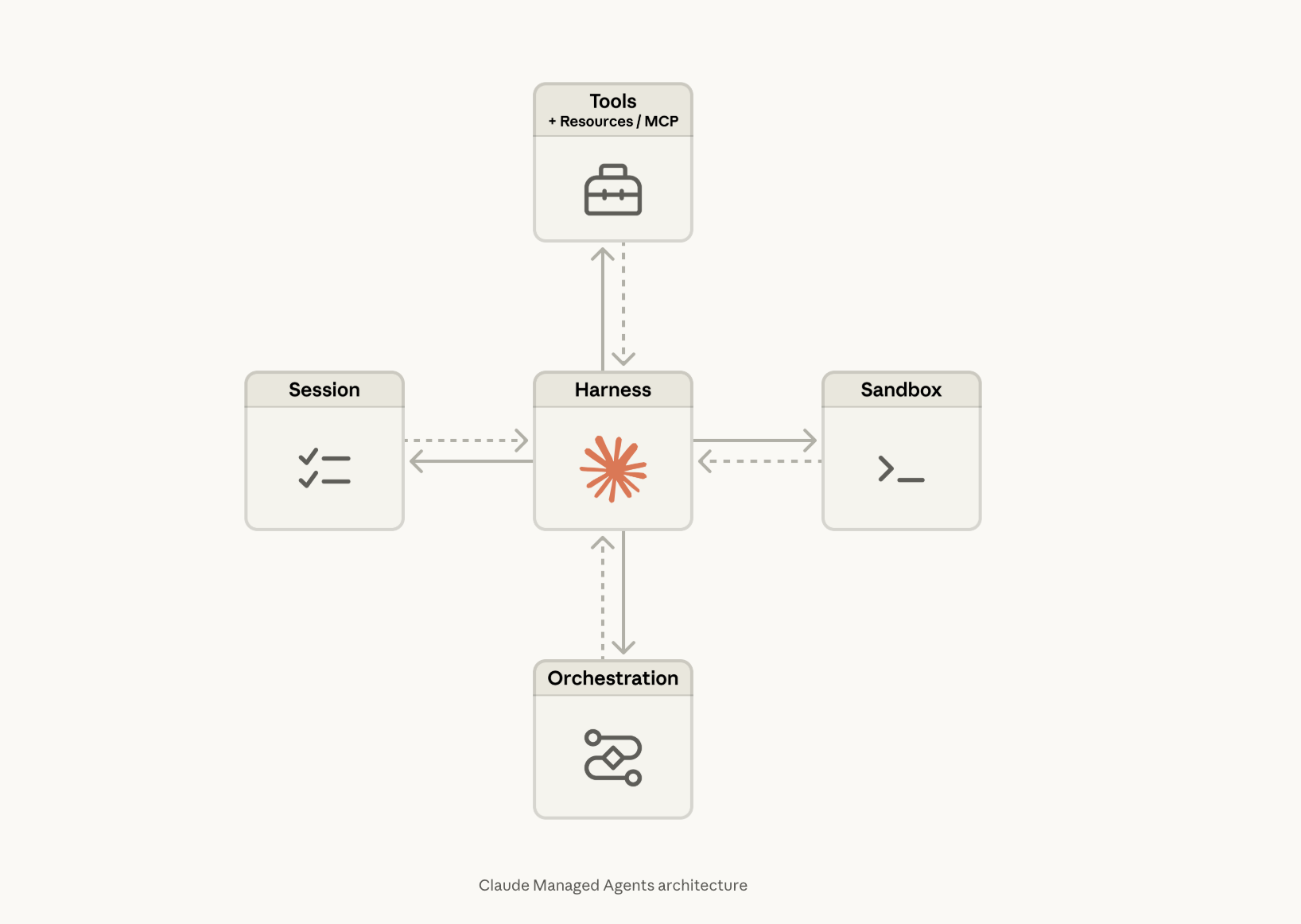
Anthropic says that some product teams are already using this to ship “10x faster” across a variety of different use cases including: coding agents that will read a codebase and propose fixes, productivity agents that can join a project and deliver work alongside the rest of the team and finance / legal agents that can process documents and extract important pieces of information.
Cowork is officially released
After weeks in an extended preview, Claude Cowork is now officially available on all paid plans. Anthropic says the official release comes with some new features like the ability to control which tools Cowork has access to as well as analytics features. But their case studies of how companies are actually using Cowork are also pretty interesting.
Anthropic says Zapier connected Cowork to Slack, Jira and their internal databases to surface engineering bottlenecks and build a custom dashboard that their PMs and designers could copy and Airtree, a venture built a board prep workflow that pulls from a portfolio company’s Drive, Slack updates, and competitor news, cross-referenced against the previous prep.
YouTube gets new generative AI features; won’t this just increase AI slop?
YouTube is introducing a new feature that will make it easier for creators to build a clone of themselves. That avatar can then generate new Shorts from text prompts (up to 8 seconds), or be dropped into existing videos. You do it once, and then you can produce content without ever appearing on camera again.
All avatar videos will also be clearly flagged as AI-generated, YouTube says. This includes visible watermarking and digital labels like SynthID and C2PA. But the net effect is likely to be an increase in AI generated content, which could be offputting for users who, if Sora’s demise is anything to go by, not too keen on AI video slop in the first place.
It feels as though YouTube is publicly fighting AI slop on one front while quietly enabling it on another.
📈 Product data and trends to stay informed
Nvidia CEO Jensen Huang has said that he would be “deeply alarmed” if an engineer earning $500,000 annually wasn’t using at least $250,000 of AI tokens a year. This concept of “token-maxxing” is the new product development trend that’s worth keeping an eye on.
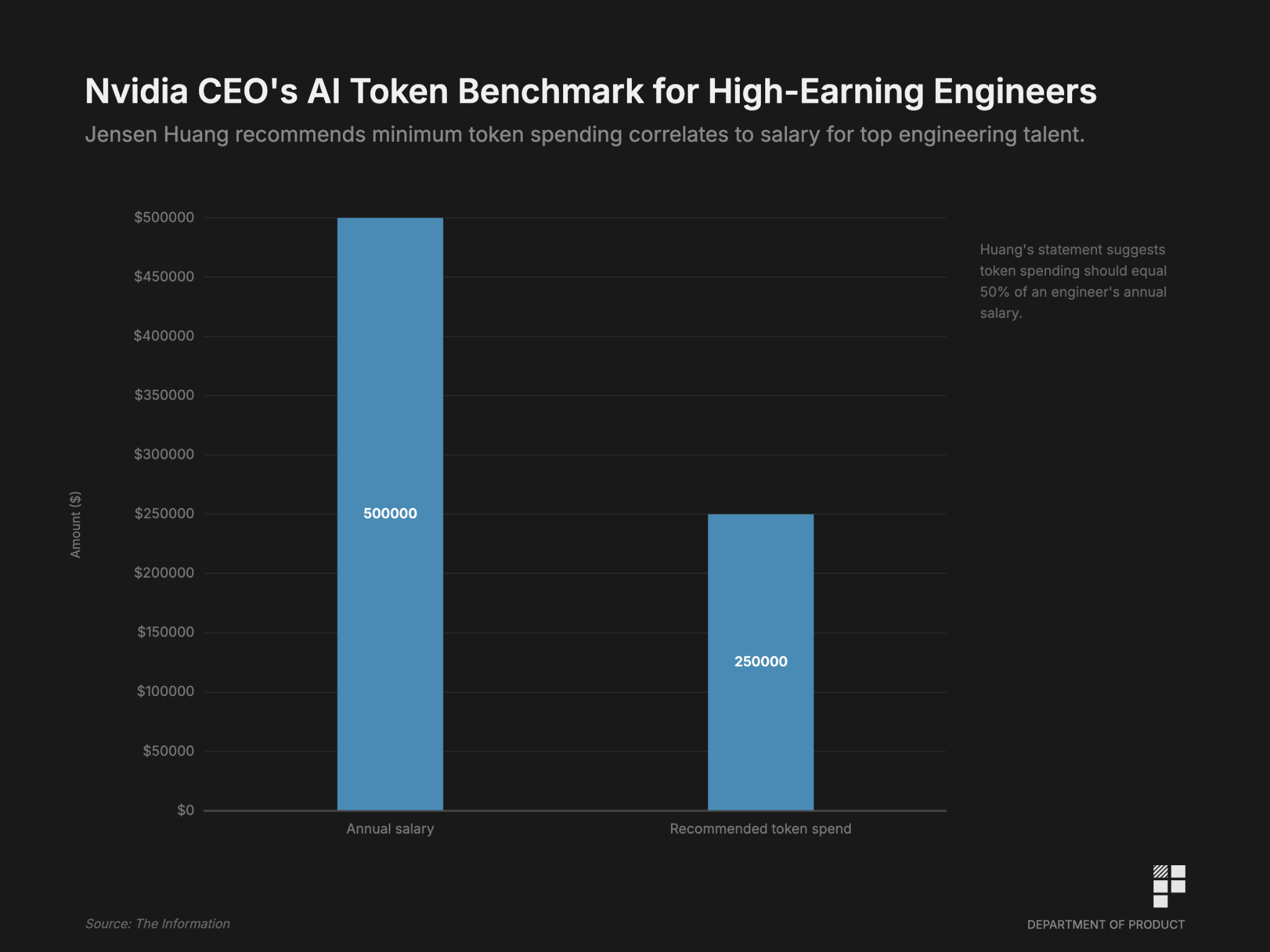
Meta took this principle to the next level and built a leaderboard that turns AI token usage into office status. At Meta, burning through AI tokens has become a measure of engineering prestige. An internal “Claudeonomics” leaderboard ranks 85,000 employees by token consumption, awarding badges and titles like “Token Legend” and “Session Immortal” to the top users.
Not everyone is a fan of “token-maxxing”, though. Linear’s COO said it’s the equivalent to ranking marketers on who spent the most money.
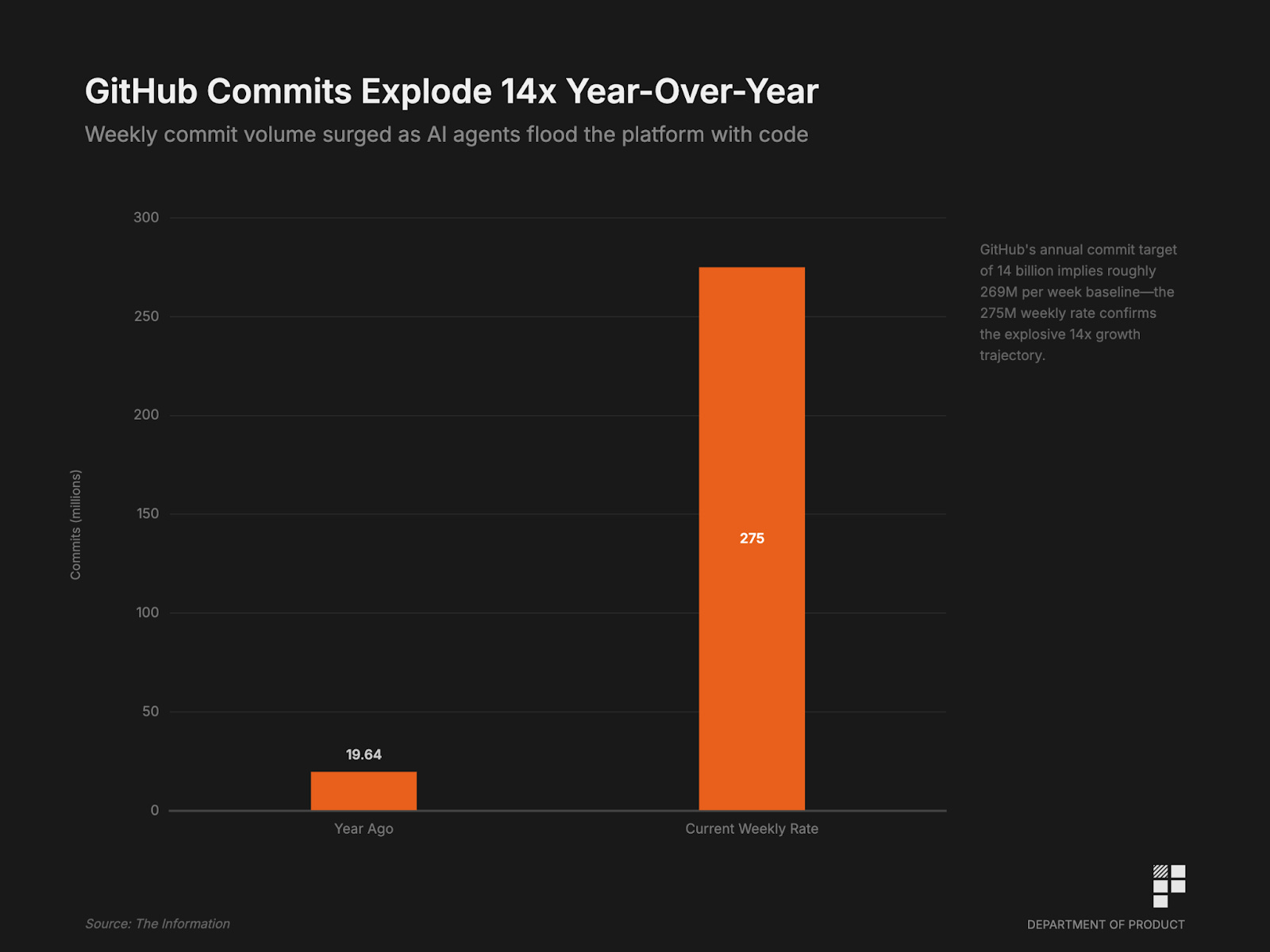
GitHub Commits have exploded 14x year on year to reach 275 million commits per week as AI agents take over. AI pull requests have quadrupled in the last six months, up from 4 million to 17 million and Claude Code authored commits have grown from 100,000 six months ago to 2.5 million last week:
Perplexity Computer boosted the company’s annual recurring revenue from $305 million to $450 million in one month according to the FT.
Monthly AI spend grew 4x from February 2025 to February 2026. Gartner projects global spend on AI services and software will total about $1 trillion in 2026. The median company dedicates nearly 15% of its total software budget to AI tools.
OpenAI published a research paper on industrial policy with recommendations including the introduction of a 4 day week.
AI isn’t destroying tech job openings in 2026, for now at least. So far this year, the number of open roles has jumped about 30%. But, this also coincides with 52,050 tech job cut announcements, the worst Q1 since 2023, with AI cited as a leading reason for layoffs.
Paid subscribers get the full DoP Substack including: The Knowledge Series for sharpening your tech / AI skills, the AI Prompt and Skills library and DoP Deep dive reports for in-depth analysis to learn lessons from the world’s top tech companies.
I’d like to comment while your articles come highly recommended to me, I find your titles/links at the beginning of the article confusing. If they are titles they should have less padding between the title and the paragraph. My eyes skip over them because they seem like product placements also because the paragraph text does not naturally flow on from the ‘title’.