
🔵 Google Transforms the Design Process with "Vibe Design" Agents
And: OpenAI's secret "super app", Claude Dispatch, why Vercel's CEO is happy an engineer spent $10,000 in one day

Hi product people 👋,
This week, Google unveiled some major new updates to its wildly popular Stitch product which look set to potentially transform the design process yet again. There are two parts of this latest Stitch update that are of particular interest to product teams. We’ll take a closer look at those with a live demo, too.
Plus, despite one CEO saying this week that he expects mobile apps to disappear altogether, right now, mobile is where major AI companies are focusing their efforts. Claude has given its mobile app some new powers of delegation, Perplexity is releasing a mobile browser and OpenAI is reportedly planning the release of a “super app”.
And why Vercel’s CEO is happy one of his engineers spent $10,000 on AI tokens in just one day.
Happy Friday and have a great weekend!
Rich
Watch on YouTube | Follow on Substack Notes
Key reads and resources for product teams
New from the Department of Product Substack this week:
Knowledge Series - How to use Perplexity Computer to build API price models and more
Unlike standard AI assistants that answer questions, Perplexity Computer runs entire workflows autonomously, in the background, for hours or months at a time. It orchestrates multiple AI models, connects to your existing tools (Linear, Gmail, Notion, Slack), and delivers finished artifacts rather than just answers. This Knowledge Series walks through four high-value use cases with ready-to-use prompts: a competitor pricing dashboard that monitors rivals and emails you alerts, a meeting-to-ticket converter that automatically creates Linear tickets from every commitment made in a call, a quarterly OKR deck generator, and an API cost simulator that flags vendor “cliff edges” before they hit your budget.
AI Library - Conversion Funnel PM with Claude Cowork
Conversion Funnel PM is a structured AI workspace in Claude Cowork that automatically analyses your revenue conversion data and tells you where you’re losing money and what to do about it. You drop monthly exports from four funnels - sign-up, trial-to-paid, plan upgrades, and churn - into pre-organised folders alongside qualitative signals like support tickets and NPS responses, and the system produces a revenue opportunity memo, a funnel impact spreadsheet, and supporting charts. Everything is pre-configured with sample data, clear file naming conventions, and a definitions file so the AI always interprets your metrics consistently - just swap in your real data and you’re ready to run. (Department of Product)
Free webinar - Ship global product updates faster with autonomous multilingual operations
Move beyond manual task automation. Agentic AI is transforming how product teams handle multilingual content by managing project routing, status tracking, and reporting end-to-end. Get instant answers on progress, spend, and quality with a simple prompt, while ensuring terminology consistency.
Join the free webinar on March 26th to see these autonomous workflows in action.
Insider info - How Anthropic uses Skills internally
A Claude Code engineer shares his guide to turning Claude Code from a “nice coding assistant” into a compound productivity engine by designing the right skills. The guide includes living folders of scripts, gotchas, verification flows, and org‑specific workflows that let the model test, deploy, debug, and even remember past work. (Anthropic)
Skills - How to build landing pages with premium animations in Lovable
This guide breaks down, step by step, how to use Lovable with GSAP and Three.js to build genuinely premium landing pages. (X)
Design case study - The principles behind Notion’s redesigned pages
Notion’s design team just published a fascinating peek behind the curtain of their latest page redesign. And it’s less about aesthetics, more about a surprisingly deep question: how do you create rhythm in an interface where users control everything? (Notion)
Tools you can use - Lincal - see your team’s Linear work in your calendar
LinCal is a companion web app that gives Linear a proper calendar interface for issues. Instead of seeing tasks only in lists or boards, LinCal shows your Linear issues laid out on a monthly calendar by due date. You can drag and drop issues between days to reschedule them, quickly create new Linear issues from a date on the calendar, and filter the view by team, assignee, state, priority, project, or cycle so you only see what matters. (Lincal)
Interview - Claude’s Design Lead on natural language as a user interface and how to manage feature release velocity
Jenny’s career spans Dropbox Paper, FigJam at Figma, and now leading design for Claude Cowork at Anthropic. In this episode, she pulls back the curtain on what it actually means to design an AI product at scale - where flows are non-deterministic, use cases are endless, and the model you’re designing for today might make your work obsolete tomorrow. She talks through the real story behind Cowork, the unsolved problem of educating users about AI capabilities, and why shipping is now the most underrated design skill. Plus, a live demo of her own design process using Cowork. (Double Diamond)
New product features and innovation this week
Google has unveiled some major updates to its AI design product, Stitch. The headline change is a completely rebuilt canvas which is now node-based, infinite, and multimodal. You can now drop in images, PRDs, or existing code as raw material, and the AI reasons across all of it simultaneously. Pair that with the new Agent Manager (which lets you run multiple design directions in parallel) and the workflow starts to feel less like prompting a tool and more like briefing a team.
The Design Agent itself has also gotten some upgrades. Rather than responding to isolated prompts, it now understands the full context of your canvas so you can ask it to do things like generate a product brief from existing screens, adapt a desktop layout for mobile, or literally interview you to help define a new design direction.
Two features stand out as signals of where design tooling is heading more broadly. First, Voice Design (”Vibe Design”) lets you talk to Stitch while it sees your canvas in real time, ask for critiques, request variations, navigate around. It’s in preview, but it’s a clear indicator of how voice is now becoming an interaction mode in professional tools as well as consumer apps. Here’s a demo of Voice Mode in action where the agent collaborates in an east end London cockney accent:
The second major change signalling a broader shift is the introduction of a design.md file. This is a markdown file that acts as a portable, exportable design rules document that bridges the gap between design systems and developer workflows. If it gains traction, it could become the design equivalent of a .env file: lightweight, shareable, and genuinely useful across teams.
Deepmind’s Demis Hassabis says “you can vibe design some incredible designs” with it and Google VP Josh Woodward says voice-powered Stitch Live is his favorite new feature.
If you’re curious about how to get started with Stitch, this previous DoP Knowledge Series might help.
Claude Cowork and Perplexity release new mobile features and apps; OpenAI reportedly planning a “super app”
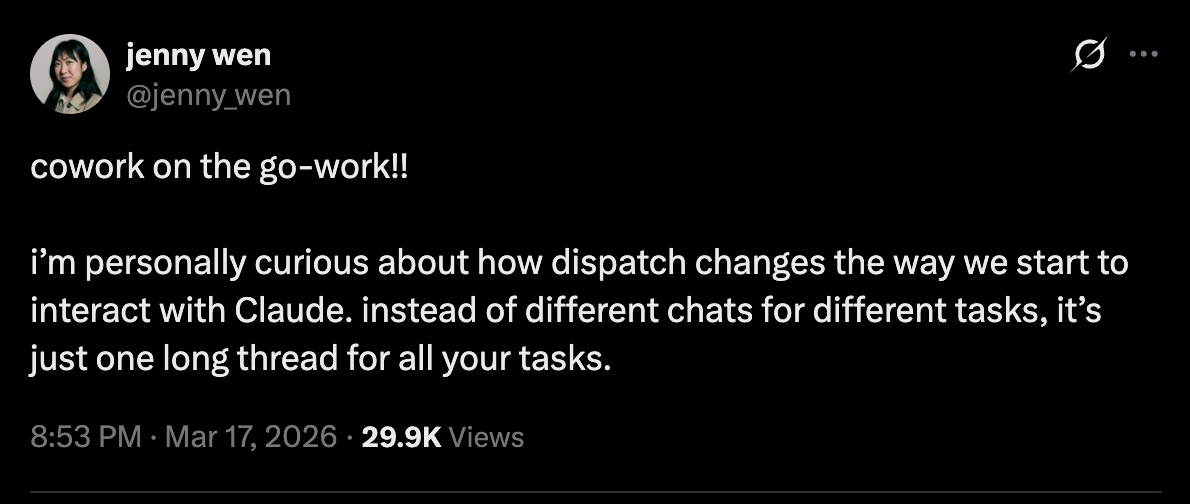
Anthropic has given Claude Code and Cowork a new mobile app feature called Dispatch. The new feature lets you assign Claude a task on your computer or in Code and then walk away. You pair your phone with your desktop, send Claude a task to complete from anywhere, and you come back to finished work. Everything runs in a local sandbox, your files stay on your machine, and you approve what Claude touches before it acts.
Claude’s Designer Jenny Wen says she’s curious about “how dispatch changes the way we interact with Claude”:
🧠 Ideas on how you can use Claude’s new Dispatch feature on the go:
If you’re keen to experiment with it, here are some ideas for how product teams might be able to use this new feature on the go to augment your workflows:
Pull sprint data - Connect Cowork to Jira or Linear and ask it to pull every ticket in the current sprint, grouped by owner and status. Dispatch runs this on your desktop while you’re commuting, and by the time standup starts there’s a structured report in your local folder to find out who’s on track, what’s blocked, what shipped.
Log customer feedback - The moment a call ends, text Dispatch from your phone with the key themes. It creates a structured entry in a local tracking doc (customer name, pain points, feature requests) and appends it to your master themes file in Notion or a local folder. Useful for teams who lose signal between the call and the write-up.
Prep an exec summary - Point Dispatch at your local data exports e.g. spreadsheets, CSVs, whatever format your analytics tool spits out and ask it to pull the key metrics into your standard summary template. Useful for stakeholder reviews where the data is ready but the document isn’t.
Triage your inbox - Before you sit down, message Dispatch to scan overnight Gmail and Slack and return a prioritised summary: what needs a response today, what’s informational, what can wait. Gives you a flavor of “what kind of morning this is”.
Meanwhile, Perplexity has launched the mobile version of its AI browser, Comet. New data from A16z shows that after the initial hype, visits to the Perplexity Comet downloads page declined pretty dramatically, but could a mobile version of Comet drive more interest? Perplexity is positioning it as an AI Assistant that will work across multiple tabs at once but given that the company already has a mobile app, you can’t help thinking that they’d be better off focusing purely on the Perplexity app rather than a browser, especially given the success of their latest Computer product.
OpenAI is planning to do something like that with rumors of a new “Super App” that will consolidate multiple different product lines into one.
Spotify lets you build your own “Taste” profile
Spotify has introduced a new beta feature called Taste Profile, announced by Co-CEO Gustav Söderström at SXSW. The new feature aggregates your listening data across music, podcasts, and audiobooks into a visible profile that includes key data points like preferred artists, genres, daily habits (e.g., upbeat workout tracks in the morning or news podcasts during commutes), and emerging interests (like exploring ‘90s alternative rock or specific hip-hop influences).
Users can review how Spotify currently understands their Taste profile and if something feels off (e.g., due to shared accounts, kids’ music, or situational listening like sleep tracks), they can actively shape it by flagging inaccuracies.
Algorithmic shaping, where users have more control over their feeds, is becoming increasingly important for product teams and other companies like Instagram, Pinterest and YouTube have released similar features.
📈 Product data and trends to stay informed
Companies are starting to track the number of AI tokens used per employee - with some surprising results. Zapier says it flags cases where an employee’s token use is 5× higher than peers as a point for investigation and Vercel said a single engineer managed to use $10,000 worth of tokens in just a single day - but likely saved the company “millions” in the long run.
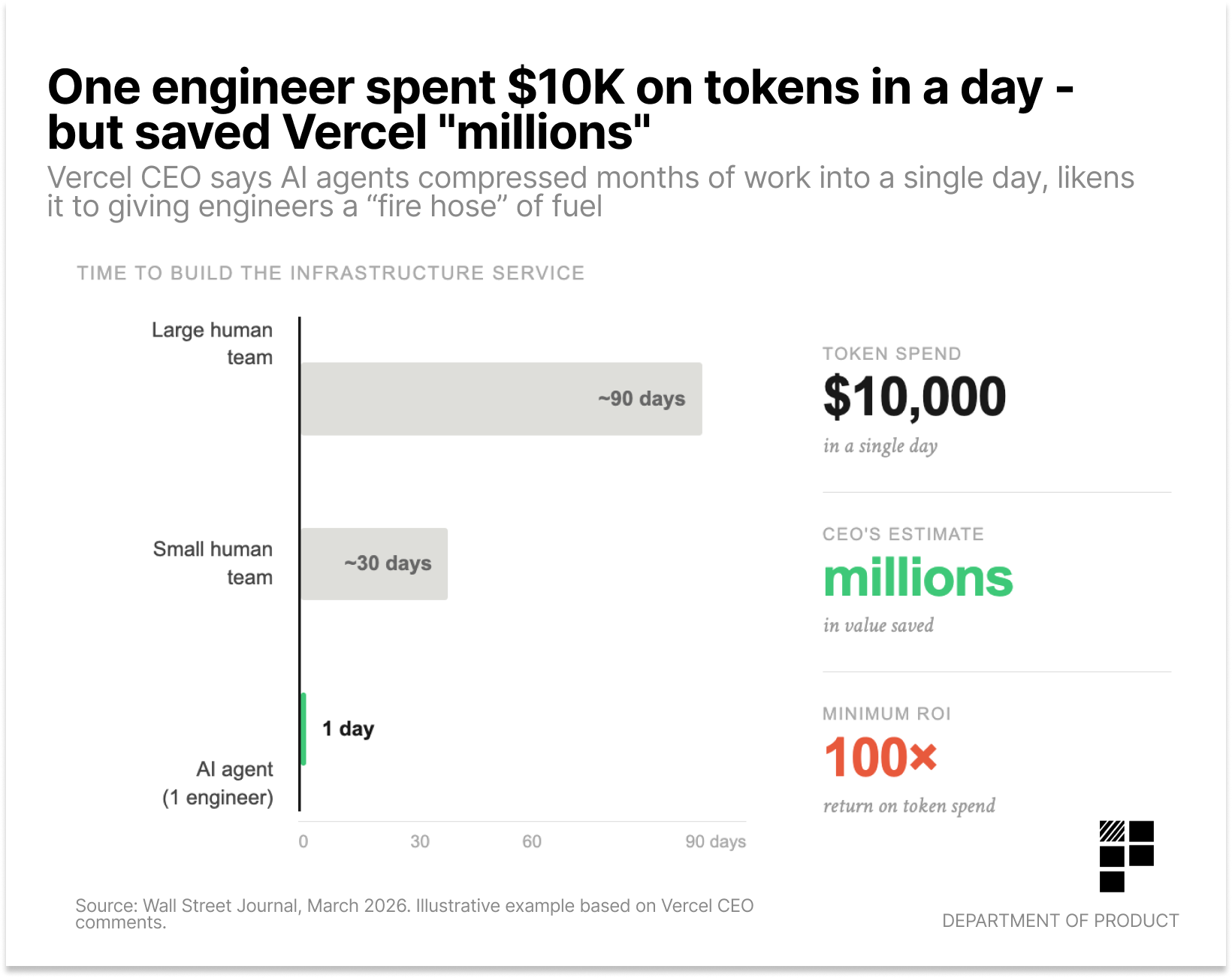
The assumption here of course, is that the AI generated code doesn’t introduce unnecessary tech debt which has been a problem for some companies who have built new infrastructure quickly, only to find themselves spending more time fixing them in the long run. Amazon’s Kiro team was reportedly one such example recently but Amazon says it was human error, not related to AI.
Anthropic published a major new study which looked at what 81,000 want from AI and Claude. Participants were Claude.ai users who were interviewed by an AI interviewer, with responses then analyzed using Claude-powered classifiers. Unreliability was the most common concern - 27% worry that AI won’t do what it’s supposed to. Crucially, this is mentioned by people in high-stakes professions (law, finance, government, and healthcare) at nearly twice the average rate. For teams building in those verticals especially, trust and accuracy are table stakes before anything else. Elsewhere in the report, one engineer said that they used AI to “cut a 173-day process down to just 3 days”.
65% of US workers say they are not using AI much at work - up from 63%. At the same time, 21% say they use AI for all, most or some of their work - up from 17% the year prior. New Pew Research.
Mobile apps are going to disappear, according to Nothing Phone’s CEO. “The future is not the agent using a human interface. You need to create an interface for the agent to use”, he says.
In the meantime, Apple may technically be behind in the AI race but with generative AI app revenue soaring, it’s on track to surpass $1 billion of AI revenue this year.
Uber’s CTO shared an update on how the company is adopting AI in its development processes:
1,800 code changes/week are written entirely by Uber’s internal background coding agent
Claude Code usage nearly doubled in 2 months: 32% → 63%
95% of engineers use AI tools every month across all tracked platforms
84% of AI users are working with agent-style workflows - not just tab completion
~70% of committed code in traditional IDEs is now AI-generated
Uber’s internal background coding agent went from <1% to 8% of all code changes in just a few months - with zero human authoring
After investing tens of billions of dollars, Meta has finally admitted metaverse VR worlds don’t have product market fit and has shut down its flagship product, Horizon.
Paid subscribers get the full DoP Substack including: The Knowledge Series for sharpening your tech / AI skills, the AI Prompt and Skills library and DoP Deep dive reports for in-depth analysis to learn lessons from the world’s top tech companies.